
One of the biggest mistakes investors make is assuming that what worked yesterday will keep working tomorrow.
For decades, stocks and bonds were supposed to balance each other out. Stocks helped grow your money. Bonds helped protect it.
When one struggled, the other was expected to pick up the slack. That worked for a very long time.
But markets evolve. Inflation comes and goes. Interest rates move. Investor behavior shifts. Eventually, the old playbook stops working.
That’s exactly what’s happening today.
My friend Todd Sohn at Strategas recently shared a chart that perfectly illustrates what’s quietly been unfolding.
Stocks, bonds, and energy are no longer behaving the way they used to:
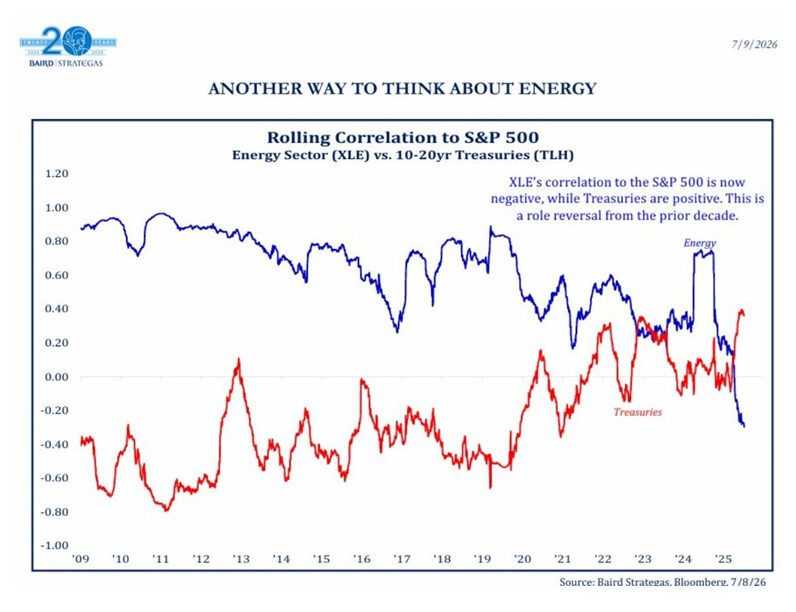
This chart is actually much simpler than it looks.
The blue line tracks how closely energy stocks move with the S&P 500. The red line does the same for Treasury bonds.
The higher the line, the more those investments move with the stock market. The lower it goes below zero, the more they tend to move differently.
For years, bonds were the investment that behaved differently. That’s why they were considered a hedge.
Energy generally moved right along with stocks.
Today, it’s almost the opposite.
Bonds have become much more closely tied to the stock market, while energy has become one of the few major areas moving to its own beat.
The labels haven’t changed.
The relationships have.
We’ve Been Watching This Story for a While
If you’ve been reading Everybody’s Wrong, this probably doesn’t come as much of a surprise.
Last September, I wrote Your 60/40 Portfolio Is Now Just 100. I argued that stocks and bonds were no longer offsetting one another the way investors had grown accustomed to for decades.
Then earlier this summer, I followed it up with The 60/40 Portfolio Died Years Ago. That piece went a step further. It wasn’t just about one bad year. It was about recognizing that one of the most important relationships in finance had fundamentally changed.
Todd’s chart adds another important piece to that puzzle.
It’s one thing to realize bonds may no longer provide the diversification investors expect.
It’s another to identify an area of the market that may actually be doing that job instead.
Maybe Energy Is the New Diversifier
This is why we’ve spent so much time talking about what I call the New 60/40.
The old version assumed bonds would diversify your stock portfolio.
Maybe that’s no longer the best assumption.
Maybe investors should stop asking, “How much should I own in bonds?” and start asking, “What actually behaves differently than the rest of my portfolio?”
That answer has been energy.
That doesn’t mean energy always rises when stocks fall. Markets aren’t that simple. Correlations change over time, and they are never perfect.
But diversification has never been about owning different ticker symbols.
It’s about owning investments that don’t all react the same way at the same time.
That’s a very different conversation than the one Wall Street has been having for decades.
The Market Already Moved On
I’m not writing this because I think bonds are finished forever.
They aren’t.
Bond prices can absolutely rally.
What I’m saying is that automatically pairing stocks with bonds simply because that’s how portfolios have always been built doesn’t make as much sense as it once did.
The world changed.
Inflation came back. Interest rates changed. And the relationships between major asset classes changed with them.
The hardest part of investing isn’t finding the next great opportunity.
It’s letting go of an old idea that no longer works.
The market doesn’t care how portfolios were built 20 years ago.
It only cares how they behave today.
Stay sharp,
JC Parets, CMT
Founder, TrendLabs