
Over the past month, I’ve written quite a bit about the breakout in bank stocks.
First, I explained why I think Banks Just Changed the Bull Market Story is one of the most important developments in today’s market.
Then, in It Started With the Banks, I went back more than 240 years to tell the story of Alexander Hamilton and why banks have always been at the center of the American economy.
Today, I want to build on those ideas with a lesson that has stuck with me for years.
One of my all-time favorite technical analysts is Louise Yamada. She taught me a lot over the years, but one lesson stands above the rest:
“The bigger the collapse, the longer the time needed for repair.”
Think about it. If you twist your ankle, you’ll probably be walking around again in a few days. Break your leg and you’ll be rehabbing for months.
Markets aren’t any different. The bigger the damage, the longer it takes before confidence returns.
That simple idea explains a lot of what we’re seeing today.
Technology Already Showed Us
The dot-com bubble peaked in 2000, and what followed was one of the biggest collapses any major sector has ever experienced.
Investors lost fortunes, thousands of companies disappeared, and an entire generation swore they’d never own technology stocks again.
But markets don’t heal overnight.
It took almost 20 years before the Technology Sector (XLK) finally climbed back above its dot-com bubble highs:
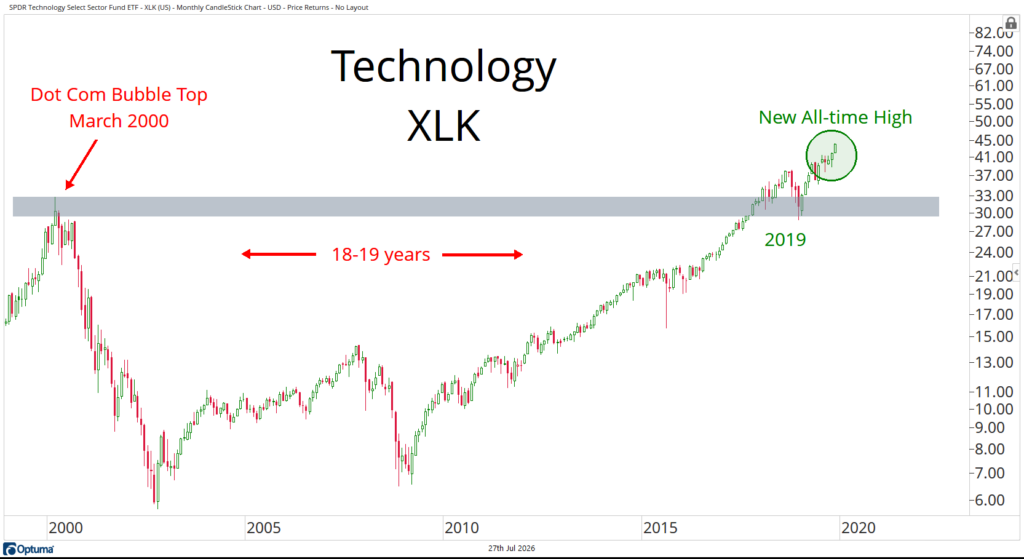
By the time Technology finally broke out in 2019, most people thought the story was over. I thought it was just beginning.
The repair had finally been completed. Nearly 20 years of investors who wanted to “just get their money back” had finally sold.
The supply was gone, and there was room for a brand-new uptrend.
That’s exactly what happened.
Over the next seven years, XLK gained roughly five times in value:
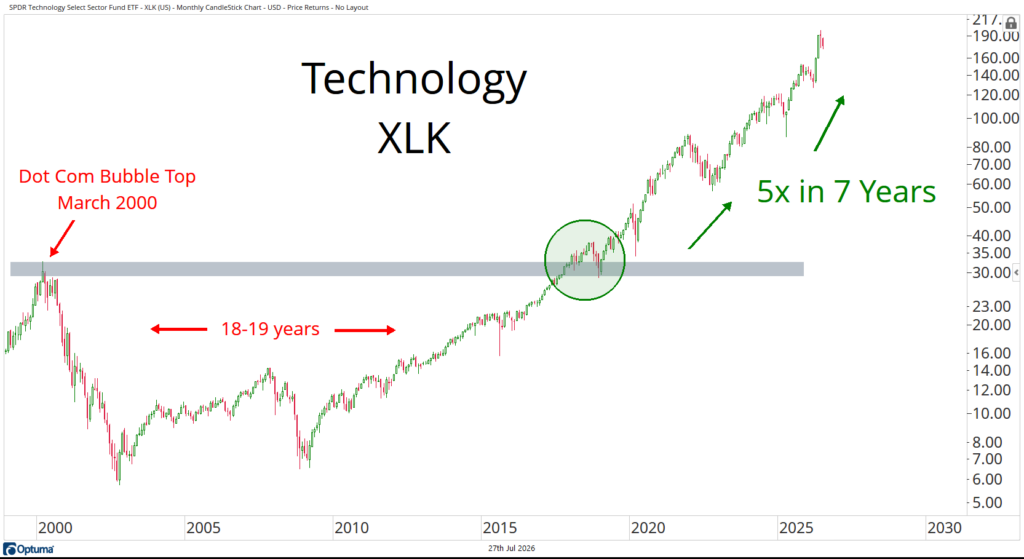
I’m not saying it went up because it spent 20 years repairing itself. But I also don’t think it’s a coincidence.
Some of the biggest advances in history have come after some of the longest periods of repair.
Now Look at the Banks
This is why I can’t stop thinking about financial stocks.
The banking sector peaked before the Great Financial Crisis in 2007. It then spent nearly two decades working through one of the worst collapses in modern market history.
Housing crashed. Hundreds of banks disappeared. Investors gave up on the entire group.
Now, almost 19 years later, the repair appears to be complete.
The S&P Bank Index (KBE) has finally broken out above those old highs:
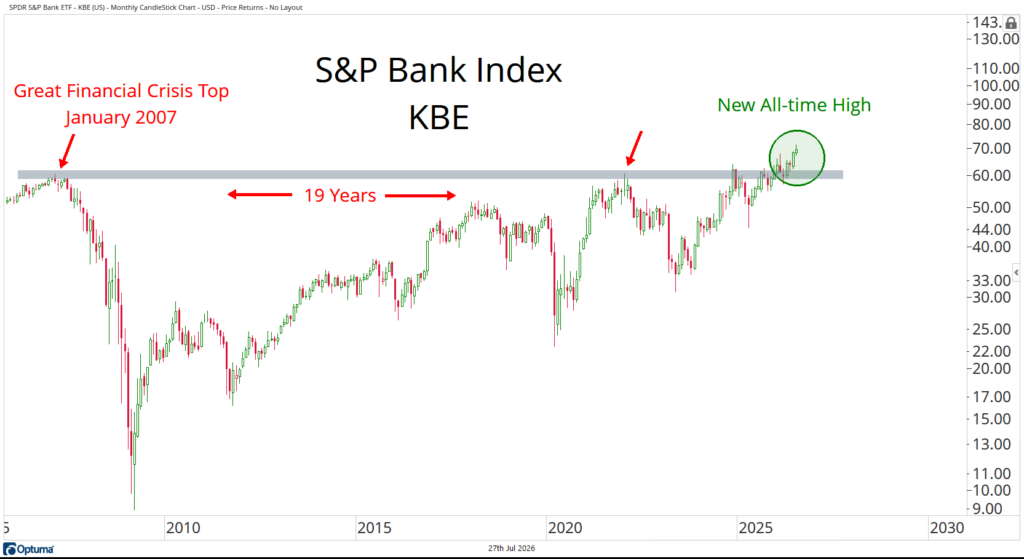
Does that mean KBE is about to do what XLK did?
Probably not. But does it have to? What if banks only doubled over the next several years?
That would still be an incredible opportunity, especially considering how little attention this breakout is getting.
I also think the implications go well beyond banks themselves. Banks don’t just participate in the economy. They help finance it.
They lend money to families buying homes, businesses building factories, companies making acquisitions, and entrepreneurs starting new ventures.
Healthy banks have historically been a good sign that healthy markets and healthy economies can continue.
That’s why we’re not just watching this move.
We’re acting on it.
We already own financial stocks, and we’re looking to own more.
Louise Yamada taught me that the bigger the collapse, the longer the time needed for repair.
Technology spent almost 20 years healing before beginning one of the greatest runs of the past decade.
Today, banks have completed a remarkably similar repair, yet almost nobody seems to be talking about it.
Maybe this breakout won’t look exactly like Technology’s. Markets never repeat themselves perfectly.
But they rhyme all the time.
And I think the market is telling us that this story is just getting started.
Stay sharp,
JC Parets, CMT
Founder, TrendLabs