
People love to talk about technology as though it built the stock market.
Today, it’s artificial intelligence. Before that, it was the internet. Before that, it was personal computers.
Those innovations changed the world.
But America’s financial markets didn’t begin with technology.
They began with banks.
In 1784, while New York was still recovering from the Revolutionary War, Alexander Hamilton helped create the Bank of New York.
The country was brand new. There wasn’t much money, much credit, or much trust.
Hamilton understood that if America was going to grow, money had to move. Businesses needed loans. People needed a safe place to keep their savings. Investors needed confidence.
The Bank of New York helped make all of that possible.
A few years later, Hamilton went even bigger. He helped create the First Bank of the United States.
This wasn’t the same bank. It had a different job. Its purpose was to help the young country stand on its own financially.
It made it easier for businesses to borrow, helped the government manage its money, and gave people confidence that the country’s financial system was built to last.
Around the same time, another great American business story was unfolding.
Aaron Burr wanted to start a bank, too.
Hamilton and his political allies weren’t interested in helping him. So, Burr came up with another plan.
He convinced New York lawmakers to let him start a company that would bring clean water to the city.
It sounded like a public works project. Buried inside the company’s charter, though, was language allowing any extra money to be invested elsewhere.
That was all Burr needed. He used the capital to start a bank.
That company became The Manhattan Company.
Over the next two centuries, it merged with other financial institutions, eventually becoming part of JPMorgan Chase & Co. (JPM), now the largest bank in the country.
I’ve always loved that story. One of America’s greatest banks started because Aaron Burr found a loophole.
The other part of the story is just as remarkable. The Bank of New York never disappeared.
It survived the Civil War.
It survived the Great Depression.
It survived the Panic of 1907, two world wars, the Great Financial Crisis, and everything in between.
Today, we know it as the Bank of New York Mellon (BNY).
Hamilton’s bank is still here.
The Market Is Telling Us Something
Here’s why I think any of this matters.
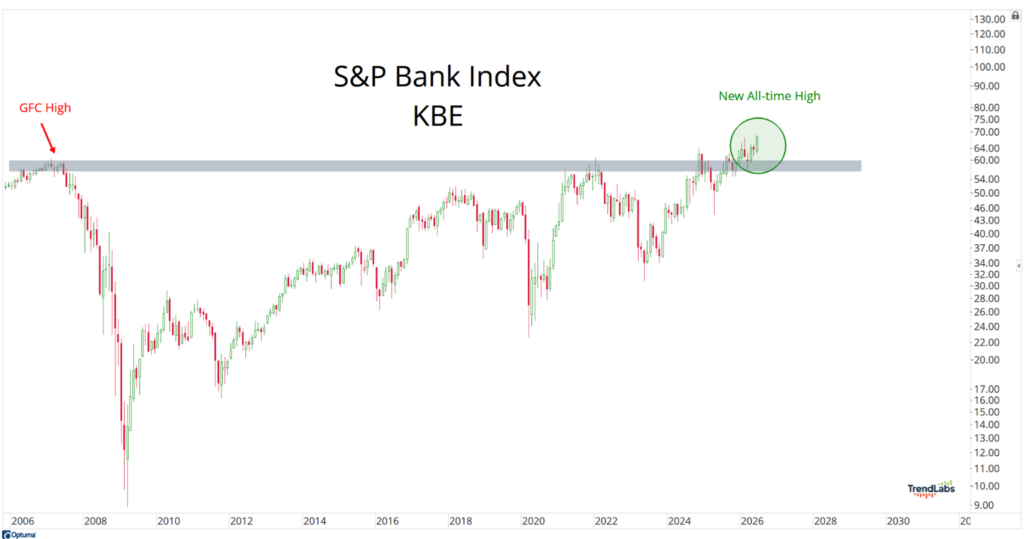
More than 240 years after Hamilton founded the Bank of New York, bank stocks are making new all-time highs:
I don’t think that’s getting nearly enough attention.
Banks don’t sit on the edge of the economy. They sit in the middle of it.
They’re involved when companies build factories, finance data centers, raise money through IPOs, issue bonds, buy competitors, or expand into new markets.
Money flows through banks before it flows almost anywhere else.
That’s why this breakout is so important.
The S&P Bank Index (KBE) spent nearly 20 years working through the highs it made before the Great Financial Crisis.
Think about that. Almost two decades.
Markets don’t spend 19 years building bases unless something meaningful is happening.
Now that base has resolved to the upside.
Maybe It Starts With the Banks Again
One of the biggest arguments against this bull market is that it’s only about a handful of technology companies.
The banks don’t seem to agree.
Neither do industrial stocks. Neither do many mid-cap companies.
Participation has been expanding for a long time now. I think that’s one of the biggest stories in this market.
There’s also something poetic about BNY being part of it.
The first bank Alexander Hamilton built to help America grow is still helping move money around the world today.
Its shares are still trading and maximizing this opportunity of tokenization, maybe better than any other bank in the world.
Its industry is making new all-time highs.
And while everybody’s busy talking about AI, one of the oldest stories in American finance is quietly writing a new chapter.
Maybe that’s exactly where we should be looking.
This Week in Everybody’s Wrong
On Monday, we explained why America is not the extreme example you’re being warned about.
Have you been told the U.S. stock market is too dependent on a few giant companies?
It’s time we debunk the market concentration myth.
On Tuesday, we surveyed another potential shortcut that just might change the world.
Buried in headlines this week were three words I don’t think we should ignore.
On Wednesday, we welcomed the arrival of “The Agentic Economy.”
It’s one of the most important questions investors should be thinking about.
What happens when AI starts participating in the economy alongside us?
On Thursday, we broke down another big IPO.
This time, it was the biggest new U.S. ADR issue ever.
Indeed, everybody wants your money… again.
What happens when the most important stock stops being important?
On Friday, we saw the quietest new all-time high in America.
The companies everybody’s talking about aren’t always the ones making investors the most money.
On Saturday, Sam Gatlin used history as a window on the present.
A centuries-old Asian method for measuring supply and demand, World War I, and early 1990s American is an entertaining mix.
What Sam has to show us is also useful right now.
Have a great Sunday.
We’ll see you Monday morning…
Stay sharp,
JC Parets, CMT
Founder, TrendLabs