Most people think artificial intelligence and crypto are two completely different stories.
AI is supposed to help us work. Crypto is supposed to replace money. They sound like two separate ideas moving in two separate directions.
I don’t think that’s what’s happening.
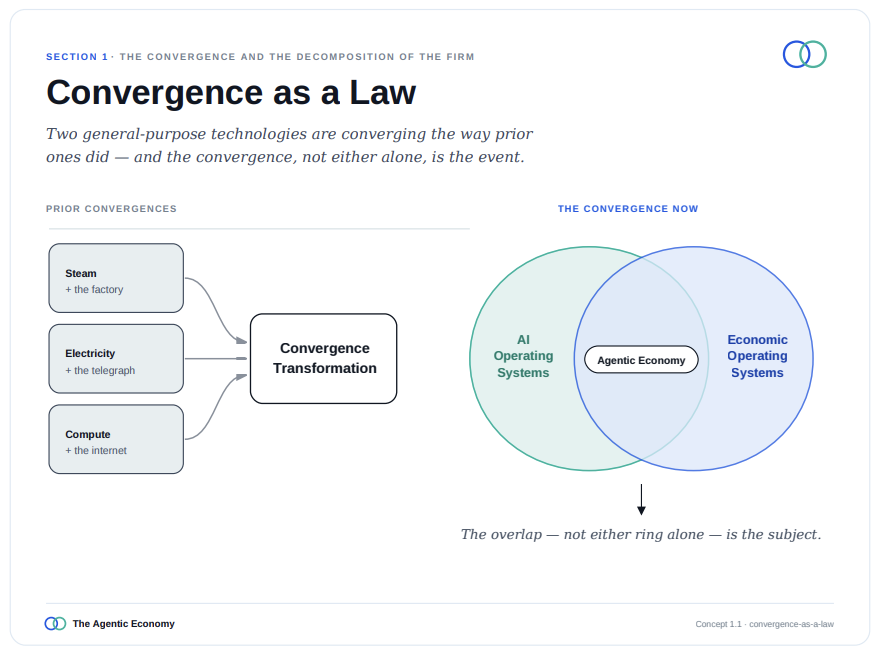
Jeremy Allaire, the CEO of Circle (CRCL), just published an essay this week called, “The Agentic Economy.”
Whether you agree with all of his conclusions or not, I think he’s asking one of the most important questions investors should be thinking about.
What happens when AI doesn’t just help people work?
What happens when AI starts participating in the economy alongside us?
That sounds like science fiction. But think about how quickly we’ve gotten here.
A few years ago, asking a computer to write an email or build a website sounded ridiculous.
Today, millions of people use AI every single day without thinking twice about it.
The technology is improving so quickly that I don’t think the most interesting question is what AI can do today.
The better question is what happens when AI can earn money, spend money, negotiate contracts, and hire other AI systems to help it finish a job.
Last month, I wrote about what I’ve been calling AI Mining.
Everybody wants to know which AI company is going to win. I think that’s the wrong question.
I argued that the bigger opportunity may be owning the companies selling the picks and shovels.
Today, that means the chips, the power generation, the networking equipment. the copper, the steel, and the data centers.
That’s all the infrastructure every AI system will need no matter who builds the smartest chatbot.
Think of today’s note as Part Two. Because now we’re taking the next step.
What if AI doesn’t just use that infrastructure?
What if AI becomes part of the economy itself?
Companies Might Never Look the Same Again
One idea from Allaire’s essay really stuck with me, and it had nothing to do with crypto.
It had to do with how businesses operate.
Think about your local insurance office. Or your lawyer. Or the company that replaced your windows.
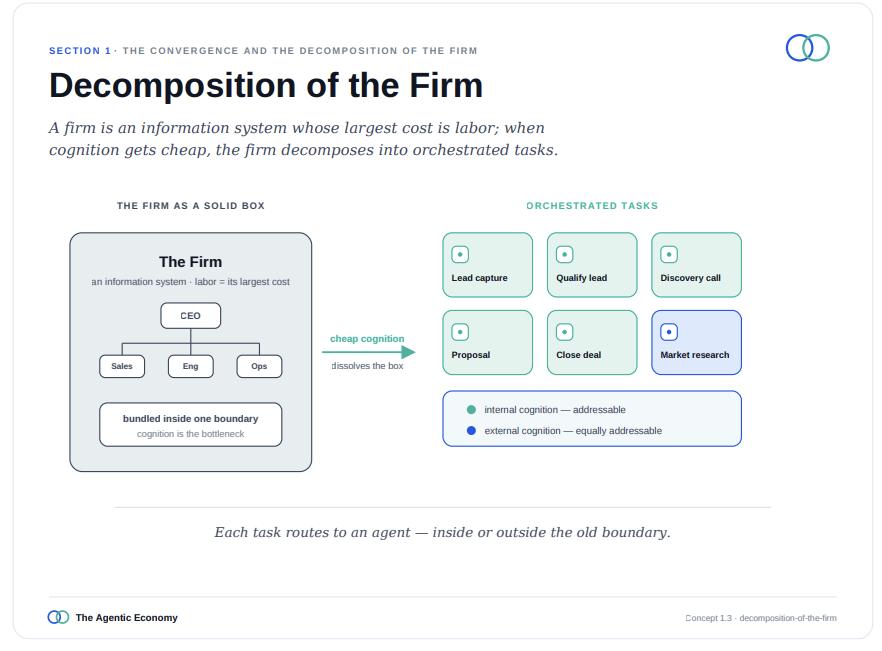
Every business hires people to solve problems. They have salespeople, accountants, customer service representatives, marketers, lawyers, software developers, and managers.
As the business grows, they usually hire more people.
What if that starts to change?
Instead of hiring another employee, maybe the business hires another AI agent.
One writes advertisements. Another answers customer emails. Another reviews contracts. Another keeps the books balanced. Another builds software. Another schedules meetings.
The owner is still running the company.
They’re just managing software instead of managing as many employees.
Now here’s the part that gets interesting.
A lot of people hear that idea and immediately think about jobs disappearing.
Maybe.
But history tells a different story.
Every time technology makes building something cheaper, people build more of it.
When cars became affordable, more people drove. When computers became inexpensive, more people started businesses.
When websites became easy to build, millions of new companies suddenly became possible.
Maybe AI follows the same path.
If one person can suddenly accomplish what used to require twenty people, starting a business becomes dramatically easier.
That doesn’t necessarily mean fewer businesses.
It could mean a lot more.
As investors, that’s the part I care about.
I’m always looking for second- and third-order effects.
If AI dramatically lowers the cost of building companies, we may be entering one of the biggest entrepreneurial booms we’ve ever seen.
That’s a much bigger story than simply asking which chatbot wins.
Why Stablecoins Suddenly Make More Sense
This is where everything starts coming together.
Imagine an AI designing a new product.
Along the way, it needs to pay another AI for research.
It rents extra computing power. It buys access to a database. It licenses software. It purchases proprietary information.
It hires another AI to review its work.
Those transactions might happen thousands of times every second.
Banks weren’t designed for that world. Banks close at night. Payments can take days.
International transfers can be slow and expensive. Humans don’t mind waiting.
Computers do.
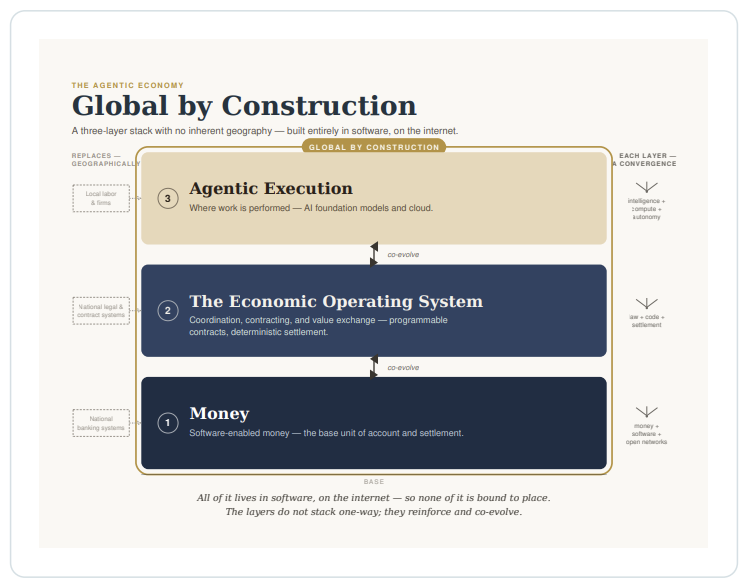
That’s why Allaire believes stablecoins could become much more important than most people realize.
Not because you and I suddenly stop using dollars, but because software needs money that moves as fast as software does.
Think about the interstate highway system. You probably don’t spend much time thinking about it.
But without highways, trucks couldn’t move food, clothing, furniture, or almost anything else we buy.
The highways aren’t the exciting part.
They’re simply the infrastructure that allows everything else to happen.
Allaire argues that blockchains become those digital highways.
Stablecoins become the trucks carrying money across them.
Maybe he’s exactly right. Maybe the future unfolds a little differently.
Nobody knows.
But I think this exercise is incredibly valuable because it forces us to stop arguing about today’s headlines and start thinking about tomorrow’s economy.
The internet changed how information moves around the world.
“The Agentic Economy” argues that AI will change how work gets done while blockchain changes how money moves alongside it.
If that’s even partially true, investors should probably stop asking only which AI company wins.
We should also be asking who builds the roads.
Who provides the electricity?
Who builds the data centers?
Who supplies the chips?
Who mines the copper?
Who manufactures the networking equipment?
Who owns the rails underneath this entire system?
That’s exactly why I keep coming back to AI Mining.
Whether AI agents pay one another in stablecoins, dollars, Bitcoin, or something that hasn’t even been invented yet, they’ll still need enormous amounts of computing power, electricity, networking, storage, and physical infrastructure.
That’s where I think some of the biggest investment opportunities could be hiding.
The technology gets all the headlines.
The infrastructure often makes the money.
The future almost never arrives exactly the way people predict.
But the biggest investment opportunities often come from recognizing the direction before everyone else does.
I’m not reading essays like this because I think every prediction will come true.
I’m reading them because they help me ask better questions.
And in investing, asking better questions is often where the biggest winners begin.
Stay sharp,
JC Parets, CMT
Founder, TrendLabs