
Investors are being warned again.
The U.S. stock market is too concentrated.
The biggest companies are too big.
The top 10 stocks control too much of the S&P 500.
Apparently, this is all very dangerous. Even Bloomberg is chiming in:
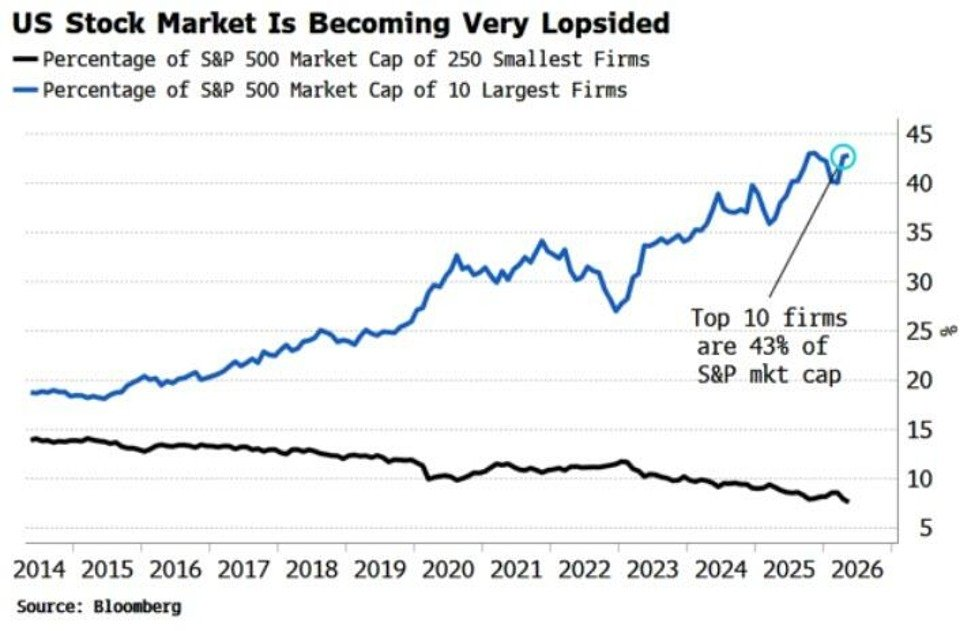
There’s just one problem.
Compared with almost every other major stock market in the world, the United States is not especially concentrated.
In fact, the U.S. is actually one of the least concentrated.
Among the 20 largest stock markets in the world, only Japan has a smaller share of its market controlled by its 10 biggest companies.
Japan’s top 10 stocks make up about 30% of the country’s main investable stock market.
The top 10 in the U.S. make up about 36%.
That means 18 of the world’s 20 largest stock markets are more concentrated than the United States.
Canada is around 45%. Taiwan is above 50%. France is close to 60%. Germany is above 60%. South Korea is around 66%. Hong Kong is above 70%. Spain is close to 76%.
So congratulations, America.
For all the complaints about our giant companies, we still have one of the deepest and least concentrated stock markets on Earth.
That’s not the story most people are hearing.
You May Be Diversifying Into More Concentration
One of the most common pieces of advice in investing is to buy foreign stocks because the U.S. market is too concentrated.
It sounds reasonable.
Why put too much money in a market controlled by a few giant companies when you can spread your money around the world?
But here’s where it gets funny.
Many of the foreign markets investors are told to buy are even more concentrated than the U.S.
Denmark has been heavily influenced by Novo Nordisk (NVO). Switzerland is dominated by Nestlé (NSRGY), Roche (RHHBY) and Novartis (NVS).
You’re not always escaping concentration when you go overseas.
Sometimes you’re buying more of it.
Taiwan is a perfect example. People talk about buying “Taiwan” as though they’re buying a wide collection of different businesses.
In reality, Taiwan’s stock market is heavily influenced by Taiwan Semiconductor (TSM).
You are buying TSM, followed by everybody else.
South Korea has a similar problem. Samsung Electronics and SK Hynix (SKHY) are enormous parts of the market. Hyundai and a few large financial companies matter, too. After that, the weights drop quickly.
These are not necessarily bad companies. That’s not the point.
The point is that most countries simply do not have as many giant public companies as the U.S.
America has Microsoft (MSFT), Nvidia (NVDA), Apple (AAPL), Amazon (AMZN), Alphabet (GOOGL), Meta (META), Broadcom (AVGO), Berkshire Hathaway (BRK.B), JPMorgan (JPM), and Eli Lilly (LLY).
But the depth doesn’t stop there.
After those companies, there are still hundreds of American businesses worth tens of billions of dollars.
There are banks, retailers, railroads, software companies, drugmakers, defense companies, homebuilders, energy producers, and industrial businesses.
The United States has a much deeper bench.
Think about a baseball team.
Some countries have two or three superstars, followed by a big drop-off.
The U.S. has superstars too, but it also has a strong middle of the lineup and a deep bench.
That matters more than most investors realize.
Big Companies Do Not Mean a Weak Market
This is where investors often make another mistake.
They confuse big companies with narrow participation. Those are not the same thing.
A few companies can become very large while hundreds of other stocks are still rising.
That’s exactly why looking only at the biggest companies can give you the wrong picture.
Throughout 2026, the New York Stock Exchange Advance-Decline Line has been making new highs.
That indicator keeps track of how many stocks are rising compared with how many are falling.
If only a few giant companies were carrying the entire market, that line would probably be struggling.
Instead, it’s been strong.
The equal-weight S&P 500 has also been making new highs. That version of the index gives every company the same importance. Apple doesn’t get a bigger vote than a smaller company.
Mid-cap stocks have been making new highs. Small caps have joined them. Banks and industrials have, too.
That doesn’t look like a market where only 10 stocks matter.
It looks like a market where many groups are participating, even while the biggest companies continue to get bigger.
This is also why comparisons with the late 1990s need to be handled carefully.
Back then, technology stocks were doing most of the work. Market breadth had been getting worse. Fewer stocks were participating even while the major indexes kept rising.
Today, many of the largest technology companies are also producing enormous profits.
They’re not large simply because investors made up exciting stories about them. They’re large because their businesses became enormous.
That doesn’t mean they can never fall. Every stock can fall.
It does mean that “large” is not automatically the same thing as “dangerous.”
So why should any of this matter to you? Because misunderstanding concentration can lead to bad decisions.
You might sell the strongest market in the world because someone told you it was too top-heavy.
You might move that money into a foreign market that is even more dependent on fewer companies.
You might confuse a handful of giant winners with a market where nothing else is working.
You might even miss a broad bull market because you were too busy complaining about the size of Nvidia and Microsoft.
Understanding the difference helps you ask better questions.
Are the biggest companies rising? Are smaller companies participating?
Are more stocks advancing than declining? Are banks, industrials and other groups joining the trend?
Those questions tell us much more than simply counting how much weight sits in the top 10 stocks.
The United States is not perfect.
No market is.
But when it comes to concentration, America is not the extreme example investors are being warned about.
It’s the opposite.
Only Japan has a lower top-10 concentration among the world’s 20 largest stock markets.
The other 18 are more concentrated.
That’s a very different story.
And it’s one worth remembering the next time someone tells you the U.S. stock market is too dependent on a few giant companies.
Compared with what?
Stay sharp,
JC Parets, CMT
Founder, TrendLabs