
Something doesn’t add up.
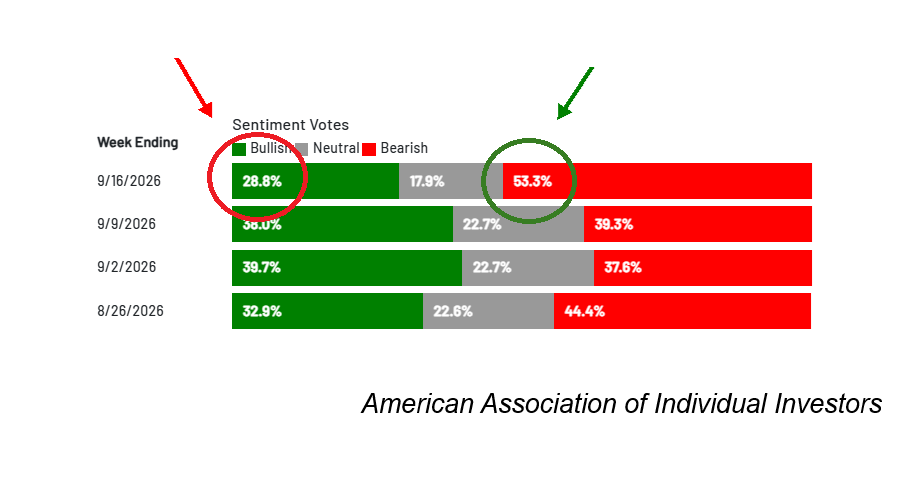
According to the latest AAII Sentiment Survey, 53% of individual investors expect stocks to fall over the next six months.
Only 28% expect them to rise.
You have to go all the way back to the spring of 2025 to find investors this pessimistic.
And you probably remember what happened next.
Back then, investors were worried about tariffs, the economy, interest rates and just about everything else they could find to worry about.
Then stocks took off.
What followed was one of the most powerful stock market rallies we’ve seen in years.
Now here we are again.
More than half of the individual investors surveyed think stocks are going lower. Bullish sentiment is near its lowest levels in more than a year.
If I only told you that, you’d probably assume the stock market was getting crushed.
There’s just one problem.
It isn’t.
The S&P 500 is only about 2% below its all-time high.
And the Russell 3000, which is basically the entire U.S. stock market stuffed into one big basket, is only about 2.3% from its all-time high.
That’s what makes this so interesting to me.
Reality vs Perception
If I showed you the sentiment numbers without showing you the stock market, you’d probably assume stocks were getting crushed.
You’d think the S&P 500 was down 20% or 30% and people were watching their retirement accounts disappear.
But that’s not what’s happening at all.
That’s a pretty big gap between reality and perception.
And this is why I keep coming back to the same lesson: If you want to see, you have to look.
Don’t listen to what people say the market should be doing. Look at what the market is actually doing.
Remember that scary chart going around comparing margin debt with GDP?
The argument was that investors were borrowing too much money to buy stocks, especially compared with the size of the economy, and therefore something bad was coming.
It sounds scary. The chart looks scary.
And that’s usually enough to get it passed around the internet a few million times.
But stocks aren’t GDP.
The stock market and the economy are two different things.
Comparing a stock-market-related number like margin debt with the size of the economy can create a dramatic-looking chart without necessarily telling us much about where stocks are going next.
It’s another example of the same problem we’re seeing today.
People start with a scary story and then go looking for evidence that confirms it.
I’d rather start with the market.
What are stocks actually doing?
Right now, they’re sitting just below record highs.
That’s Fuel
Here’s why I think this matters as we head toward the end of the year.
If the S&P 500 were near all-time highs and everybody was wildly bullish, that would be a very different setup.
If everybody already loved stocks, everybody was already positioned for stocks to go higher, and nobody could imagine them falling, then I’d want to know where the next wave of buyers was going to come from.
That’s not what we have.
We have stocks near all-time highs while more than half of the individual investors surveyed think they’re going down.
That’s a lot of people who can change their minds.
Historically, unusually high bearish readings in the AAII survey have been associated with better-than-average stock market returns over the following six and 12 months.
That doesn’t mean stocks have to rally from here.
Sentiment isn’t a magic trick, and no survey can tell us what happens tomorrow.
But that’s not how I use sentiment anyway.
I look at it as fuel.
Think about what happens if stocks just keep doing what they’ve been doing.
The S&P 500 makes another all-time high. More stocks participate.
Eventually, some of the people expecting stocks to fall have a decision to make.
They can keep waiting for the selloff.
Or they can buy.
And the longer stocks stay near their highs, or make new ones, the harder it becomes to keep waiting.
Some of today’s bears will change their minds. Some will buy stocks. Others will wait until prices are even higher before finally giving in.
That’s how markets work.
So when I see the most bearish sentiment since the spring of 2025, right before one of the most powerful stock market rallies we’ve seen in years, while stocks are sitting roughly 2% from record highs, I don’t see all that pessimism as a headwind.
I see it as a potential tailwind for a year-end rally.
Investors are looking down. Stocks are looking up.
I’m looking at the stocks.
Stay sharp,
JC Parets, CMT
Editor, Everybody’s Wrong