
I told you things were going to get silly.
Over the weekend, Nvidia (NVDA) CEO Jensen Huang admitted to an affair, and the company announced an investigation into whether he had been targeted by a foreign intelligence operation.
The Chinese spy element remains an allegation. The affair he acknowledged himself.
You can’t make this stuff up. And if you think this is as crazy as things are going to get, get your popcorn ready.
But we’re here to make money. So the question is what all this means for stocks.
When a market has already been getting crushed, another ugly headline can help bring out the remaining sellers.
Everybody who wanted out finally gets out. That’s the kind of thing you see around bottoms.
Does that make this the Huang Bottom? For semiconductors and the Nasdaq, I think it could be.
At least for now.
Nvidia Is Losing. Does Everybody Else Have To?
Look at NVDA relative to the S&P 500 (SPY). That ratio is making new 52-week lows:
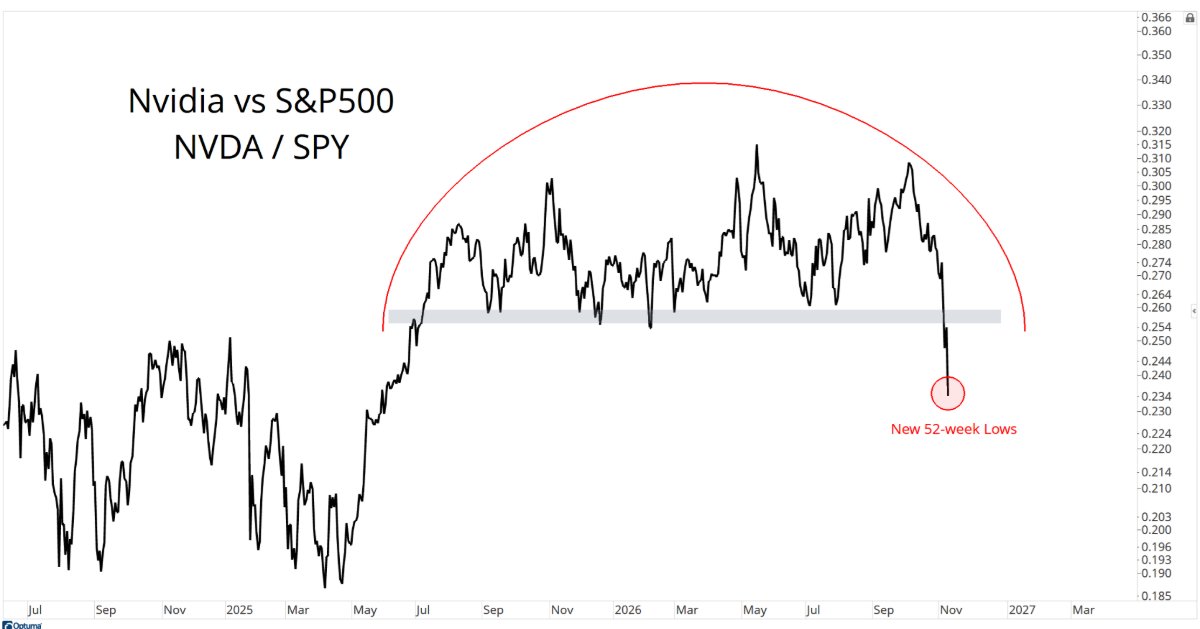
This chart compares owning Nvidia with owning the broader market. When the line falls, Nvidia is underperforming.
That’s a pretty ugly break below an area that had held up repeatedly.
One of the biggest companies in the world is losing ground to the rest of the market.
We should pay attention.
Keep in mind this was on the cover of The Economist just two months ago, near the all-time highs:
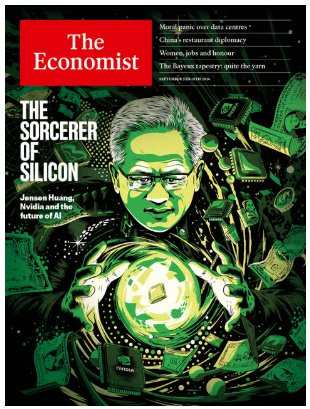
Pretty amazing. The Magazine Cover Indicator strikes again.
But now look at the Nasdaq 100 through its ETF, QQQ. Last week, the Qs broke below its summer lows.
Then it quickly recovered that level, and Monday brought a sharp rally:
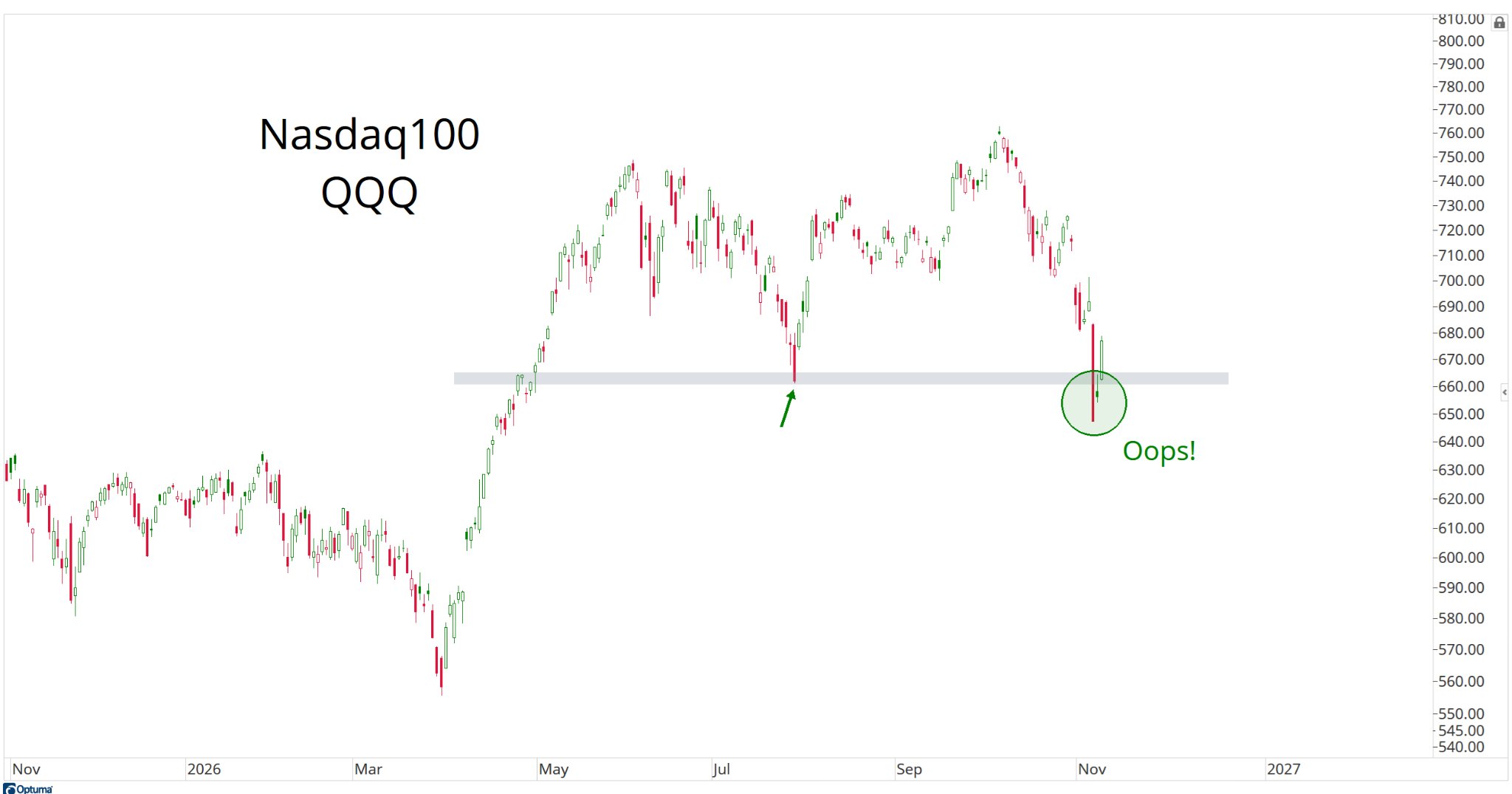
Oops.
This is the type of whipsaw you tend to see at historic turning points.
The market is proving that Nvidia can struggle while other stocks pick up the slack.
In fact, Monday’s rally in the broader market and other chipmakers came while Nvidia was still falling.
That’s why I’m interested in a possible Huang Bottom for the group.
Nvidia itself still has something to prove.
A Bottom Doesn’t Have To Be THE Bottom
One of the things that impressed me last week was the bond market.
Stocks were getting thrown around, but credit spreads narrowed.
The bond market was Kevin Bacon in “Animal House,” reminding us, “Remain calm! All is well!”
That doesn’t guarantee anything. But when stocks look panicked and credit isn’t confirming the panic, to me that’s a sign.
It supported the idea that we were seeing forced selling rather than everything falling apart.
Now we have a possible failed breakdown in QQQ and a rally in the opposite direction. That gives us something to work with.
For traders, those recovered summer lows become a useful reference. Holding above them supports the rally. Losing them again would weaken the case.
My view is that we want to be buying stocks that fit our strategies, with risk we can define.
Could semiconductors rally here, put in a lower high, and eventually build a much bigger top? Absolutely.
Technology and the Nasdaq could do the same thing.
But a rally we can participate in doesn’t require a promise that the lows will hold forever.
Remember, over the past month, roughly 80% of stocks have been outperforming the S&P 500. There are already plenty of things working.
If technology starts participating, too, there could be a lot of upside into the end of the year.
That’s the opportunity I’m watching.
Technical analysis doesn’t give us all the answers. But it goes a long way toward helping us ask the right questions.
And the question I’m asking is, is this the Huang Bottom?