
When I was a little kid, I used to spend a lot of time with my great-grandmother. We called her Tata.
My parents were working, school was out, and somehow I always ended up over there with her.
She was older by then and needed help with little things around the house. Nothing dramatic, just everyday life stuff, like cleaning, cooking, and carrying things around.
The kinds of tasks you don’t think much about until you watch somebody struggle with them every day.
For whatever reason, I became obsessed with this idea that someday I was going to get her a robot.
Something that would help around the house, carry things for her, maybe even keep her company while everybody else was at work.
She used to laugh at me like I was completely insane.
“OK, JC, sure you are,” she’d say in Spanish.
But I was dead serious. And I never let go of that vision.
Even now, at 44 years old, I still think about it constantly. I still have this picture in my head where I wake up in the morning and some robot hears me stumbling upstairs half asleep to brush my teeth and immediately knows it’s coffee time.
By the time I walk downstairs, the coffee is sitting there waiting for me exactly how I like it.
Not because I programmed it that morning. Not because I pressed buttons on an app. Because the thing just knows.
Then while I’m at work all day, it’s taking leaves out of the pool. Taking the trash out on trash day. Pulling weeds before the gardeners show up. Handling random little chores that eat up time and mental energy.
And when it’s done, it puts itself away somewhere and recharges without me having to think about that either.
That’s the dream.
Honestly, it’s been this same developing dream for almost 40 years.
Long Robots, Short Humanoids
So naturally, over the years, I’ve asked smart people about this.
And the answer I always got was basically the same.
“Robotics? Absolutely.”
“Humanoids? Not anytime soon.”
That became my framework: Long robots, short humanoids.
I understood the value of robotics in manufacturing. Warehouses. Cars. Factories. Logistics. Agriculture. All that made perfect sense to me. We already live in a world filled with robots. Most people just don’t think of them that way because they don’t have faces and arms and legs.
But the idea of a humanoid robot walking around my house helping with everyday life? Every smart person I talked to basically told me the same thing.
“Cool fantasy, JC.”
“Maybe someday.”
So I accepted it.
I figured I’d waited this long already. What’s another decade?
Then last week happened.
I was down in Nashville with a bunch of incredibly smart people. About 30 of us in a room sharing ideas, talking markets, technology, business, trends, all of it.
Those are my favorite environments because I get to ask selfish questions about things I’m genuinely curious about.
And one of the guys there was Dan Ives.
Dan’s the man. He’s the No. 1 technology analyst in the world. So naturally, I sat right next to him at dinner.
I’m like, “Alright Dan, level with me here: When do I get the robot?
“When does this thing make my coffee, take the trash out, pull weeds, maybe even jog next to me so I stop slacking halfway through my run?”
He looked me dead in the eye and said: “Three years.”
Not 10.
Not 20.
Three.
The Brain Behind the Robot
I honestly didn’t know what to say for a second.
Because this wasn’t some random guy on Twitter trying to pump a theme. This wasn’t some science fiction fantasy hour. This is literally one of the top people on the planet studying this stuff every single day.
If he thought it was 10 years away, he would’ve said 10.
If he thought it was hype, he would’ve rolled his eyes and laughed at me.
Instead he said three years without hesitation.
And suddenly I’m sitting there thinking about Tata.
Thinking about how badly I wanted that technology to exist when I was six years old sitting in her house. Thinking about how impossible it sounded back then.
Honestly, thinking about how impossible it still sounded to me a week ago.
And now one of the smartest and most informed people I know is telling me we’re basically standing right in front of it.
Maybe not perfect humanoids. Maybe not robot butlers folding towels like in a sci-fi movie.
But close enough where the shift becomes real.
Close enough where the average person starts interacting with intelligent machines inside their own homes every single day.
That changes everything.
The labor market changes. The economy changes. Consumer behavior changes. Entire industries get rebuilt around it.
And somewhere underneath all that chaos, there’s probably a massive investment opportunity developing that most people still think sounds ridiculous.
Which, of course, is usually where the best trends begin.
Once my brain stopped exploding over the idea that this thing might actually happen inside of three years, I immediately started thinking about the stocks.
Not the trillion-dollar IPOs everybody is already fantasizing about.
I’m more interested in the companies quietly supplying the actual brains behind these machines while most people still think humanoids are science fiction.
One of the names I keep coming back to is Ambarella (AMBA).
This is basically the robot thinking for itself instantly right there on the device. No delays. No sending information away to some cloud server while your humanoid walks into a wall carrying hot coffee.
The robot sees something, processes it, and makes a decision instantly.
That’s the game.
And when I look at the stock itself, what stands out immediately is this massive base it’s been carving out for years while almost nobody is talking about humanoids seriously yet:
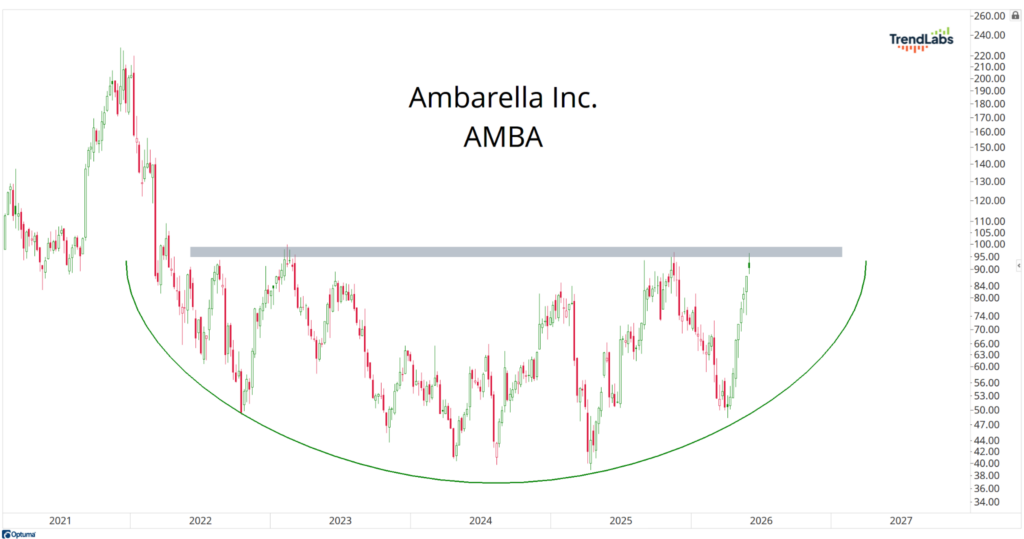
That’s usually what the early stages look like before the market fully connects the dots.
Maybe Tata and I were just 40 years too early. And maybe the market is finally starting to realize it.
There will be plenty of stocks tied to humanoids over the next decade. I’ll keep pointing them out when the setups are this compelling.
Because that’s the part that matters.
Not the headlines, not the story.
The setup.
Then all we have to do is execute.
Stay sharp,
JC Parets, CMT
Founder, TrendLabs