
In every family there are two cousins who always show up together.
One is calm and keeps the peace. The other one is loud and tells the story you’re not supposed to tell in front of Grandma.
That’s gold and silver.
Gold is the calm cousin, silver is the wild one, but they go everywhere together.
If you listen to the textbooks and the sales guys, they’ll tell you silver is different.
They’ll say more than half of silver demand comes from factories. They’ll talk about solar panels, electric cars, phones, all of it.
And they’re right.
Almost 60% of silver demand is industrial. Solar alone has gone from a tiny slice to close to a third of that industrial use.
The Silver Institute calls it “increasingly essential to the technological transformation driving the global economy.”
The U.S. government even added silver to its official Critical Minerals list.
Gold didn’t make that list. For gold, tech is just a sliver of demand. Gold is jewelry, savings, and central banks.
So the story writes itself. Gold is the precious metal, silver is the industrial metal.
That’s the theory. Now let’s look at the reality.
Same Road, Twice the Bumps
For 20 years, those two lines have climbed together, peaked together, sunk together, and rocketed higher together:
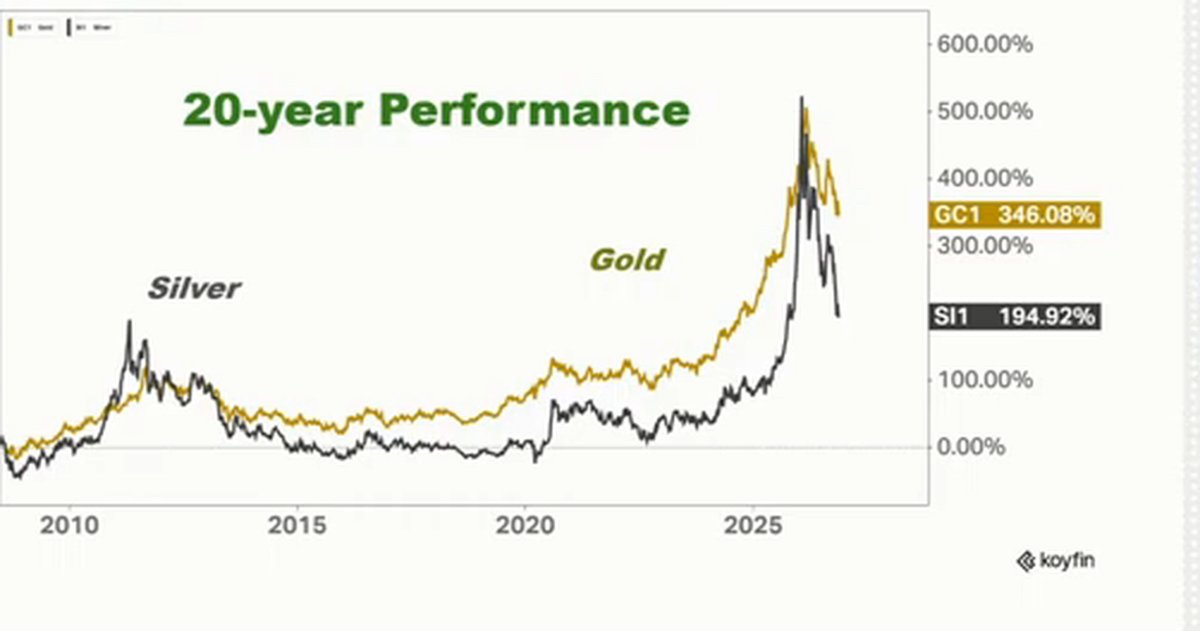
Silver overshoots on the way up, and it gets crushed harder on the way down.
In 2025, gold had a huge year. Silver had an even bigger one, more than double the gain.
So far in 2026, gold is down. Silver is down a lot more, roughly three times the pain.
This is one trade with two volume knobs.
There’s a simple way to measure how two things move together. It runs from 0 to 1.
Zero means they ignore each other. One means they’re basically the same thing with two name tags.
Over 20 years of daily prices, through a financial crisis, a pandemic, inflation, and an AI boom, gold and silver print 0.80. About 0.80 in 2006 to 2009. About 0.80 in 2010 to 2019. About 0.80 in 2020 to 2026.
The world changed. Silver’s industrial use surged. The number didn’t move.
If Silver really traded on factories and solar panels while gold traded on fear and central banks, that number would swing around.
Silver is gold’s crazy little cousin.
They move together, industrial or no industrial.
Gold for Poor People
On Monday, my friend Bill was talking about all this “50% of demand” stuff for silver and all that industrial use.
And I get it. The demand is real.
In practice, which is the only thing that actually matters, silver is really just gold for poor people.
When gold moves a dollar, silver tends to move about a dollar sixty in the same direction. Same road, twice the bumps.
A year ago, when silver was clocking all-time highs, the question in these pages was what gold can tell us about its crazy cousin.
Before that, I told you that if gold is making moves, silver is likely not too far behind. I wasn’t saying that to be cute.
If you own silver, you own the gold trade. You don’t own “the solar trade” or “the EV trade.”
You own gold with the volume turned up.
That doesn’t mean the industrial story is fake.
It just means it doesn’t decide how the price behaves. The tape does.
Next time somebody tells you silver is an industrial metal, are you going to believe the brochure?
Or are you going to believe 20 years of prices that say it’s just gold’s crazy little cousin?