
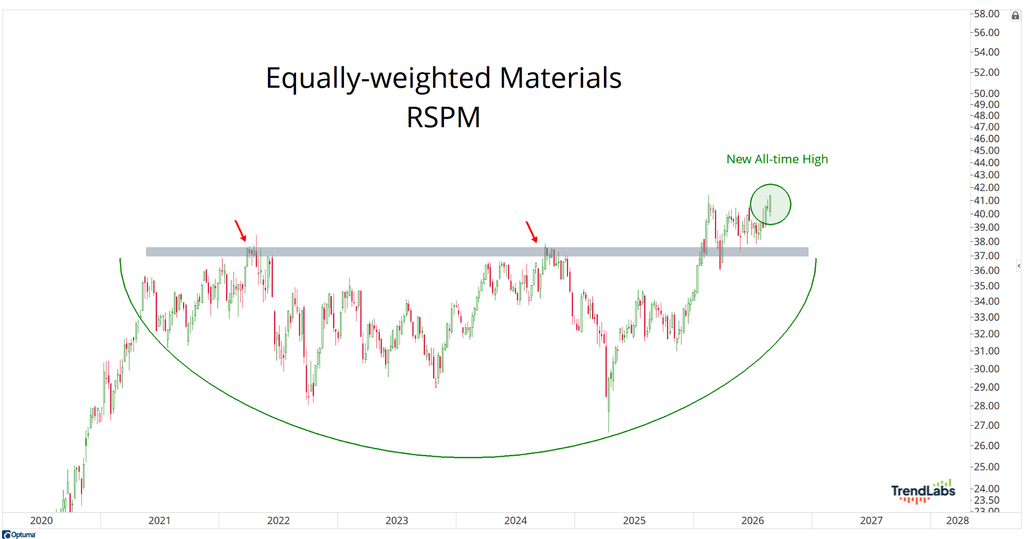
The average materials stock just closed the week at the highest level in American history.
Not Nvidia (NVDA). Not the Nasdaq-100 (QQQ).
The S&P 500 Equal Weight Materials ETF (RSPM).
Instead of letting the biggest companies dominate the index, RSPM gives each stock roughly the same importance.
So it gives us a pretty good look at what the average materials stock is actually doing.
Right now, they’ve never been stronger:
I’m not showing you this because I think everyone needs to run out and buy RSPM. That’s not the point.
I want you to recognize what’s happening underneath the surface of this bull market.
For years, technology has received most of the attention, and for good reason. Tech stocks have been some of the biggest winners in the world.
Meanwhile, materials, energy, and healthcare were some of the worst areas of the market not that long ago. Now they’re all making all-time highs.
That’s not something I want to ignore.
Sector Rotation Is the Lifeblood of a Bull Market
We’ve talked about this plenty over the years. Healthy bull markets don’t need the same stocks to lead forever.
In fact, I think it’s better when they don’t.
One group can have a huge run while another takes a break. Then, money starts finding its way into different parts of the market and a new group begins participating.
That’s sector rotation, and we’re watching it happen right now.
Technology doesn’t have to crash for materials to do well. Tech can take a break while investors find opportunities elsewhere.
We’ve already watched energy stocks break out to new all-time highs. Healthcare has been making new highs, too.
And now the average materials stock just joined them.
To me, this is not evidence that the bull market is running out of gas.
It’s just further evidence that more areas of the market are participating in the bull market.
And materials are suddenly becoming one of the most interesting places to look.
This is a big group with a lot going on underneath the surface. There are chemical companies, fertilizer stocks, mining companies, and metals producers.
There are also businesses tied directly to agriculture and the growing agribusiness theme we’ve been discussing.
I suspect we’re going to be spending a lot more time looking through this group throughout the rest of this year and probably into next year.
Nobody’s Talking About This
Here’s another reason materials are so interesting: Nobody cares.
Materials represent only a small piece of the S&P 500. There’s just one materials stock in the Dow Jones Industrial Average. And exactly 1% of the Nasdaq-100 is materials.
Think about that. Some of the most widely followed indexes in the world barely have any exposure to this group at all.
A lot of newer investors have never even experienced a real materials cycle. They’ve spent their entire investing lives looking for the next hot technology stock.
That’s understandable. But our job isn’t to find the coolest company. Our job is to buy things that go up in price.
And right now, materials stocks are going up in price.
For investors who’ve been around for a few cycles, you know what can happen when these stocks get moving. They can really move.
So this is an area I think deserves a lot more attention.
Look through the chemical companies, fertilizers, metals and mining stocks, and the businesses benefiting from the growth in agriculture.
You don’t have to buy all of them. You don’t have to buy any of them.
But you should know what’s happening.
The average materials stock just closed the week at the highest level in American history while energy and healthcare are making new highs of their own.
That’s what I want to see in a bull market.
More groups participating, new leadership emerging, and money finding opportunities outside of yesterday’s winners.
And, if this rotation continues, I think materials are about to become a much bigger part of the conversation.
Stay sharp,
JC Parets, CMT
Founder, TrendLabs