
Think about a Saturday afternoon with the family.
Some people head to Target for a few things and leave with full shopping carts.
Others stop at Apple because somebody suddenly “needs” a new phone.
Maybe they grab lunch and put it all on a Visa card.
Other families are booking flights, planning Disney trips, or calling an Uber.
Different plans, same idea: people spending money.
But, according to Wall Street, none of those companies belong in the Consumer Discretionary sector.
Apparently, these families need to shop somewhere else before it counts.
That sector includes businesses selling things we want but don’t necessarily need, like restaurants, hotels, and cars.
A fund tracking the S&P 500 Consumer Discretionary Index is down about 2.5% over the past year.
Look at that chart alone, and you might think Americans have stopped opening their wallets.
But plenty of consumer businesses have been acting better than that.
So, this morning, my team and I built a broader consumer index. We started with the official group, then we added 12 companies.
Our index includes Apple (AAPL), Walmart (WMT), Costco (COST), Target (TGT), Walt Disney (DIS), Visa (V), Mastercard (MA), American Express (AXP), United Airlines (UAL), Delta Air Lines (DAL), Uber Technologies (UBER), and Simon Property Group (SPG), among the official names.
Bigger companies get bigger weights, just like in the official index.
The result?
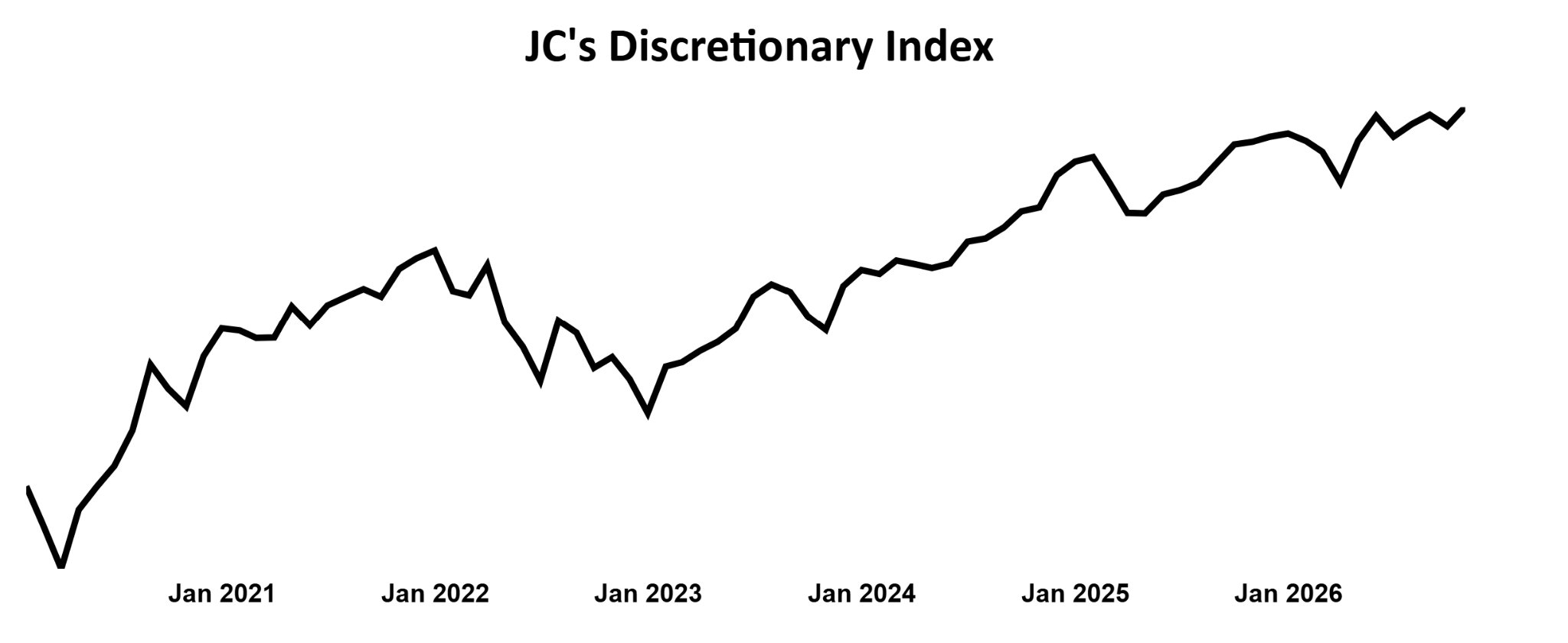
Your Wallet Doesn’t Care About Wall Street’s Labels
Apple is Technology. Visa is Financials. Delta is Industrials. Disney is Communication Services. Simon Property, which owns shopping malls, is Real Estate.
Those labels help organize the stock market.
But your family can visit a mall, buy an iPhone, book a flight, and pay for everything without touching most of the companies in the official Consumer Discretionary Index.
That’s a strange place to stop if we’re trying to understand the consumer.
I want to see the stores where people shop, the companies processing their payments, and the businesses taking them on vacation.
Whether Wall Street puts those companies in three different boxes or 30 doesn’t change why I’m watching them.
Think of these stocks as thermometers.
Adding Disney doesn’t mean I’m telling you to buy Disney.
It means a business built around getting families to spend money belongs on my consumer dashboard.
Right now, that dashboard looks a lot healthier than the official consumer index does.
Why You Should Care
Because a narrow chart can lead you to a very broad, very expensive conclusion.
If you look at the official consumer index, decide the consumer is falling apart, and avoid every business tied to consumer spending, you could miss strength happening right in front of you.
The index you picked might be struggling while the companies you ignored are making new highs.
That’s why we do the work. Before a chart answers your question, you need to know what’s actually in it.
This doesn’t mean every family is doing great.
But when we include more of the businesses where families actually spend money, the picture gets a lot stronger.
Strong enough to make new all-time highs.
The next time someone tells you the consumer is broken, ask them to show you their chart.
Then ask what’s in it.