
There’s a big difference between a market with weak breadth and a market that’s simply rotating.
We’ve been talking about market breadth because the major indexes are making new highs while fewer stocks are participating.
We also just talked about the Magnificent Seven, which spent most of the past year going sideways and are now making new highs again.
So, yes, there are legitimate questions about breadth.
But breadth is more than counting how many stocks went up today.
I also want to know which groups are leading, which groups are falling behind, and whether the market keeps finding new leadership.
Think of the stock market like a relay race. One runner doesn’t need to carry the baton for the entire race.
In fact, you don’t want that.
You want one runner to lead for a while, then pass the baton to somebody else.
That’s sector rotation. And we’ve seen plenty of it this year.
Look at the first quarter:
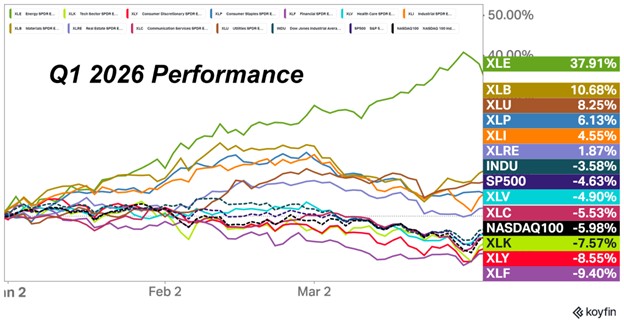
Energy was the star of the show, gaining almost 38%. Materials, utilities, and consumer staples were also positive.
Meanwhile, technology fell about 8%. Consumer discretionary fell almost 9%. Financials were down more than 9%.
If you only looked at technology during the first quarter, you might’ve thought something was terribly wrong with the market.
But money didn’t disappear.
It moved.
That’s an important distinction.
Then the Baton Moved
Now, look what happened next:
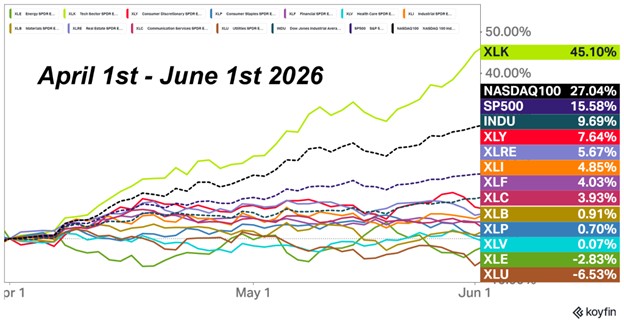
From April through May, technology absolutely exploded.
The Technology ETF (XLK) gained 45%. The Nasdaq-100 gained 27%, and the S&P 500 gained almost 16%.
These are historic numbers.
Remember, technology had just been one of the worst-performing groups during the first quarter.
Suddenly, it was the best.
At the same time, energy went from the best-performing sector in Q1 to one of the worst. Utilities also fell.
The market didn’t stop rotating. It just handed the baton to someone else.
Then, it happened again:
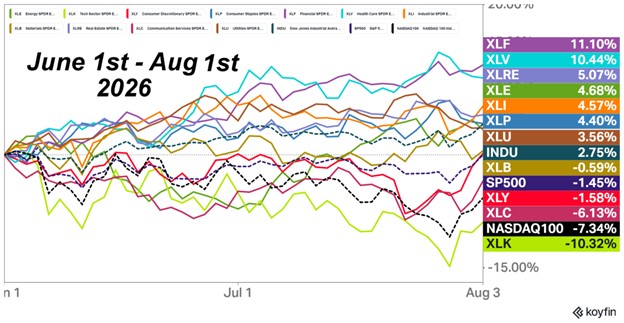
From June through July, financials and healthcare took over.
Financials gained more than 11%. Healthcare gained more than 10%. Real estate, energy, industrials, consumer staples, and utilities were all positive too.
Technology?
It was the worst-performing sector on the board, falling more than 10%.
So think about what happened in just a few months.
Energy led. Then technology led. Then financials and healthcare led.
Then we got another handoff:
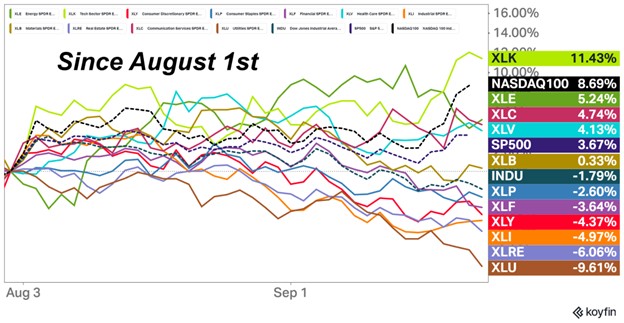
Since August, technology has taken the baton right back.
XLK is up more than 11%. The Nasdaq-100 is up almost 9%. Energy and communications are also positive.
Meanwhile, utilities are down almost 10%. Real estate, industrials, consumer discretionary, and financials have all struggled.
That’s not a market where the same five stocks have been the only things working all year.
Leadership has been moving around.
That’s rotation.
Here’s What Would Change the Conversation
This is where the breadth discussion gets more interesting.
Weak breadth isn’t just fewer stocks making new highs.
I want to know why fewer stocks are participating.
Are yesterday’s leaders taking a break while new leaders emerge?
Or are the laggards simply catching down, with fewer and fewer groups left standing?
Those are very different markets.
Here’s another clue I’m watching:
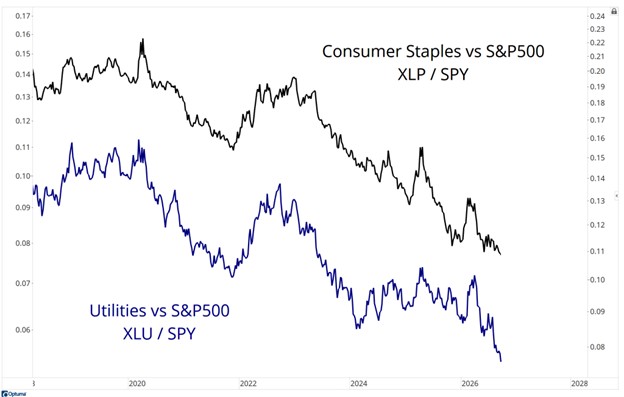
Consumer staples and utilities are two of the most defensive areas of the stock market.
These are the companies selling water, toothpaste, cereal, toilet paper and all the boring stuff people need whether the economy is booming or falling apart.
When investors get scared, they often hide in these groups.
Nobody’s hiding there right now.
The Utility ETF (XLU) relative to the S&P 500 Index ETF (SPY) is making new lows.
The Consumer Staples ETF (XLP) relative to the S&P 500 is making new lows, too.
Nobody wants them.
Meanwhile, technology is leading again.
That combination is much more typical of a bull market than a market where investors are running for cover.
But that doesn’t mean we can ignore the breadth deterioration.
Now we know exactly what to watch.
I want to see the baton keep moving.
Industrials have been weak lately. I want to see buyers come back there. I also want to see home construction participate again.
And, after their strong run earlier this summer, the banks need to hold in there, too.
If those groups start participating again, then the recent weakness underneath the indexes looks a lot more like normal rotation.
But if industrials keep falling, homebuilders can’t get going, banks start breaking down, and technology becomes the only thing left working, then we have a different conversation.
That would mean the baton isn’t being passed anymore.
One runner would be carrying the entire team.
That’s when weakening breadth becomes a much bigger problem.
For now, we’ve had energy lead. We’ve had financials lead. We’ve had healthcare lead. We’ve had technology lead.
We’ve watched leadership change multiple times throughout the year.
And while the Magnificent Seven are making new highs again, defensive sectors like staples and utilities are making new relative lows.
So, yes, we’re watching breadth closely.
But don’t confuse rotation with deterioration.
For now, the market is still passing the baton.