
Every four years, around this time, I find myself digging through the same charts.
You’d think I’d eventually stop.
I don’t.
Not because I’m looking for something to confirm what I already believe. Quite the opposite. I’m looking for reasons to prove myself wrong.
If the data changes, I want to know. Markets have a funny way of humbling people who fall in love with their opinions.
So, every midterm year, I pull out the same study. And, every midterm year, I come away thinking the same thing.
Maybe we should all be paying a lot more attention to this.
Turn on the news during a midterm election year, and you’ll hear plenty about politicians.
You’ll hear debates about who’s ahead, who’s behind, who’s saying what, and who’s making everybody angry.
The market doesn’t care.
When you remove the politics and just study what stocks have actually done over history, one pattern keeps showing up.
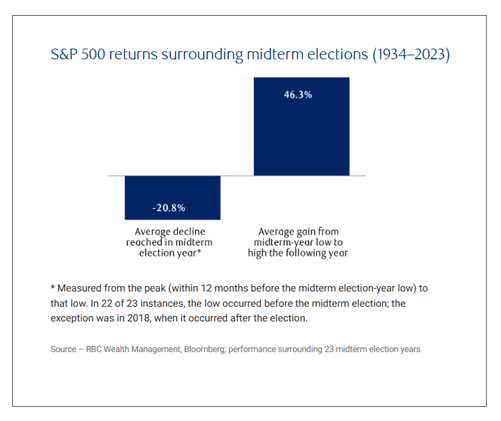
The market has often found an important low sometime during the midterm election year.
From there, it has frequently rallied all the way into the following year, the year before the next presidential election.
RBC Wealth Management studied every presidential cycle going back decades.
Their research found that, on average, the S&P 500 has gained more than 46% from the midterm-year low to the following year’s high.
Some cycles were much stronger than others.
But after seeing the same tendency repeat itself over and over again, I think it’s worth respecting.
That wasn’t enough for me. I wanted to know what happened beneath the surface.
The S&P 500 is a great benchmark, but it doesn’t tell the whole story. I wanted to know where the biggest opportunities tended to show up.
So I started digging into small caps.
The Opportunity Might Be Smaller Than You Think
This is where things started getting interesting.
Everybody knows the names at the top of the S&P 500. Nvidia (NVDA), Microsoft (MSFT), and Apple (AAPL) dominate the headlines because they’re enormous companies.
But bull markets rarely stay that narrow forever. Eventually, more stocks join the party. Then more industries.
Then smaller companies start climbing up the returns leaderboard.
That’s exactly what healthy bull markets look like.
When I went through every presidential cycle and measured the move from the midterm low to the following pre-election high, I found something that really stood out.
Small caps have historically produced even larger gains than the S&P 500 during this stretch.
That doesn’t mean every small stock deserves your attention.
Far from it. Some deserve to be ignored completely.
I’m interested in the ones already proving themselves. The companies making new highs. The industries showing relative strength.
The places where buyers are already showing up before the crowd notices.
That fits perfectly with what we’re seeing today.
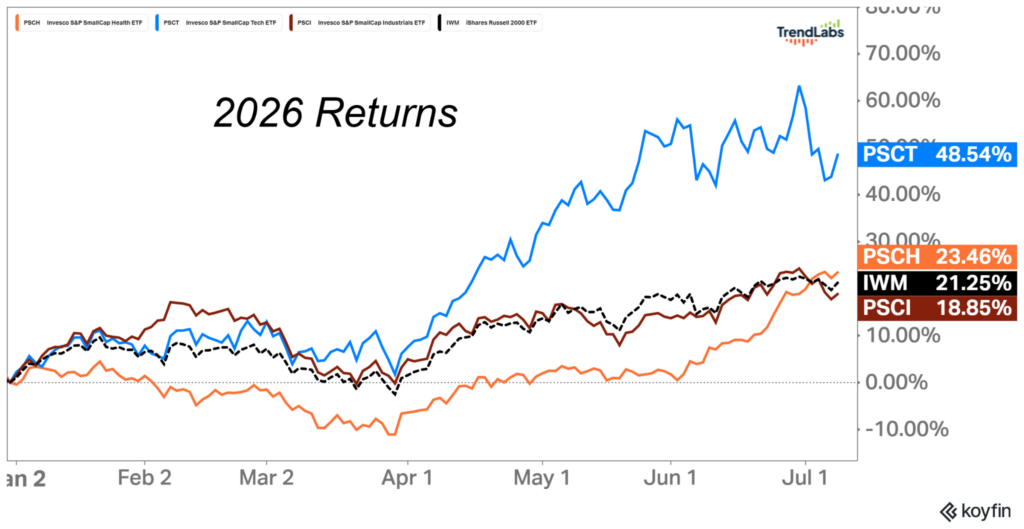
The Russell 2000 just finished its strongest first half of the year since 1991, climbing roughly 22% through the first six months of 2026.
That’s not the kind of action you usually see if investors are running away from risk. It’s what you see when money starts moving beyond the biggest household names.
The areas catching my eye aren’t random: small-cap industrials, small-cap healthcare, small-cap technology.
Those are the places where I’m finding more and more stocks acting the way I want winning stocks to act.
What Happens Next?
One reason this setup fascinates me is because it doesn’t arrive at a comfortable time.
We’re entering the part of the calendar when investors start getting nervous.
August and September have earned a reputation for being difficult months.
Maybe this year will be no different. Maybe we see some weakness.
If we do, history suggests that weakness during a midterm year has often created opportunities instead of permanent damage.
That’s how I’m thinking about the months ahead.
There’s another reason I’m paying attention.
The U.S. dollar is sitting at an important level.
We’ve been talking inside TrendLabs about how positioning has become stretched.
If the dollar breaks lower from here, it could become a major tailwind for risk assets.
Commodities could benefit. Metals and mining stocks could benefit. Industrials could benefit. Financials could benefit. Technology doesn’t have to stop working, either.
Leadership can rotate without ending the bull market.
That kind of environment has historically been very friendly to small caps.
If the trends begin breaking down, we’ll adjust.
But, until they do, history argues that we should spend less time worrying about the next election and more time paying attention to what stocks are actually doing.
The Midterm Melt-Up isn’t about Republicans or Democrats.
It’s about recognizing one of the most consistent tendencies in market history.
Maybe it already started.
Maybe the next great buying opportunity comes after a late-summer pullback.
Either way, I’m not looking for reasons to avoid small caps.
I’m looking for the strongest ones to own.
Stay sharp,
JC Parets, CMT
Founder, TrendLabs