Every business has a favorite customer.
Costco (COST) loves the family that fills up two shopping carts every Saturday.
Disney (DIS) loves the family that stays at the hotel, buys the meal plan, and leaves with a suitcase full of souvenirs.
And investing apps? They have a favorite customer, too.
It isn’t the person buying shares of Apple (AAPL) and holding them for years. That customer barely pays the bills.
Their favorite customer is the one with the gambling addiction.
The one betting on everything from the Miami mayor’s race to WNBA games. The one who can’t wait to find something else to wager on tomorrow. The one who keeps coming back for more action.
If you want to understand why, all you have to do is follow the money.
The Math Isn’t Even Close
Let’s pretend you have $1,000.
You decide to buy $1,000 worth of AAPL because you want to own a piece of one of the greatest businesses ever built.
Robinhood (HOOD) makes roughly 25 cents from that trade.
Not $25.
Twenty-five cents.
Now let’s say you use that same $1,000 to trade options instead. Robinhood might make several dollars.
Already, you’re a much better customer.
Now let’s look at prediction markets.
Imagine you’re betting on whether the Federal Reserve cuts interest rates next month or how many streams The Beatles will have this year.
If those contracts are trading around 50 cents each, your $1,000 buys about 2,000 contracts. Robinhood and the exchange can collect up to two cents on every contract.
Two thousand contracts multiplied by two cents is $40.
Think about that for a second.
The person investing in Apple earned the company about a quarter.
The person gambling on prediction markets earned them about $40.
In other words, Robinhood can make roughly 160 times more from a customer gambling on prediction markets than from someone investing the same $1,000 in Apple stock.
But here’s the part that really caught my attention.
The person who bought Apple might not touch that investment again for years.
The gambler is back tomorrow.
They’re betting on another election. Another basketball game. Another interest rate decision. Another event. Another reason to open the app.
Robinhood doesn’t just make dramatically more money from each gambling transaction.
They also get dramatically more chances to make that money.
One customer is investing. The other customer is generating revenue.
Which customer do you think the business wants more?
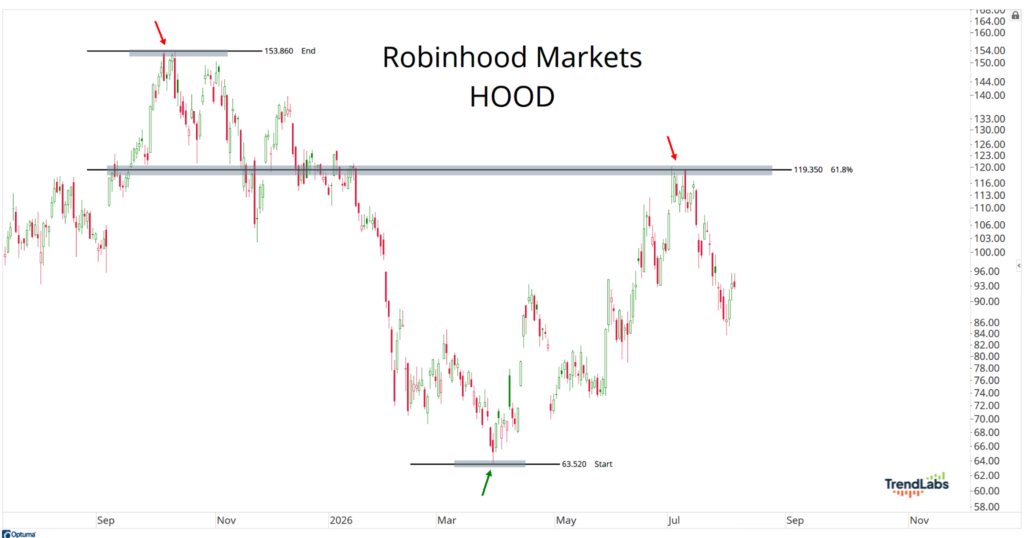
But I wonder, if gambling is such a great business, why is Robinhood still more than 65% below last year’s highs while the broader market continues to close at the highest levels ever?
Follow the Incentives
This isn’t really a story about Robinhood. It’s a story about incentives.
Companies don’t spend billions of dollars building products that make them the least amount of money. They build products that make them the most.
If someone pays you 25 cents for one activity and $40 for another, you don’t need to have a doctoral degree to know which one you’re going to promote.
That’s why investing apps keep finding new ways to get people to gamble.
That’s why prediction markets suddenly show up everywhere.
That’s why your phone keeps buzzing with another notification.
The app says “investing.” The economics say something very different.
None of this means prediction markets shouldn’t exist. None of this means Robinhood is doing anything illegal.
It simply means you should understand how the business works.
Because once you know how a company gets paid, you start seeing the world differently.
The best investors I know don’t place dozens of sports bets every day.
They don’t spend their weekends wagering on next month’s inflation report.
They don’t confuse entertainment with investing.
They buy great assets. Then they give those assets time to work.
That’s a wonderful way to build wealth. It’s also a terrible way for a brokerage to make money.
The next time your investing app encourages you to place another trade, ask yourself one simple question.
Is this helping me build wealth, or is it helping them build revenue?
The answer usually isn’t that hard to find.
Stay sharp,
JC Parets, CMT
Founder, TrendLabs