Every major technological shift creates a familiar debate.
Investors immediately start asking which industries will disappear, which business models are broken, and who the winners will be.
Artificial Intelligence has become the latest example.
Spend five minutes on financial media and you’ll hear plenty of opinions about how AI is going to kill software.
Maybe it will kill some software. That doesn’t mean it’s going to kill the software industry.
We’ve seen this movie before.
When the internet began changing the world, people correctly recognized that technology was entering a new era.
What they couldn’t identify was which companies would actually benefit from it.
Plenty of internet stocks became nothing more than great stories. Others went on to become some of the most valuable businesses in history.
The internet didn’t eliminate technology companies. It reshuffled the leaderboard.
I think AI is doing the same thing today.
The market isn’t telling us software is dead. It’s telling us leadership inside software is changing.
Those are two different messages, and the distinction matters if your goal is making money instead of winning arguments.
The Wrong Chart
One reason so many investors have become bearish on software is because they’re looking at a market-cap weighted index.
In those indexes, the largest companies have an outsized influence on performance. If a handful of mega-cap software stocks struggle, the entire index appears weak even if most software companies are doing just fine.
That’s exactly what’s happening today. Remember, Microsoft (MSFT) fell more than 35% from its highs last year. Oracle (ORCL) fell more than 65%.
But now look at software through an equal-weight lens, where every company carries the same weight regardless of its size, and the picture changes dramatically.
Instead of seeing an industry that has suffered a historic decline, you find an index sitting only a few percentage points below its all-time highs:
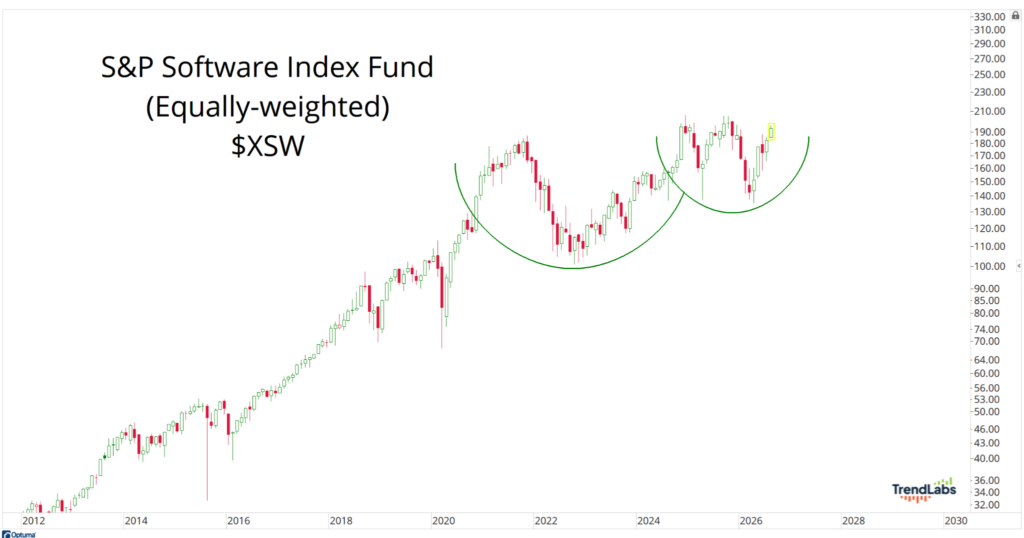
That’s not what an industry in secular decline looks like. It’s what rotation looks like.
This is why it’s so important to understand what the averages are actually measuring.
Market-cap weighting tells you how the biggest companies are behaving. Equal weighting tells you how the average company is behaving.
Right now, those are telling two different stories.
Follow the Leaders, Not the Headlines
The same message shows up when we zoom out beyond software.
On Tuesday, the Equal-Weight Nasdaq 100 closed at the highest level in its history:
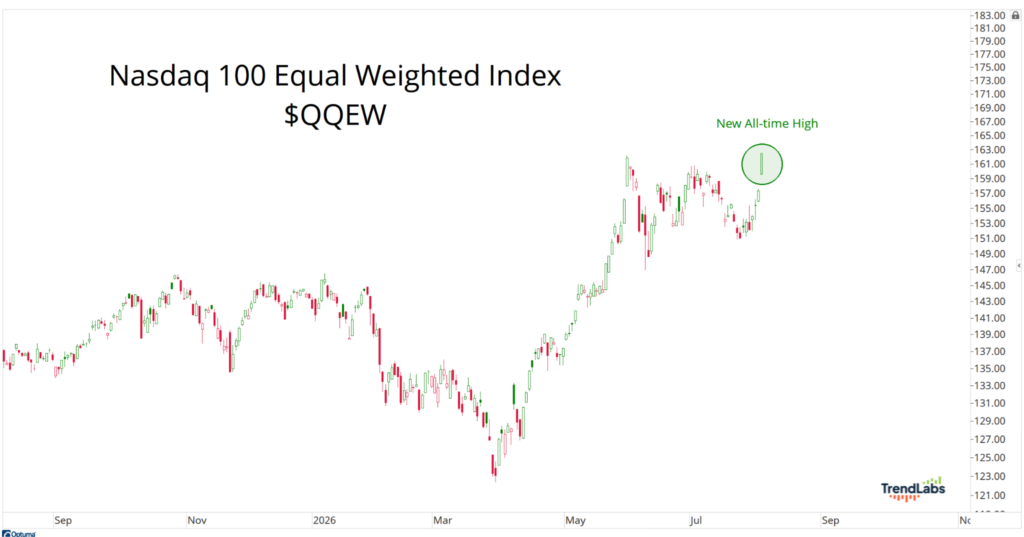
That’s a remarkable development considering how much attention has been paid to the weakness in some of the large technology stocks.
You’ll rarely see broad participation when an entire sector is falling apart.
Instead, it’s evidence that money continues flowing into technology, just not necessarily into the names that dominated the last cycle.
That’s exactly what we’d expect during a leadership transition.
The question isn’t whether AI is killing software. The better question is which software companies are becoming stronger because of AI.
Some businesses will almost certainly lose relevance as this technology evolves. Others will build better products, gain market share, and emerge as the next generation of leaders.
Markets have always rewarded adaptation, and there’s no reason to think this cycle will be any different.
That’s why we’re spending our time looking for software stocks showing both absolute and relative strength.
We don’t need to own every software company. We only need to own the ones institutions are accumulating.
As those opportunities make their way into our TrendLabs portfolios, members will be the first to know.
Everybody else can debate whether AI is killing software.
We’ll keep following the money.
Stay sharp,
JC Parets, CMT
Founder, TrendLabs