
There are certain moments that stick with you for no real reason.
One of mine happened almost 20 years ago.
Back then, I was living over in Sutton Place on the east side of Manhattan. One weekend, I decided to take a walk uptown toward Madison Avenue looking for brunch.
By the time I got up into the 80s, I was in one of the wealthiest neighborhoods in America, where tree-lined blocks, doormen, and beautiful brownstones make you feel like you’ve wandered into a different city.
Back then, Le Bilboquet was still in its original location. It was tiny. Just a handful of tables squeezed inside and a few more outside on the sidewalk.
If you’ve ever been there, you know exactly what I’m talking about. If you haven’t, and you ever find yourself in New York, do yourself a favor and order the Cajun chicken.
Recommending chicken at a French bistro sounds ridiculous, but it’s the right move.
As I walked past the outdoor tables, someone caught my eye.
It was Jack Welch.
There he was, sitting outside on a beautiful afternoon, having lunch with a friend. They each had their own bottle of chilled white wine sitting in its own ice bucket beside the table.
I remember laughing to myself. It had to be around noon, and Jack Welch looked like a man who had absolutely nowhere else to be.
I didn’t interrupt him. I didn’t ask for a picture. I just kept walking.
But I’ll never forget it.
At the time, Jack Welch wasn’t just another retired CEO. He was one of the most famous businessmen in America.
During his 20 years running General Electric, from 1981 through 2001, GE became the most valuable company in the world more than once.
Shareholders made fortunes. Business schools studied everything he did. CEOs everywhere tried to copy him.
If you grew up in America, General Electric wasn’t just a stock.
It was America.
The company traces its roots back to Thomas Edison.
It helped bring electricity into homes. It made light bulbs, appliances, jet engines, locomotives, medical equipment and countless other products that shaped modern life.
It was one of the original members of the Dow Jones Industrial Average and spent well over a century representing American industry.
Then it lost its way.
25 Years Is A Long Time
By the late 1990s, General Electric could seemingly do no wrong.
The stock soared during the dot-com bubble, even though it wasn’t a technology company.
Investors loved it. Wall Street loved it. Almost everyone owned it.
Then the bubble burst. The stock collapsed and never came close to those highs again.
Things only got worse during the Great Financial Crisis.
Somewhere along the way, GE had built an enormous finance business. It became so important that people joked General Electric wasn’t really an industrial company anymore. It was a bank pretending to make jet engines.
When the banking system nearly broke in 2008, GE paid the price.
The company spent the next decade doing something investors hate: repairing.
Businesses were sold. New management came in. Entire divisions were separated. Healthcare became its own company. The energy business was spun off.
What still trades today under the original GE ticker is no longer the sprawling conglomerate most people remember.
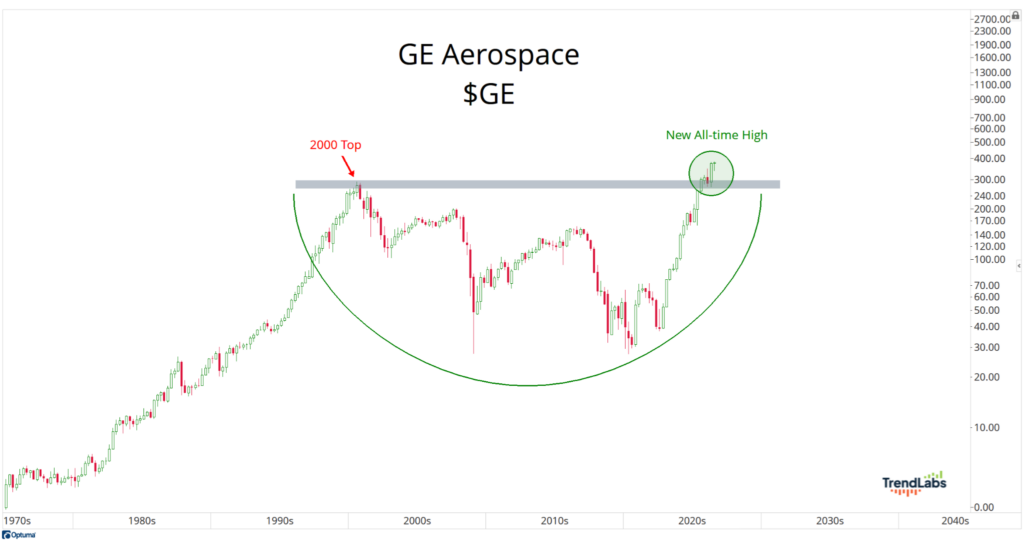
Today, it’s GE Aerospace:
Most investors never noticed.
Most people still think of light bulbs when they hear the name General Electric.
The market has already moved on.
This year, GE Aerospace finally broke above the highs it made during the dot-com bubble.
Think about what that means.
Twenty-five years. A quarter of a century.
An investor who bought at the very top in 2000 had to wait until 2026 just to see the stock make a new all-time high.
Markets have a funny way of testing people’s patience.
The longer a stock spends repairing the damage from an old cycle, the fewer people are left paying attention.
That’s often when the biggest opportunities begin.
One of my favorite sayings has always been simple: The bigger the base, the higher in space.
Twenty-five years is one heck of a base.
The Market Doesn’t Remember
Yesterday, we talked about Europe.
For 25 years, European stocks couldn’t get back above the highs they made during the dot-com bubble.
Generation after generation of investors wrote them off. Europe became the place everyone loved to hate.
Then it broke out.
If you haven’t read yesterday’s post, go back and take a look because the similarities are remarkable.
General Electric has just done almost the exact same thing.
One is an entire continent. The other is a single company. But the market is telling us the same story.
Long periods of disappointment eventually end.
The hardest part for investors is letting go of what they think they know.
People still think about GE as the company that nearly became a bank. People still think about Europe as the place where nothing ever happens.
Those stories may have been true once.
They don’t explain what’s happening now:
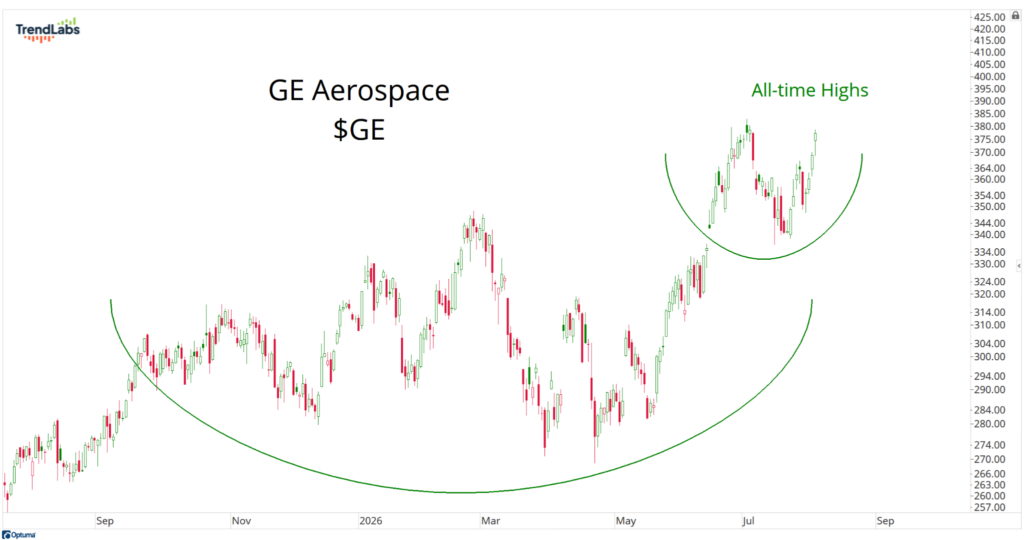
Most people are still evaluating General Electric based on the company they remember.
The market is evaluating the company that exists today.
Those aren’t always the same thing.
And that’s where opportunities come from.
Price only reflects what buyers and sellers are willing to do today.
That’s why these 25-year breakouts matter.
They’re telling us something has changed. Whether everyone else has realized it yet is another story.
Sometimes the biggest opportunities don’t come from finding something new.
They come from looking at something old with fresh eyes.
And that’s exactly why everybody’s wrong.
Stay sharp,
JC Parets, CMT
Founder, TrendLabs