
There’s a lot of talk about interest rates right now.
The U.S. 30-year Treasury yield is pushing toward levels we haven’t seen in decades. Naturally, everybody wants to know who’s responsible.
Is it President Donald Trump?
Is it Treasury Secretary Scott Bessent?
Is it Kevin Warsh and the Federal Reserve?
Is America borrowing too much money?
Those are all fair questions. But I think we’re making a mistake by starting there.
Because if this were really an American problem, you’d expect it to mostly be happening in America.
It isn’t.
Take a look at this chart:
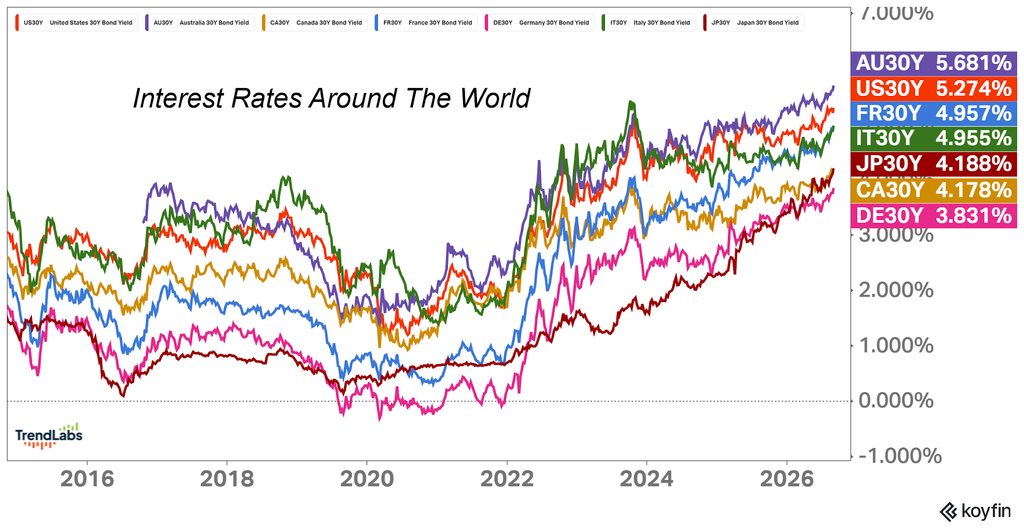
Every line represents the 30-year government bond yield for a different country.
We’ve got the U.S., Australia, Canada, France, Germany, Italy, and Japan.
You don’t need to understand bonds to see what’s happening. Just look at the direction of the lines.
They’re all going up and to the right.
Australia’s 30-year yield is above 5.6%. France and Italy are around 5%. Japan, which spent decades with some of the lowest interest rates on Earth, is above 4%.
These countries have different presidents, different central banks, different budgets, and different economies.
But their long-term interest rates are all moving in the same direction.
That’s a pretty big clue.
Maybe this isn’t just an American story.
Maybe it’s a bond market story.
What Does the Bond Market Know?
Let’s make this really simple.
A government wants to borrow money, so it sells bonds.
Investors decide what return they need in order to lend that government their money for the next 30 years.
That return is the yield.
When investors are willing to accept 2%, yields can stay around 2%.
But if investors suddenly demand 4%, 5%, or 6% before they’re willing to lend their money for three decades, interest rates go up.
That’s what we’re watching around the world. This matters because interest rates are basically the price of money.
They help determine what it costs to borrow money to buy a house. They influence what companies pay to build factories and data centers.
They affect government budgets and the value investors are willing to put on stocks.
Money touches everything.
So when the price of money is rising all over the world at the same time, I want to know about it.
And I especially don’t want to explain a global trend with a local story.
It’s easy for Americans to do that.
We turn on the TV and hear about Trump, Bessent, Warsh, Congress, and the Federal Reserve, all the time.
So when Treasury yields rise, naturally we assume something happening in Washington D.C. must be responsible.
Sometimes it is.
But Donald Trump isn’t running Australia. Scott Bessent doesn’t control Canadian bonds. And Kevin Warsh isn’t setting Italian interest rates.
Yet look at the chart: Rates in those countries are going up, too.
That doesn’t mean American policy doesn’t matter. Of course it does.
It means American policy can’t possibly be the entire explanation for something we’re seeing all over the world.
Think Like an Earthling
I’ve written about this before.
I was born in America. I love America.
But when it comes to investing, I don’t want to think like an American.
I want to think like an Earthling.
This is just as true for stocks as it is for bonds.
We just got another month of data, and stocks aren’t only making new highs in the U.S. We’re seeing new highs throughout Europe and Asia, too.
If stocks around the world are going up, I’m not going to pretend it’s just an S&P 500 story.
And if 30-year government bond yields around the world are going up, I’m not going to pretend it’s just a U.S. Treasury story.
Markets don’t care about our passports. That’s why looking around the world is so useful.
If U.S. interest rates were exploding higher while rates everywhere else were falling, that would tell us something very important about America.
But that’s not what this chart shows.
It shows the U.S. participating in a much larger global trend.
So what are we going to do about it?
We’re going to keep looking around.
When U.S. yields rise, we’ll check Europe. We’ll check Asia. We’ll check the rest of the developed world.
The same goes for stocks, commodities, and currencies.
Because if we only look at America, we can very easily come up with the right observation and the wrong explanation.
Yes, U.S. interest rates are rising. But so are interest rates all over the world.
This isn’t just an America thing. It’s a bond market thing.
And if we want to understand markets, we need to stop thinking like Americans.
We need to think like Earthlings.
Stay sharp,
JC Parets, CMT
Founder, TrendLabs