
Nvidia (NVDA) just reported another ridiculous quarter.
The company generated $96 billion in revenue in three months. Its Data Center business alone brought in $89 billion, and Nvidia expects another $108 billion of total revenue next quarter.
These numbers are getting difficult to comprehend.
But here’s one that might help put it in perspective.
Nvidia is now worth more than $5 trillion. So when the stock rallied about 8% after earnings, it added more than $440 billion in market value in a single day.
Think about how crazy that is.
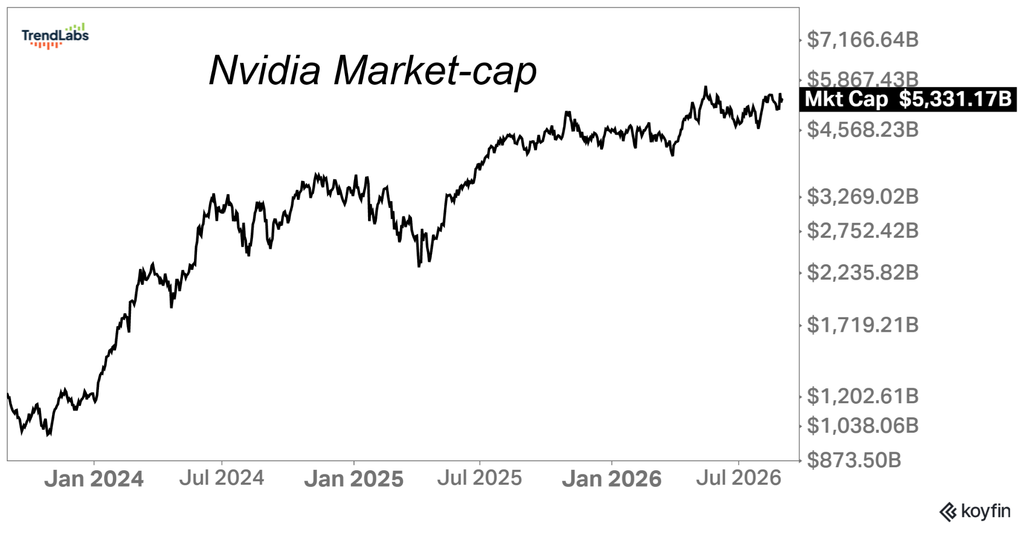
It was the largest single-day increase in Nvidia’s history and the second-largest market-cap gain by any company ever.
The amount of wealth created by one stock in a matter of hours was greater than the entire value of almost every publicly traded company on Earth.
That’s the scale we’re dealing with here.
And, apparently, selling all those chips isn’t enough.
Now Nvidia is helping figure out how everybody is going to pay for them, too.
Which raises a pretty funny question:
Is Nvidia a bank now, too?
Not exactly.
But Nvidia is getting increasingly involved in helping finance the enormous infrastructure buildout required to keep the AI boom going.
And some investors think that could eventually become a problem.
They call it “circular financing.”
It sounds scary. So let’s talk about what it actually means.
We already know Nvidia is selling a lot of chips. The more interesting question is who is actually paying for all of them.
Because $96 billion every three months has to come from somewhere.
And this is where the AI story gets really interesting.
Everybody Is Financing Everybody
We’ve talked about this before.
You need the chips, but you also need enormous buildings to put them in. You need electricity. You need cooling. You need all the equipment required to connect millions of chips together.
We’re talking about hundreds of billions of dollars.
And Nvidia recently announced partnerships with some of the largest investment firms in the world designed to help finance more than $500 billion of AI infrastructure.
Half a trillion dollars.
But Nvidia isn’t turning itself into JPMorgan (JPM). It’s doing something a little more clever.
Instead of borrowing hundreds of billions of dollars itself and putting all that debt on its own balance sheet, Nvidia can help other companies borrow the money.
Imagine I want to build a giant data center.
There’s only one problem. I need $10 billion and I don’t have it.
That’s a lot of money for a bank to lend me.
But now imagine I walk into the bank with an agreement saying Nvidia plans to be one of my customers for the next 15 or 20 years.
That’s a very different conversation.
The bank isn’t just betting on me anymore. I have one of the richest companies in the history of the world promising to send me checks.
Suddenly lending me billions of dollars doesn’t seem quite as crazy.
So I borrow the money, I build the data center, and then I need to fill it with chips.
Guess who makes the chips?
Nvidia!
Nvidia didn’t necessarily have to borrow the $10 billion itself. But its promise to become my customer helped make the $10 billion loan possible.
And then some of that borrowed money ultimately finds its way right back to Nvidia when I buy its chips.
That’s the circular-financing argument everybody’s talking about.
And I understand why people are paying attention to it.
But I also think people are getting a little ahead of themselves.
Calling something “circular financing” makes it sound like we’ve already discovered the crime scene.
We haven’t.
Businesses have been borrowing money to buy expensive equipment forever. And lenders have always been more willing to finance a project when they know there are big customers waiting on the other side.
The important question isn’t whether the money moves around in a circle.
The important question is whether the economics work.
Imagine I help you borrow $100 to buy a machine from me.
If that machine helps you make $200, who cares how we financed it?
You pay back the loan. You make money. I make money.
The arrangement worked.
The problem comes when that $100 machine doesn’t make enough money to justify what we spent on it.
And that’s the part of this AI boom that deserves our attention.
Eventually, somebody outside the circle needs to show up with real money.
Think about a shopping mall.
A developer can borrow money to build it. The bank can finance it. Stores can borrow money to open locations inside it.
But eventually somebody needs to walk into the mall and buy a pair of shoes.
AI isn’t that different.
All of these chips and data centers ultimately need to produce something that businesses and consumers are willing to pay for.
If AI helps companies make more money, save money, and become more productive, then all this spending might turn out to be one of the greatest investments ever made.
That’s certainly possible.
But there’s another possibility.
Maybe everybody’s building because everybody assumes somebody else will eventually need all this computing power.
That’s when things can get dangerous.
We’ve seen versions of this before.
During the internet boom, companies spent fortunes laying fiber-optic cable across the country because everybody knew the internet was going to change the world.
They were right. The internet changed everything.
But that didn’t mean every investment made during the boom was a good one. Too much money went into building too much capacity too quickly, and plenty of investors lost a fortune.
That’s one of the most important things I’ve learned about investing.
A technology can change the world and still be a bad investment at the wrong price.
Both things can be true.
So What Are We Going To Do About It?
This is where I think the conversation gets off track.
There seems to be an assumption that once you’ve identified the circular financing, you’ve identified the top.
I don’t think that’s how this works.
The financing itself isn’t necessarily the problem.
The financing becomes a problem when the economics stop working.
If these data centers generate enough money to pay their bills, the loans get paid back and companies keep ordering Nvidia chips, then everybody calling this a “bubble” today could be talking about it for a very long time.
But if the economics stop working, then we have something to worry about.
If companies build more computing power than customers actually need, or they can’t charge enough to justify what they spent building it, the math starts to break down.
Eventually, borrowers have trouble paying back lenders and the money stops flowing.
That’s when this becomes a real problem.
But here’s the good news: We don’t have to guess.
If this becomes a problem large enough to threaten the biggest investment theme in the world, I have a difficult time believing Nvidia’s stock will just sit there quietly while nobody notices.
And right now?
Nvidia is basically going sideways. That’s why this range matters so much:
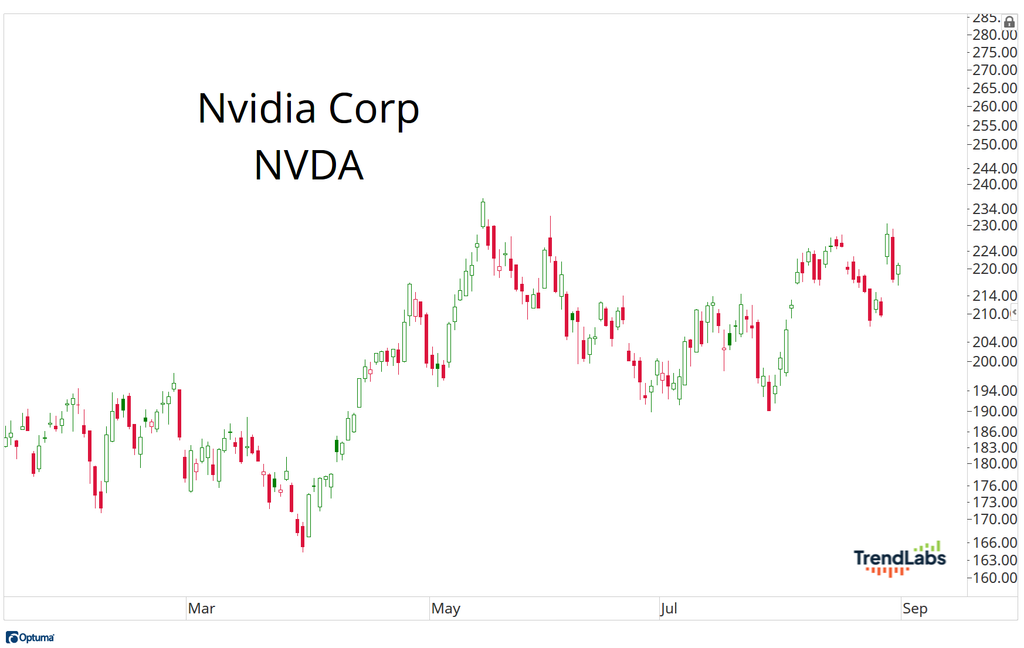
We have a $5 trillion company sitting in a range while investors argue about whether the biggest technology spending boom we’ve ever seen is sustainable.
I think that’s incredibly useful information.
If Nvidia breaks out of this range, we need to respect what the market is telling us.
Despite all the hand-wringing over circular financing, investors would be voting with actual money that this boom still has plenty of life left in it.
If Nvidia breaks down? Now you have my attention.
Because this is how markets usually work.
People remember the Great Financial Crisis as if everything suddenly exploded one morning in 2008.
That’s not what happened.
Home construction stocks had already been falling in 2006, long before the broader stock market peaked. Financial stocks started breaking down in early 2007.
By the time Lehman Brothers disappeared in September 2008, the market had been screaming that something was wrong for a long time.
There were plenty of signs. You just had to look.
My bet is that the next crisis works the same way.
Circular financing could eventually become a disaster.
We could build way too many data centers only to discover that the companies actually using all this computing power can’t make enough money from AI to justify what everybody spent building it.
Those are legitimate risks.
But I’m not going to short everything today, turn on “The Big Short” for the 47th time and convince myself that I’ve miraculously discovered the next crisis before everybody else.
At least not yet.
Because we have something much more useful than a scary story.
We have price.
So that’s what we’re going to watch.
If Nvidia breaks out of this range, that tells us something. If it breaks down, that tells us something very different.
Until then, I’m not interested in pretending I know something the market doesn’t.
If there really is a monster hiding under the bed, my bet is that price will tell us long before everybody else sees it.
Stay sharp,
JC Parets, CMT
Founder, TrendLabs