One of the more interesting things happening in the AI boom is that everybody seems to be financing everybody.
The biggest technology companies in the world need an incredible amount of infrastructure to build AI.
That means computer chips, massive data centers, enormous amounts of electricity and everything else required to keep it all running.
That costs a lot of money.
But here’s where it gets interesting.
The companies creating all this demand don’t necessarily have to come up with all that money themselves.
Let’s say someone wants to build a $10 billion data center.
Before construction begins, a giant technology company agrees to rent a big chunk of it for the next 15 years.
That promise is valuable.
Now the company building the data center can walk into a bank and say, “Microsoft has agreed to pay us for the next 15 years.”
Suddenly, lending billions of dollars doesn’t sound quite as crazy.
The builder gets the money it needs, while Microsoft (MSFT) gets the computing power without having to build everything itself.
And somewhere along the way, somebody is buying a whole lot of Nvidia (NVDA) chips.
The debt might technically belong to the company building the data center.
But the reason it can borrow that money in the first place is because somebody much bigger has promised to use what they’re building.
That’s the important part.
Everybody is financing everybody.
The Great AI Money Loop
We’ve been talking about this for a while.
In our Everybody Wants Your Money series, we’ve looked at the incredible amount of money technology companies have been raising from investors.
Intel (INTC) raised $20 billion. Google parent Alphabet (GOOGL) did an $80 billion deal. Nvidia raised $25 billion. SpaceX (SPCX) raised $75 billion, then another $25 billion. SK Hynix (SKHY) raised $26.5 billion.
My point then was simple.
If investors keep giving these companies money, they’re going to keep asking for it.
Now we’re watching the next step.
Instead of technology companies simply raising more money themselves, Wall Street is building an entire financing system around the AI boom.
This week, Nvidia announced partnerships with Apollo (APO), BlackRock (BLK), Blackstone (BX), KKR (KKR), Goldman Sachs (GS), and Brookfield (BN).
The goal is to eventually bring more than $500 billion of outside money into AI infrastructure.
To be clear, Nvidia did not raise $500 billion this week.
There isn’t a giant bank account somewhere with half a trillion dollars sitting in it.
These companies are creating financing platforms that would eventually bring that much money into AI projects.
And here’s where it gets particularly interesting.
Nvidia says it could provide backing for as much as $125 billion, or about 25%, of the potential financing.
Think about what that means.
Nvidia sells the chips that go inside these giant data centers. Now the company may also help support the financing that allows some of those data centers to get built.
They’re potentially helping finance the infrastructure that creates demand for the thing they sell.
Everybody really is financing everybody.
And this is much bigger than Nvidia.
Apollo and Blackstone are involved in a $35 billion expansion of computing capacity for Anthropic using Broadcom (AVGO) technology.
Meta Platforms (META) has used a $27 billion financing deal with Blue Owl (OWL) for a giant data center project.
And Bank of America (BAC) announced another $250 billion initiative this week aimed at financing American technology, energy, and infrastructure.
The numbers are enormous. But I think the more important story is how the money is moving.
Wall Street is creating new ways for money from banks, insurance companies, and investment firms to flow into AI infrastructure.
Even the computing power itself is starting to become something that can be financed.
That sounds complicated.
It isn’t.
Think about an apartment building.
Someone might borrow $100 million to build one because they expect people to pay rent there for decades. Those future rent payments are part of what makes the building worth financing today.
AI infrastructure can work in a similar way.
Someone spends billions building a data center and filling it with chips because companies are expected to pay to use that computing power for many years.
If those future payments look dependable enough, investors may be willing to lend money against them.
That means Microsoft, Google, Meta, and Amazon (AMZN) don’t necessarily have to write every check themselves.
Outside investors can help pay for the infrastructure.
AI isn’t just becoming a technology industry anymore.
It’s becoming an infrastructure industry.
And infrastructure can be financed.
Let Price Decide
Of course, this is where the scary stories begin.
You’re going to hear a lot about “off-balance-sheet debt,” circular financing, and trillions of dollars being committed to AI.
Some of those concerns are legitimate.
There is a tremendous amount of money being borrowed, and some of it is harder to see than simply looking at the balance sheets of Microsoft, Meta, Google, or Nvidia.
But not every commitment is debt.
A lease isn’t the same thing as a loan, and money borrowed by a data center company doesn’t suddenly become Nvidia’s debt because the building is filled with Nvidia chips.
The real risk is much simpler.
What happens if everybody builds for demand that never comes?
If AI demand disappoints, we could end up with expensive data centers full of expensive chips that don’t produce enough money to justify what was spent.
But if the demand does show up, all this financing might simply be how we paid for one of the largest infrastructure expansions in history.
That’s the bet.
Fortunately, we don’t have to guess.
We have prices.
For all the excitement surrounding AI, Nvidia’s stock has spent much of the past couple of years going mostly sideways, digesting its enormous prior gains:
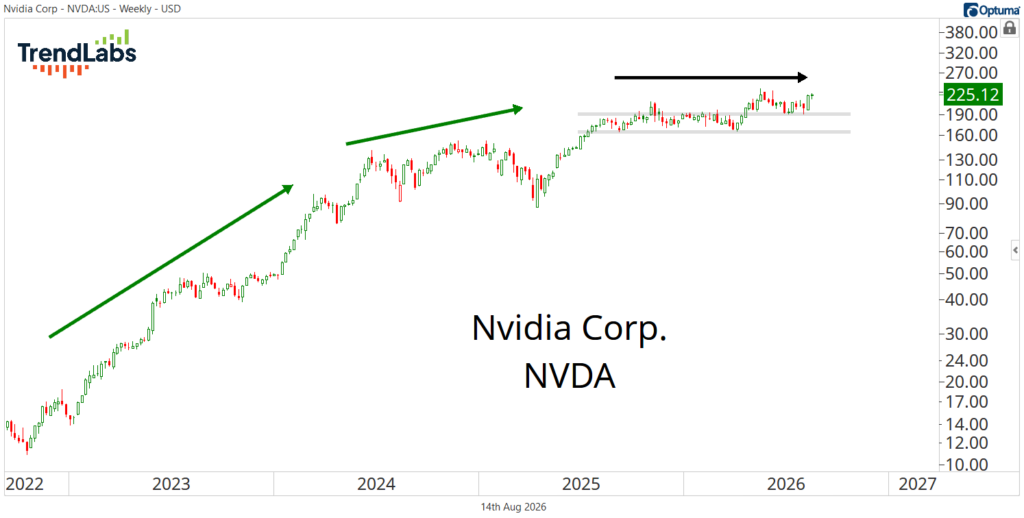
Now we get to see what happens next.
If this financing boom starts becoming a problem, the market will tell us. Credit will weaken. Semiconductor stocks will struggle.
And Nvidia will eventually stop acting like Nvidia.
But if Nvidia breaks out of this long range and starts making sustained new highs, that tells us something too.
Maybe everybody financing everybody eventually becomes an enormous credit problem.
Maybe it’s how we finance one of the biggest infrastructure booms in history.
I don’t know. Neither does the guy writing the “$1.8 trillion ticking time bomb” headline.
The market gets the final vote.
Price is the ultimate arbiter.
And until price starts telling us there’s a problem, I’m not going to invent one.
This Week in Everybody’s Wrong
On Monday, we took a look below the surface of the stock market.
More and more stocks are starting to beat the S&P 500.
What if that index isn’t where the best opportunities are anymore?
On Tuesday, we explained how “inflation” is an average of economic realities.
One of the biggest mistakes we make is pretending everybody experiences the same thing.
At any rate, are you only paying higher prices, or are you buying the assets benefiting from them?
On Wednesday, we were reminded, again, that everybody wants your money.
There’s a lot of it moving around right now.
As long as investors keep saying yes, companies are going to keep asking.
On Thursday, we talked about 3M (MMM).
Its products are everywhere, and the stock has more than doubled over the past three years.
Participation is expanding, and the market is getting stronger.
On Friday, we looked at some surveys and sentiment indicators.
One shows investors are so bullish that its indicator is almost maxed out, but another shows more bears than bulls, and consumers feel miserable.
On Saturday, Grant Hawkridge shared details of a personal journey that help illustrate how helpful “process” can be under any circumstances.
Indeed, we can use data to positive effect in real life, as well as in the stock market.
After all, the longer we can enjoy that up-and-to-the-right trend, the better.
Have a great Sunday.
We’ll see you Monday morning…
Stay sharp,
JC Parets, CMT
Founder, TrendLabs