
I told you they were going to keep coming back.
As long as investors keep handing companies money, why would they stop asking?
Intel (INTC) is the latest one.
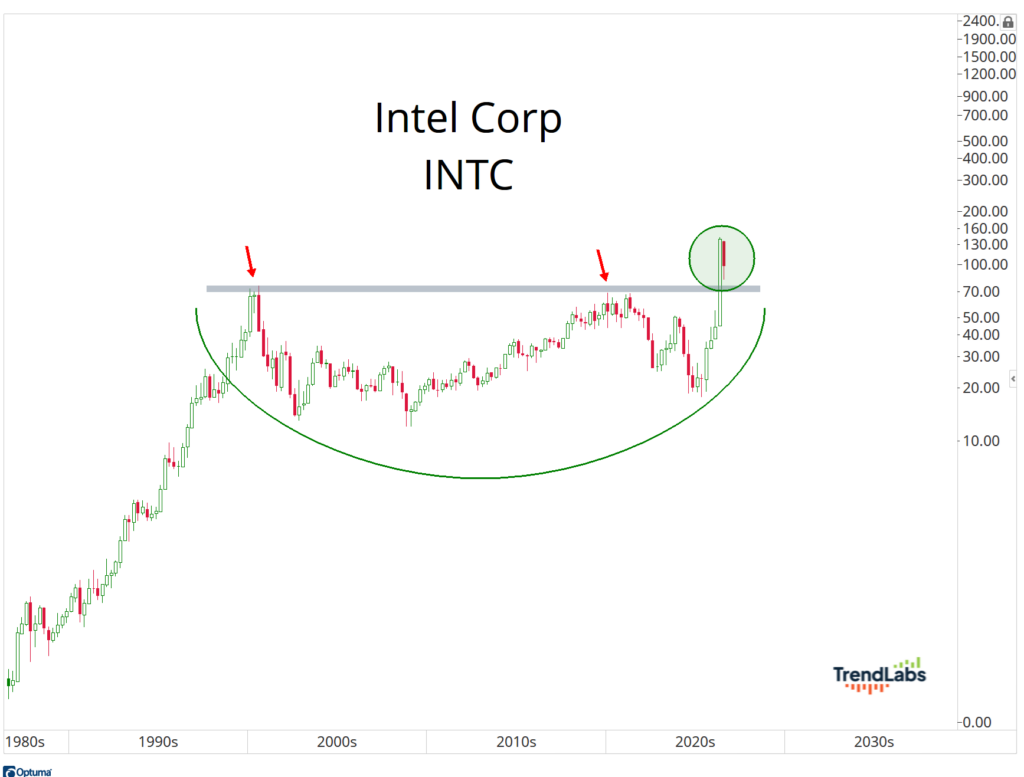
The company announced plans this week to sell $15 billion worth of stock.
And then management almost immediately upped its ask to $20 billion.
Intel says it plans to use the money for things that can include new factories, equipment and other parts of the business.
Fifteen billion dollars is a lot of money. Twenty billion is even more.
At least it used to feel that way.
Because after everything we’ve seen lately, even $20 billion almost sounds small.
That’s crazy.
We first covered this in June, writing Everybody Wants Your Money after Alphabet (GOOGL) announced plans to raise $80 billion as it spends heavily to build the future of AI.
Then, Nvidia (NVDA) raised $25 billion.
SpaceX (SPCX) raised $75 billion when it went public. A couple of weeks later, it came back looking for another $25 billion.
Then SK Hynix (SKHY) raised $26.5 billion.
We followed up with Everybody Wants Your Money… Again because the message from the market was becoming impossible to miss.
Companies want money. Investors have money.
And investors keep giving it to them.
Now, Intel wants another $15 billion $20 billion.
Remember When $15 Billion Was Huge?
Here’s how much things have changed.
Back in 2012, the U.S. government sold $20.7 billion worth of AIG stock.
At the time, it was the largest single common stock offering in U.S. history.
Think about that.
One of the biggest stock sales America had ever seen was $20.7 billion.
Intel is now getting $20 billion and it barely stands out.
Before it turned into Meta Platforms (META), Facebook’s entire IPO in 2012 raised $16 billion.
General Motors (GM) raised $15.8 billion when it returned to the stock market in 2010. Visa’s (V) giant IPO in 2008 raised $17.9 billion.
These were some of the biggest stock offerings anyone had ever seen.
Intel’s new deal is about the same size.
But now look at what we’re comparing it with.
Alphabet: $80 billion.
SpaceX: $75 billion.
SK Hynix: $26.5 billion.
Nvidia: $25 billion.
SpaceX again: another $25 billion.
And now Intel: $20 billion.
What used to be a once-in-a-generation amount of money is starting to look normal.
That’s the story.
They’re Asking Because You’re Saying Yes
I don’t think the important question is why all these companies want money.
Of course they want money.
If you could sell stock at high prices and investors were lined up to buy it, wouldn’t you?
The more interesting part is that investors keep saying yes.
That’s what we’ve been watching from the beginning.
Companies can only raise this much money when there are people willing to give it to them.
And right now there seems to be a lot of money looking for somewhere to go.
This tells us something important about the market.
Investors are willing to take risk.
They’re willing to fund new factories, data centers, chips and other huge projects that may take years to pay off.
They’re not hiding under their beds with their money. They’re putting it to work.
That’s not what scared investors usually do. And there’s another side to this.
The companies aren’t raising all this money just so they can put it in the bank and stare at it.
They’re going to spend it.
That’s where this story connects to everything else we’ve been talking about.
Building AI takes an incredible amount of real stuff. It takes electricity, chips, memory, factories, cooling systems and equipment.
Someone has to build all of it, and someone else gets paid to sell it.
These giant stock offerings are helping pay for that buildout.
So I don’t look at Intel raising $20 billion and think, “Wow, that’s a lot of money.”
I look at it and ask where that $20 billion goes next. That’s what matters to us as investors.
Money doesn’t disappear when Intel raises it. It moves.
It moves from investors to Intel. Then Intel spends it on factories, machines, workers, and equipment.
The companies receiving that money spend some of it, too.
That’s how money moves through an economy. Our job is to follow it.
And right now there’s a lot of it moving around.
I’ve said it before and I’ll say it again.
As long as investors keep saying yes, companies are going to keep asking.
The only thing that’s changed is what we consider a lot of money.
Stay sharp,
JC Parets, CMT
Founder, TrendLabs