If you know anything about me by now, it’s how I feel about the end of the month.
Not because of the calendar or some arbitrary reset.
Because markets move in trends. Not opinions, not narratives. Price trends.
And if you’re serious about actually making money in markets, your job is simple: Identify the direction of that trend and stay on the right side of it.
That’s it.
The problem is most people make it way harder than it needs to be. They zoom in too much. They get caught up in the noise. They argue with price.
I’d rather zoom out.
Because when you zoom out far enough, the truth gets obvious. Trends reveal themselves. The primary direction shows up whether you like it or not.
And in my experience, there is no better tool for doing that than monthly candlesticks.
That’s where the signal lives. That’s where the edge is.
Some charts, some good tunes (Tupac this month), and the beverage of your choice. Maybe a beer. Or water, or tea.
I went with a 2018 Ribera Del Duero, which is probably my favorite Spanish wine.
This is what I do at the end of every month, not because it’s fun, although it is.
Because this is the work that pays.
But What Are You Even Reviewing?
There’s no right or wrong way to do this. It really depends on what you’re into and what you’re trying to accomplish.
I’ll tell you how I do it, why it brings so much value to me, and then you can decide how to adapt this methodology to your own investing process.
For me, it’s a top-down approach.
I start by going one by one, reviewing the monthly candlestick charts for all the major stock market indexes.
That includes those in the U.S., like the S&P 500, the Russell 3000, the S&P MidCap 400, as well as all of those from overseas, like the German DAX, the Japanese Nikkei, the Brazilian Bovespa, and everything in between.
Then we take it down one level to the individual sectors, like technology, financials, energy, healthcare, etc.
After that, I’ll do the same thing for all the major industry groups, like regional banks, biotechnology, semiconductors, and many of the most important industries.
Then come the bellwethers. These are the stocks that dominate their industries, like Caterpillar (CAT) within industrials or JPMorgan (JPM) in financials.
Finally, I want to add a layer of intermarket review into my process. This is where forex, commodities, and interest rates fit into the whole system.
That’s the top-down macro approach to markets. And as I go one by one through each of the most important charts in the world, I’m doing my best to identify the direction of the primary trend.
Is it going up? Down? Sideways?
Not only does zooming out and using monthly candlestick charts help me identify the direction of primary trends. It truly doesn’t even give me much of a choice. It forces me to recognize the direction of primary trends.
And this alone, I kid you not, is easily the most valuable part of my entire process.
Those who know me are probably laughing because they’ve heard me talk about this, and likely seen me walk through it, over many, many years now.
The Market Answered for Us
A lot of you are already doing this. And the feedback has been awesome.
The people getting the most out of it aren’t copying my list. They’re building their own.
Same framework, different emphasis.
Maybe you care more about small-cap stocks. Maybe you live in the forex world. Maybe you’re all about individual stocks.
It doesn’t matter.
What matters is that you’re putting in the reps and forcing yourself to zoom out in the assets that mean the most to you.
Because when you do, the market starts to speak a lot more clearly.
Take emerging markets:
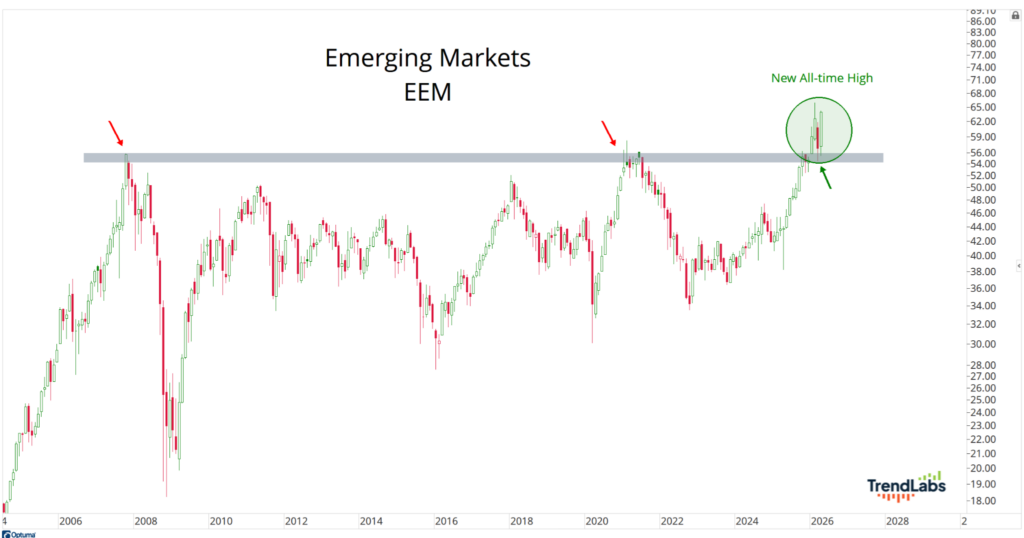
That’s not messy. That’s not confusing. That’s a massive base resolving higher.
Now look at micro caps:
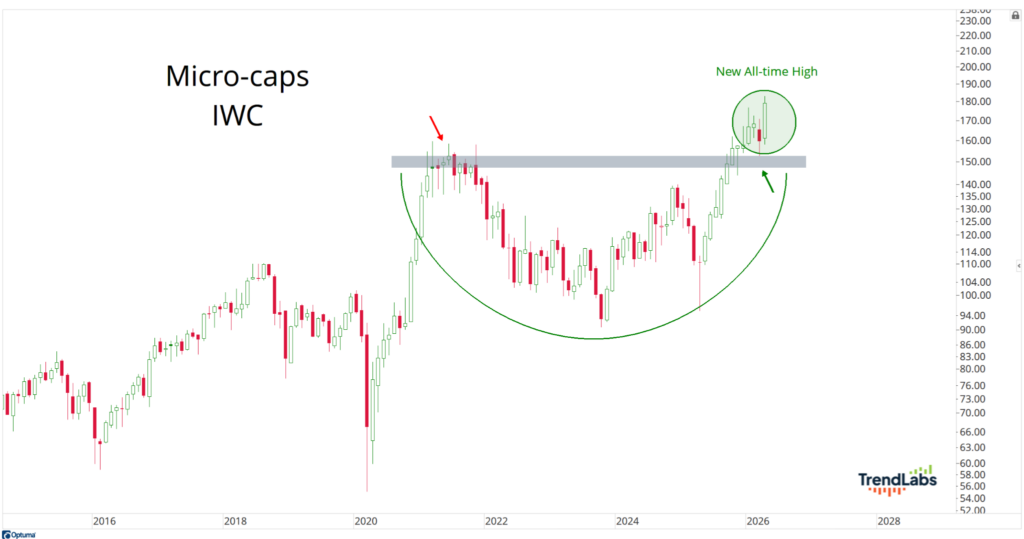
These are the smallest stocks in the market. They don’t have to participate. But they are.
And when you already have small caps and mid caps doing the same thing, this becomes confirmation, not coincidence.
Bitcoin is another one:
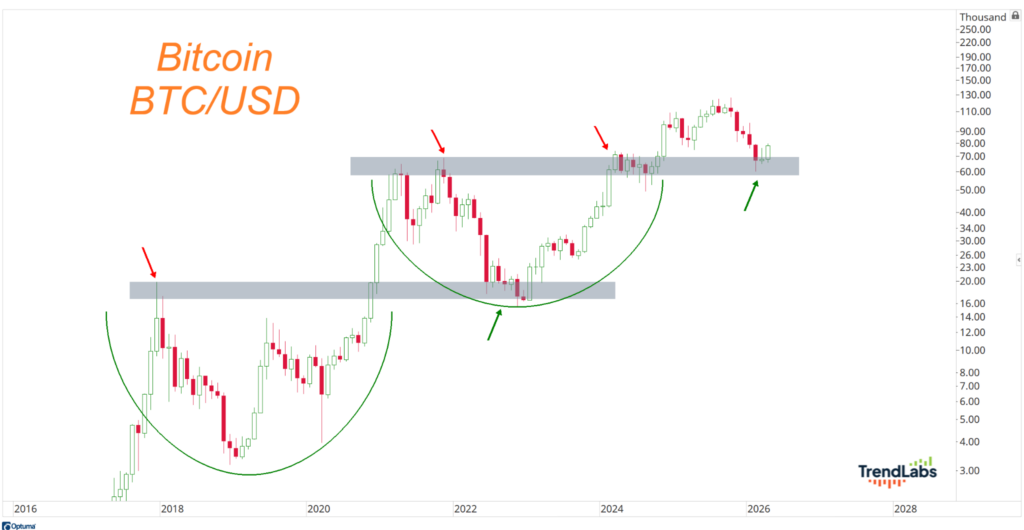
All that resistance for years is now support.
That’s what an uptrend looks like. That’s what they mean by a “stair-step higher.”
And then there’s the Nasdaq Composite:
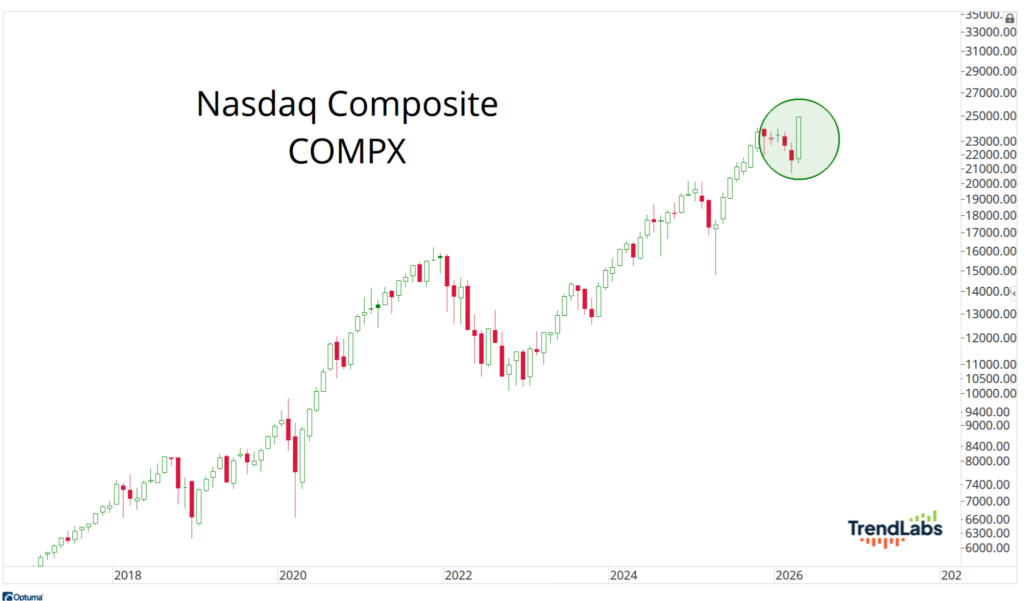
Up hard to new highs, again.
But this is the part that matters most: It’s not just one index, not just one group.
It’s everything.
The Dow Jones Industrial Average (DJIA), the Dow Jones Transportation Average (TRAN), the Nasdaq-100 (QQQ), the Nasdaq Next Gen 100 (QQQJ), the S&P MidCap 400 (MDY), the Russell 2000 (IWM), the Russell Micro Caps (IWC), and the S&P 500 Large Caps (SPX).
All of them are at new all-time monthly closing highs.
We know something about that. New highs are not a characteristic of downtrends.
So if our job is to identify the direction of the primary trend, the market just made it easy for us.
Down is not an option.
Stay sharp,
JC Parets, CMT
Founder, TrendLabs