
There’s a lot about the stock market that we don’t know, especially about the future.
But there are a few things we do know. And here at TrendLabs, those are the things we build around.
Prices trend. They don’t move randomly over time, no matter how many textbooks try to convince you otherwise. Trends exist because people exist.
Behavior isn’t random, so price isn’t either.
Volatility, on the other hand, doesn’t trend. It mean reverts.
In other words, from higher volatility tends to come lower volatility. And from extreme volatility compression comes volatility expansion.
But here’s the thing. Lately, volatility has been mean reverting much faster than it used to.
We just watched the Cboe Volatility Index (VIX) go from above 30 to below 20 in eight trading days. That’s not normal if you’re thinking in terms of decades past.
But it’s becoming very normal if you’re paying attention right now.
These violent resets in volatility are happening faster, and with more force than most investors are used to.
And if that’s the environment we’re in, then the way we interpret risk, opportunity, and momentum has to adjust with it.
Volatility Gets Erased Fast
My friend Jared Blikre over at Yahoo Finance ran a study on how long it takes the VIX to go from above 30 back down below 20, going all the way back to the early 1990s.
Quick refresher: The VIX measures the market’s expectation for volatility in the S&P 500 over the next 30 days, based on options pricing.
Higher VIX means bigger daily swings. Lower VIX means things are more calm.
They call it the “fear index” for a reason. It spikes when investors panic and rush to buy protection. And, like most emotional decisions in markets, that usually happens when it’s too late.
That rush for protection is what sets up the unwind. Once everyone who needs insurance already has it, there are no buyers left.
That’s when volatility collapses.
What Jared’s work shows is that this collapse is happening faster than it used to.
This time it took just eight trading days:
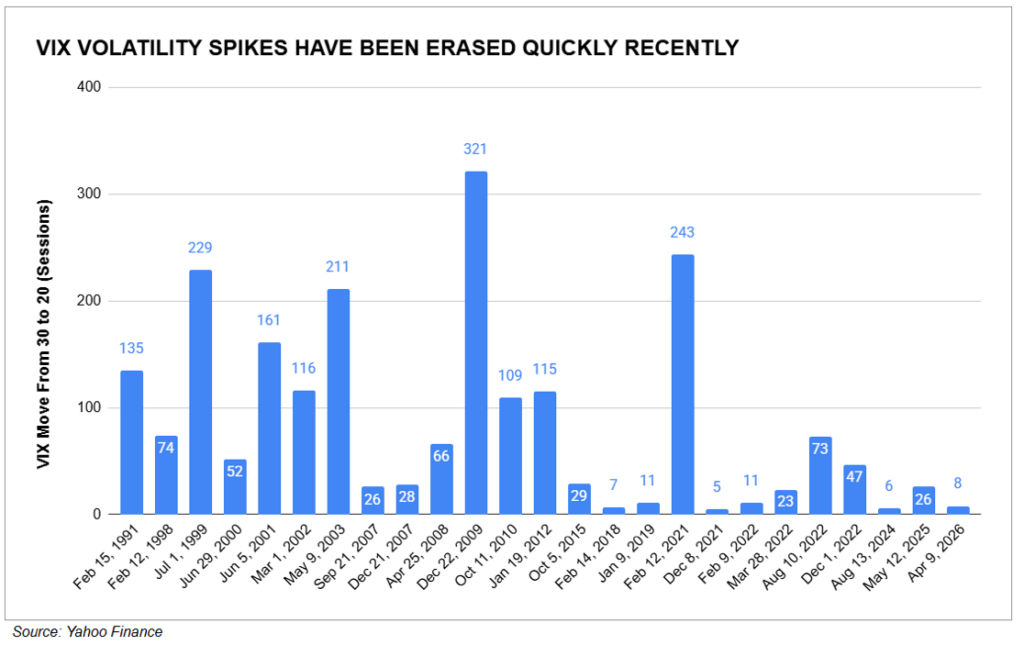
If you zoom out, this isn’t some one-off event.
Over the past decade, these moves from extreme fear back to relative calm are getting resolved in a matter of weeks, not months or quarters like we saw in the prior decades.
That shift in speed is the whole story.
Because if volatility is getting crushed this quickly, then the moves in stocks tied to that unwind aren’t just strong. They’re violent.
And that brings us to what that actually looks like in price.
What It “Means” for Investors
See what I did there? What it “means”? I got dad jokes.
But seriously, this part actually matters.
What we’re seeing isn’t random. This kind of violent mean reversion in volatility is becoming a feature, not a bug.
The move from panic back to calm is happening faster, and when that unwind comes, it hits with force.
A few weeks ago, we highlighted the fact that all the ingredients were set up for a historic rally. As it turns out, this last one gave us one of the strongest two-week runs we’ve ever seen.
Warren Pies of 3Fourteen Research found that the S&P 500 gained 9.8% in just 10 trading days.
That puts it in the 99.7th percentile of all 10-day returns in history:
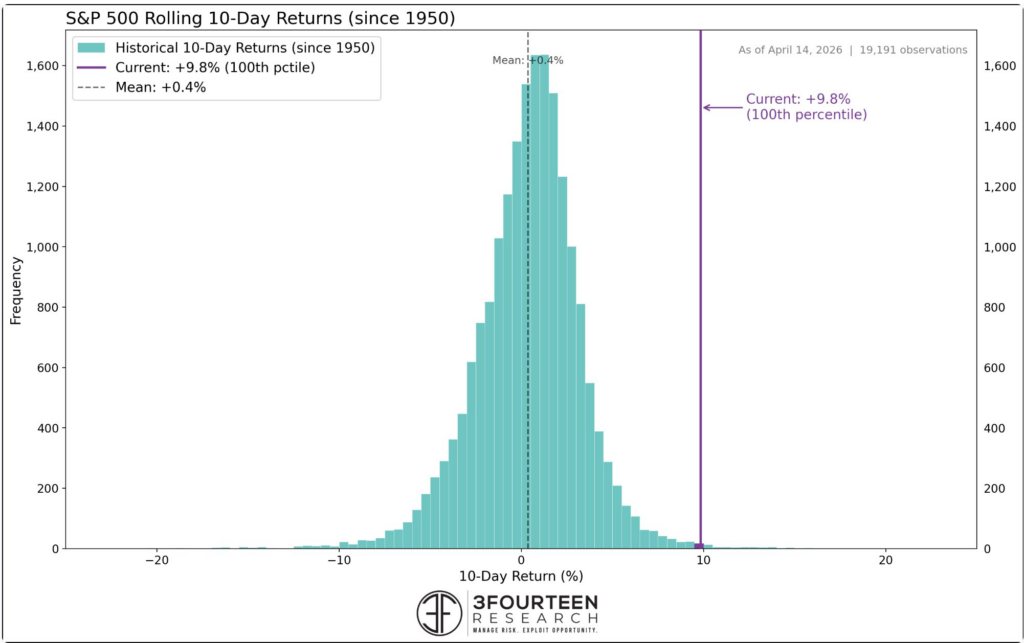
There are outliers, and then there’s this.
Since 1950, we’ve only seen about 20 instances where stocks rallied this much in such a short period of time. That’s it.
When you study what tends to happen next, the message is pretty clear.
These are momentum thrusts. We know from experience that these thrusts consistently show up early in new advances, not near the end of them.
In other words, they’re evidence that something is starting, not finishing.
Forward returns back that up.
Over the next 12 months, the S&P 500 has averaged close to 19% after these kinds of moves, with a strong track record across most timeframes.
So, yes, volatility is collapsing faster. But what really matters is what comes with it.
Explosive upside. Persistent trends. Markets that don’t wait around for everyone to get comfortable.
If you’re still thinking in terms of slow recoveries and gradual moves, you’re already behind.
This is a faster market now.
And it’s not slowing down for you.
Stay sharp,
JC Parets, CMT
Founder, TrendLabs