
People can say whatever they want.
But there’s a big difference between saying you’re worried and actually positioning your money like you’re worried.
I’d rather watch the money.
Especially when we’re talking about the biggest financial institutions in the world.
Because when markets really start to deteriorate, money moves.
Investors start protecting themselves. They move away from riskier parts of the market and toward safer ones.
And we can see it happening in real time.
That’s what this chart is about:
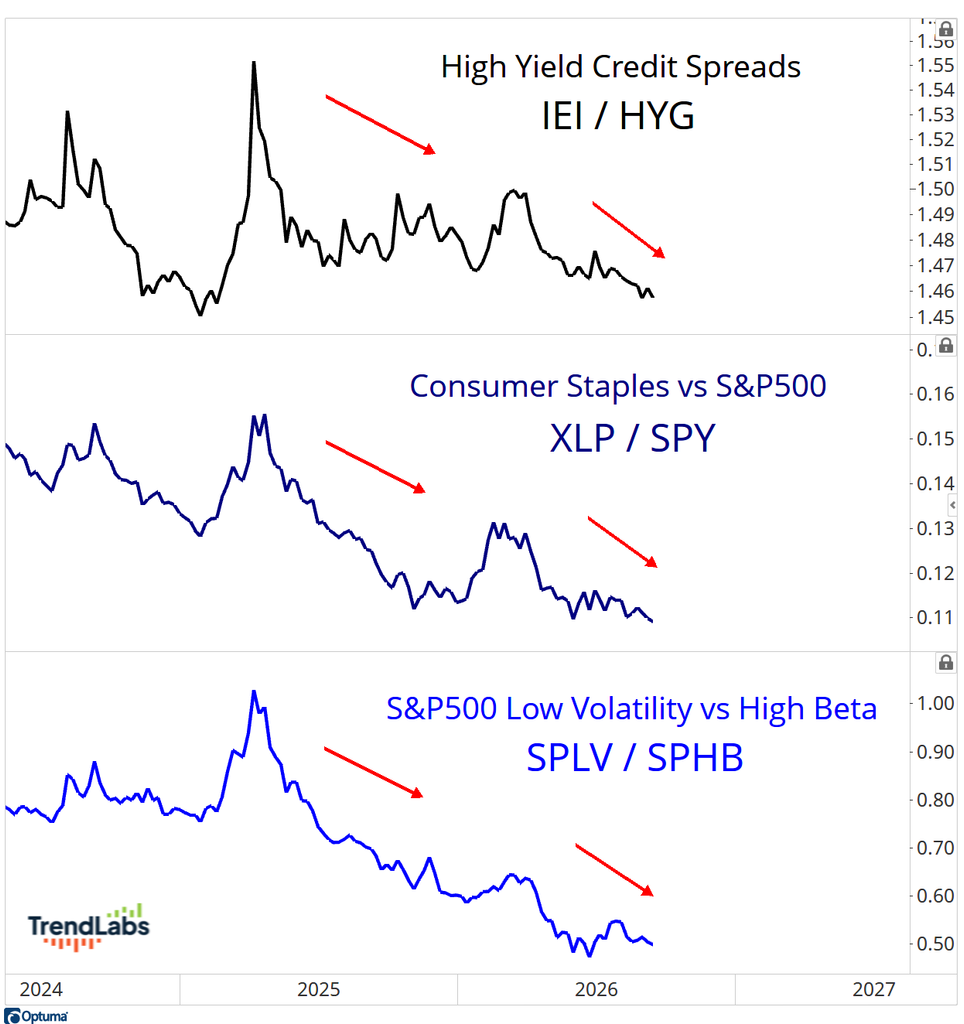
These are three completely different relationships.
But they’re all telling us something similar about the health of the market.
And right now, I don’t see much evidence of deterioration.
Follow the Money
Let’s start with the bond market.
We’ve talked about credit spreads before because this is one of the places I look when I want to know whether something is starting to break beneath the surface.
The idea is simple.
When investors become less willing to take risk, risky corporate bonds start struggling compared with the much safer U.S. Treasury bonds.
Our line starts going up.
That’s the bond market telling us conditions are getting worse.
But look at what it’s doing today.
It’s going down. And hitting new 52-week lows.
That means riskier bonds are outperforming Treasuries.
That’s NOT what deteriorating credit conditions look like.
And remember, we’re not asking anyone for their opinion here.
This is real money.
These are the largest institutions in the world deciding where to put billions and billions of dollars.
Right now, they’re not running away from credit risk.
They’re doing the opposite.
Nobody’s Hiding
Now look at consumer staples.
We’ve looked at consumer staples before because they’re one of the classic defensive areas of the stock market.
Think toothpaste, toilet paper, and groceries.
You’re buying those things whether the economy is booming or struggling.
So when markets get into trouble, investors have historically moved toward these types of companies.
But that’s not happening.
Consumer staples just finished the week at their lowest level in history relative to the S&P 500.
Lowest ever.
You want to talk about underperformance?
There it is.
And then there’s the third line.
This one compares Low Volatility stocks with High Beta stocks.
We’ve talked about high beta vs low volatility before, and it’s one of my favorite ways to see whether investors are playing offense or defense.
High-beta stocks are the ones that tend to move around more. They’re the faster horses. And roughly half of the High Beta Index is technology.
These are exactly the kinds of stocks we expect to see leading during healthy bull markets.
Low-volatility stocks are the opposite. They’re the slower, steadier companies investors often prefer when they want protection.
Look at which ones are winning.
High beta.
So credit isn’t showing stress. Consumer staples are getting destroyed relative to the market. And investors continue to favor high beta over low volatility.
That’s not a prediction about what happens tomorrow.
It’s evidence about what’s happening today!
There’s a big difference between protecting yourself because the market is actually deteriorating and protecting yourself because you’re afraid it might.
Right now, I’m just not seeing the evidence that investors are running for safety.
Could that change? Of course.
Markets can deteriorate. And when they do, these are exactly the kinds of relationships that should start telling us.
Until then, I’m going to keep following the money.
And right now, the money isn’t acting like anything is broken.
Stay sharp,
JC Parets, CMT
Founder, TrendLabs