You might be surprised how much of what we do in markets today was figured out before anyone had a computer.
Before Twitter. Before Bloomberg terminals. Before ETFs. Before Bitcoin.
Even before your grandparents were born.
More than 125 years ago, a guy named Charlie Dow was writing about how markets actually work.
And here’s the funny part: If you’ve ever looked at whether a stock is going up or down, you’ve used his work.
If you’ve ever zoomed out on a chart because the daily moves were getting too noisy, you’ve used his work.
If you’ve ever ignored a great story because the stock price was going the wrong way, you’ve used his work too.
You just probably didn’t call it “Dow Theory.”
Which brings me to my friends Jay Woods and Brian Shannon.
Jay is Executive Floor Governor at the New York Stock Exchange and someone I’ve known forever. He likes to tell people I’m the reason he got his CMT designation.
That’s only because I spent years busting his chops for not having it.
Eventually, I guess he got tired of hearing from me and went out and got the damn thing. Now he’s really active in the CMT community and does a ton for the New York City chapter.
Anyway, Jay was looking at something interesting in the market this week.
The Dow Jones Industrial Average has been making new highs.
But the Dow Jones Transportation Average hasn’t been keeping up.
Here’s my version of what he was referring to:
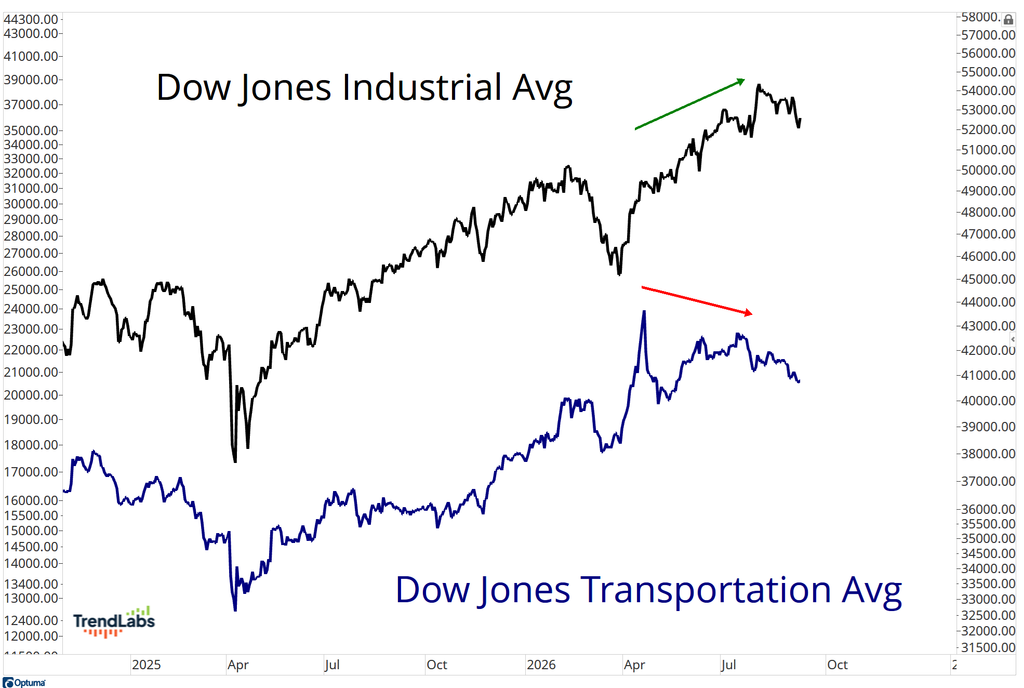
Jay posted about it and tagged me, asking what the “Dow Theory crew” thought.
Then Brian Shannon jumped in.
His response was basically: nice theory, never helped or hurt me make money.
Now, these are two guys I have tremendous respect for. And Brian in particular has been a mentor to me for more than 20 years.
Back in 2005, I used to run home from work to watch Brian Shannon’s YouTube videos. True story.
When his first book, “Technical Analysis Using Multiple Timeframes,” came out, I was about to fly to Italy and wanted something to read on the plane.
I reached out to Brian, and he overnighted me a copy so I’d have it for the flight. I read the whole thing.
We’ve since become good friends. We’ve hung out a million times. We’ve even gone skiing together.
He’s an annoyingly good skier, by the way. It pisses me off.
So when Brian says the Industrials and Transports confirming each other has never helped him make money, I get what he means.
Because that’s only one small piece of something much bigger.
Dow Theory Is Not Just Two Dow Averages
Charles Dow created what became the Dow Jones Industrial Average and the Dow Jones Transportation Average.
The basic idea was that the companies producing the goods and the companies moving those goods around the country should generally be telling the same story.
If the Industrials are making new highs, you would like to see the Transports participating too.
When they’re not, you pay attention.
It doesn’t mean you sell everything. It doesn’t mean a crash is coming. It’s simply another piece of information about the health of the market.
And we’ve seen some pretty famous examples.
In January 2000, the Dow Industrials made a new all-time high while the Transports were already down substantially from their highs.
Two months later, the Nasdaq peaked.
That certainly got your attention.
But here’s the thing.
Of all the lessons Charles Dow gave us, the relationship between the Industrials and Transports probably wouldn’t even make my top five.
How often does it really matter?
A couple of times a decade? Maybe three?
I’m not sitting around every morning staring at the Transports waiting for them to tell me whether I should buy a stock.
The bigger ideas behind Dow Theory are much more useful.
Brian is famous for saying, “Only price pays.”
It’s one of my favorite sayings in markets.
You can have the greatest story in the world. You can know everything about the company, the economy, interest rates and whatever Jerome Powell had for breakfast.
But ultimately, if you’re an investor, your account goes up or down because of what happens to price.
One of Dow’s most important ideas was that the market discounts everything.
That’s a fancy way of saying that all the information, opinions, expectations, fear and greed eventually show up in the price.
Charlie Dow gave us the idea.
Brian Shannon gave us the bumper sticker.
And, frankly, Brian might explain it better.
Then there’s the really obvious one.
Brian literally wrote the book “Technical Analysis Using Multiple Timeframes.”
Multiple timeframes are one of the oldest ideas in technical analysis.
Dow explained that markets have different trends happening at the same time.
There’s the big trend that can last for years. Inside that are shorter moves that can last weeks or months. And inside those are all the little day-to-day moves that make everyone crazy.
Think about looking at a map.
You can zoom way out and see that you’re driving from Pennsylvania to Florida. Then you can zoom in and see which highway you’re taking. Then you can zoom all the way in to figure out which exit you need.
Same trip, different views.
That’s essentially what Dow was describing more than a century ago.
Brian obviously uses much more modern tools. He might look at a daily chart, a 65-minute chart and then zoom in even further to figure out exactly where he wants to buy.
Charlie Dow wasn’t sitting around in 1900 staring at a 65-minute candlestick chart.
But the principle is the same.
Understand the bigger trend. Then zoom in to make better decisions.
Brian built an entire trading career around it.
There are other ideas that have survived too.
Higher highs and higher lows tell us buyers are in control. Lower highs and lower lows tell us sellers are in control. A trend should be respected until the evidence tells us that trend has changed.
Closing prices matter because what happens during the day can just be noise.
These ideas are more than a century old.
We just have much better tools for applying them today.
The Stuff That Survives
And that’s really why I loved this little exchange with Jay and Brian.
Because there’s a much bigger lesson here than whether the Dow Transports are confirming the Dow Industrials this week.
Charles Dow was writing about markets in the late 1800s.
Think about that.
There were no computers. No financial television. No ETFs. No apps on your phone. You couldn’t sit on your couch on Sunday afternoon and check where Bitcoin was trading.
The world Dow was analyzing barely resembles ours.
But people still resemble people.
We still get greedy when prices are going up. We still get scared when prices are falling.
We still chase things after they’ve already rallied and panic after they’ve already crashed.
And when millions of people make those decisions at the same time, they show up in price.
That’s why so much of this stuff survives 125 years later.
There are bull markets and bear markets. There are big trends and smaller trends inside them.
Price reflects what buyers and sellers collectively know and believe.
And when a trend is going in one direction, fighting it simply because you think it should turn can get very expensive.
None of this means every idea Charles Dow ever had needs to be treated like scripture.
I certainly don’t.
Markets change. Technology changes. The tools we use should change too.
That’s actually one of the things I’ve always appreciated about Brian’s work.
He’s spent decades taking these basic ideas about price, trends, and timeframes and figuring out better ways to apply them to modern markets.
Multiple timeframes, moving averages, market structure, anchored VWAP.
And, of course, only price pays.
I learned a lot from Brian when I was running home to watch those videos 20 years ago. I still learn from him today.
Jay, too.
That’s one of my favorite things about markets. You can spend your entire career doing this and still learn something from the people around you.
Charles Dow has been dead for more than 120 years, and we’re still debating his ideas on Twitter.
That tells you something.
The tools keep getting better. The markets keep getting faster.
But human beings?
We haven’t changed nearly as much.
This Week in Everybody’s Wrong
On Monday, we looked into the future of labor.
What happens when one of the things coming out of the factory becomes a factory worker?
What will one billion humanoids look like?
On Tuesday, we exposed phantom stats hiding in plain sight.
Never stop at the headline number.
That’s because you don’t own “the market.” You own the things in your portfolio.
On Wednesday, we wondered whether everybody’s right about AI being a bubble.
Here’s the thing: It’s not the technology; it’s the economics.
And what if we’re nowhere near the end?
On Thursday, we warned you that Wall Street’s on to something new, and suddenly everybody’s freaking out again.
I knew this was coming, but I thought we had more time.
On Friday, we talked about something you might’ve heard recently.
“Sell Rosh Hashanah,” the old Wall Street saying goes. “Buy Yom Kippur.”
Here’s where that comes from and, more importantly, what it means for markets.
On Saturday, Grant Hawkridge broke down what it means when the S&P 500 breaks a moving average.
We always listen to Grant when he’s going deep with numbers.
That’s especially important now when we think about what comes next for stocks.
Have a great Sunday.
We’ll see you Monday morning…
Stay sharp,
JC Parets, CMT
Founder, TrendLabs