Founder’s Note: Jason Perz is a big part of everything we do around here. You know that if you keep up with his consistently great Saturday reads.
As you can imagine, Jason’s got a lot going on. And there are some things he’s up to that need more attention than others right now.
So he’s going to take a hiatus from TrendLabs. But he’ll never be gone.
And he’s leaving us with another invaluable piece about how to manage your risk and maximize your rewards, in the stock market and everywhere else… – JC
By Jason Perz
Everybody wants the result.
Very few people fall in love with the work required to get there.
Trading makes this painfully obvious.
Everybody wants the outlier, the 10x trade, the year that changes their life.
They want to catch the commodity supercycle, the next Bitcoin, the next great bull market.
But almost nobody wants the thousands of hours that come before it.
The bad trades. The journals. The mistakes.
The years of feeling like you don’t know what the hell you’re doing.
The boredom of waiting. The humility of being wrong.
The discipline of doing absolutely nothing when there is nothing to do.
I’ve spent a huge part of my life trying to master trading.
And somewhere along the way, I realized something I wasn’t expecting:
Trading was actually teaching me how to master myself.
Not perfectly. Not even close.
But that’s probably the point.
Because mastery isn’t a destination you finally arrive at.
There isn’t some magical day when you wake up and suddenly understand markets, stop making mistakes and become immune to fear, greed, ego, and stupidity.
Mastery is the process of getting a little better at recognizing those things in yourself.
Then building a process that keeps them from destroying you.
Growing up, I thought I was a stupid kid.
I was dyslexic. I didn’t learn the way everyone else seemed to learn.
School had a way of making intelligence feel like this narrow thing, and if your brain didn’t fit inside the box, you assumed something was wrong with you.
It took me years to understand that I wasn’t incapable of learning.
I had to learn how I learn.
That might have been my first lesson in mastery.
Stop trying to become everyone else.
Take what works. Throw away what doesn’t.
Build something around who you actually are.
BMX taught me another part of it.
You can stand at the top of a ramp thinking about something forever. Eventually you have to point the bike at it and fucking go.
Sometimes you land it. Sometimes you eat shit.
Then you figure out what happened and try again.
Life wasn’t much different.
Addiction taught me that you don’t rebuild your entire life tomorrow. You do today’s work today.
Then you wake up and do it again.
Eventually, trading pulled all of these lessons together.
The Thesis Isn’t the Trade
There‘s a reason I keep coming back to this chart:
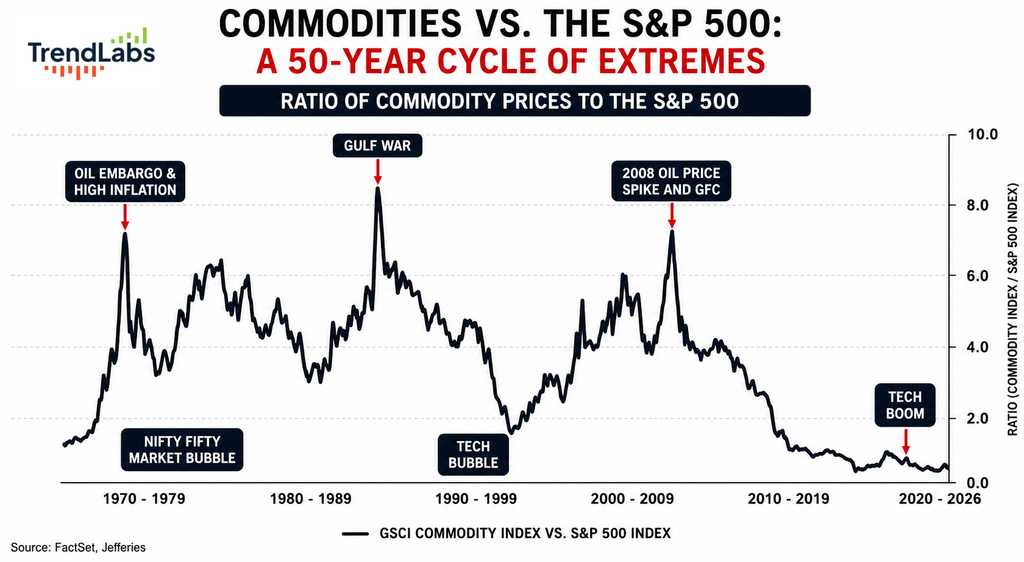
Commodities are still extremely cheap relative to stocks.
I’ve believed for years that we’re living through a long-term commodity cycle. I still believe that today.
Energy, metals, agriculture, and the companies producing these things continue to tell me this cycle is alive and well.
But believing that and making money from it are two completely different things.
That distinction took me a long time to understand.
Having the right idea and trading the idea correctly are two completely different things.
You could have understood the commodity thesis years ago and still lost your ass trading it.
You could have bought oil at the wrong time. Leveraged copper until volatility forced you out.
Sold gold too early. Held a loser because the “long-term thesis” was still intact.
Or gotten so emotionally attached to the idea of a commodity supercycle that you stopped listening when price told you something different.
That’s trading.
The thesis isn’t the trade.
You can be right and still lose.
Being right about the destination doesn’t mean you know the path we’re going to take to get there.
And that’s probably one of the most important things the market has ever taught me.
I don’t need to know exactly what happens next.
I need to know what I’m going to do when I’m wrong.
I need to know how much I’m willing to lose.
I need to know how large the position should be.
And, when I’m right, I need to have the patience to shut up and let the trade work.
Somewhere along this journey I stopped trying to become the person with the best predictions.
I started trying to become the person best equipped to survive the journey.
When I look backward, that’s basically the story of my entire life.
I rarely took the straight path.
Not through school, not through BMX, not through the dark times, and not through trading.
I got lost. I f***ed things up. I learned. I adjusted. I kept going.
Maybe mastery isn’t finding the straight path.
Maybe mastery is becoming incredibly good at adjusting when the path changes.
Build Your Own Template
Over the years I’ve studied great traders, asked an annoying number of questions, read everything I could get my hands on, and kept journals of my own successes and failures.
I’ve built systems. I’ve abandoned systems.
I’ve made money. I’ve lost money.
I’ve had trades that worked better than I ever imagined, and I’ve had trades where I wondered what the hell I was thinking.
Eventually, I realized there’s no perfect template for becoming a great trader.
We’re all too different.
But I do think there are some things we can steal from each other.
First, figure out how you learn.
Steal ideas from everyone. Read the books. Talk to traders. Study the greats. But eventually you have to build something that fits your own brain.
Then become obsessed with your mistakes instead of embarrassed by them.
Journal them. Study them.
Ask yourself why you did what you did.
Your worst trades probably contain more information about becoming a better trader than your best trades ever will.
Then build bumpers around yourself.
Position sizing. Stops. Systems. Rules. Routines.
Whatever keeps the worst version of you from destroying everything the best version of you built.
That’s what risk management really is.
It isn’t just protecting your portfolio from the market.
Sometimes it’s protecting your portfolio from you.
And then learn to do less.
This might be the hardest one.
Doing Less
The world wants traders to believe mastery looks like constant activity: more screens, more trades, more indicators, more predictions, more opinions.
But the longer I do this, the more mastery seems to look like the opposite.
You become increasingly selective about where you spend your capital, your attention, and your emotional energy.
You stop needing to have an opinion on everything. You stop needing to trade every day.
You stop caring whether everyone knows you were right. You become comfortable saying, “I don’t know.”
You become comfortable doing nothing.
And, most importantly, you stop tinkering with good trades simply because you’re bored.
One of the strangest things about trading is that the better you become, the less exciting parts of it should probably look.
Wait.
Wait.
Wait.
Take the trade. Define the risk.
Then wait some more.
We all want to believe mastery gives us more control.
Trading taught me the opposite.
Mastery is understanding how little control you actually have and building a process around that reality.
Care About the Craft
There’s so much bullshit surrounding trading now.
Followers. Engagement.
Calling the next crash. Posting winning trades.
Being the smartest person on Twitter.
Selling people some magical system that supposedly spits out a great trade every morning at 9:31.
None of that is trading.
The trade is trading.
The process matters. The risk matters.
The hours spent studying when nobody is watching matter. The journal entry after a horrible trade matters.
Admitting you’re wrong matters. Sitting on your hands when you’re right matters.
And staying curious matters.
Maybe more than anything.
Because the second you think you’ve figured this game out, the market has a funny way of reminding you that you haven’t.
That’s why I want to remain a student forever.
I still believe commodities have a long way to go.
The relative valuation is still extraordinary. The long term cycle looks alive and well to me.
But I don’t know exactly how we’ll get there.
Maybe oil leads. Maybe gold. Maybe agriculture. Maybe copper.
Maybe there are brutal corrections along the way that make everyone question whether the cycle is over.
I don’t know.
And I don’t need to.
That’s the difference between having a thesis and having a process.
I’ll take the process every time.
I’ve spent a lot of my life trying to prove things.
That I wasn’t stupid. That I could survive. That I could make it.
That I belonged here.
I don’t feel much need to prove those things anymore.
I just want to get better.
Better at trading. Better at thinking. Better at managing risk.
Better at recognizing when I’m wrong. Better at sitting still when I’m right.
Maybe that’s mastery.
Not arriving somewhere. Not finally figuring it all out. Not having more answers than everyone else.
Just caring enough about something that you’re willing to keep doing the work long after everyone else gets distracted by the bullshit.
I’ve given a huge part of my life to trading.
And, somehow, trading gave me my life back.
The work was the point all along.
Save the bees,
Jason Perz
Senior Analyst, TrendLabs