
Remember when legalized marijuana was supposed to be the next great American growth story?
A brand new industry that was supposed to mint a whole new class of millionaires.
At least that’s what everyone said. And that right there is the problem.
Because narratives don’t pay. Price does.
Cannabis stocks have spent the better part of a decade reminding investors of that, whether they want to hear it or not.
Meanwhile, today is basically a holiday for the whole thing. April 20. “Four-twenty,” to use the proper nomenclature.
Think of it as the Super Bowl for pot smokers, their version of Black Friday or the Fourth of July.
There’s no shortage of celebration.
There’s just been a massive shortage of returns.
So today feels like a good time to revisit one of the great narrative traps of the past cycle.
Not because it’s unique, but because it’s exactly how this game works.
A great story shows up, everyone believes it, the media packages it beautifully, new products get launched, your friends start texting you about it, and the whole time price is already telling you something completely different.
That’s what we’re going to walk through.
From the magazine covers to the ETFs, from the can’t miss opportunity to the reality that followed.
Because if you understand what happened here, you’re going to recognize it the next time it shows up.
Trust me, it’ll show up again.
It always does.
420 to Zero
Today is the day. Happy 420, everybody!
The whole thing started out in California in the early 1970s (of course it did) when a bunch of high school kids came up with a code for when it was time to go smoke.
Back then it was underground, illegal, and, for the people moving product, pretty lucrative.
Fast forward a few decades, and suddenly this was supposed to be one of the biggest legal industries in America.
That’s when the narrative really took off.
By 2018, this wasn’t some fringe idea anymore. This was front-page, mainstream, everybody’s-talking-about-it type of stuff. The kind of attention that doesn’t show up early.
It shows up once the story is already fully baked and ready to be sold:
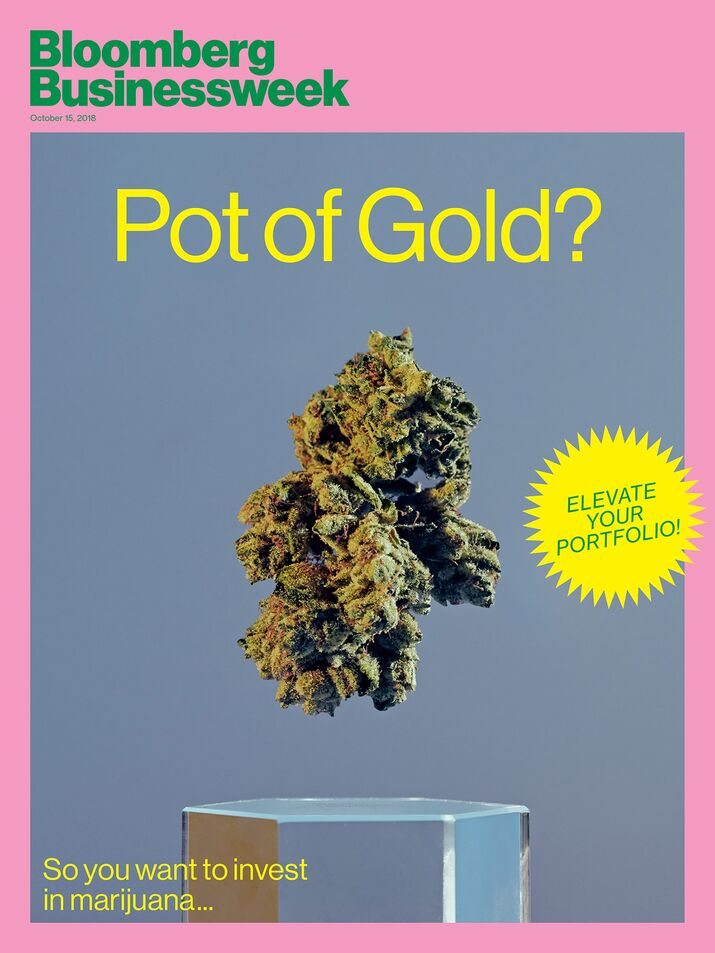
You remember this one… “Pot of Gold”… “Elevate Your Portfolio”… they really went for it.
To be fair, it was creative. I’ll give them that. But markets don’t care about creativity.
They care about price:
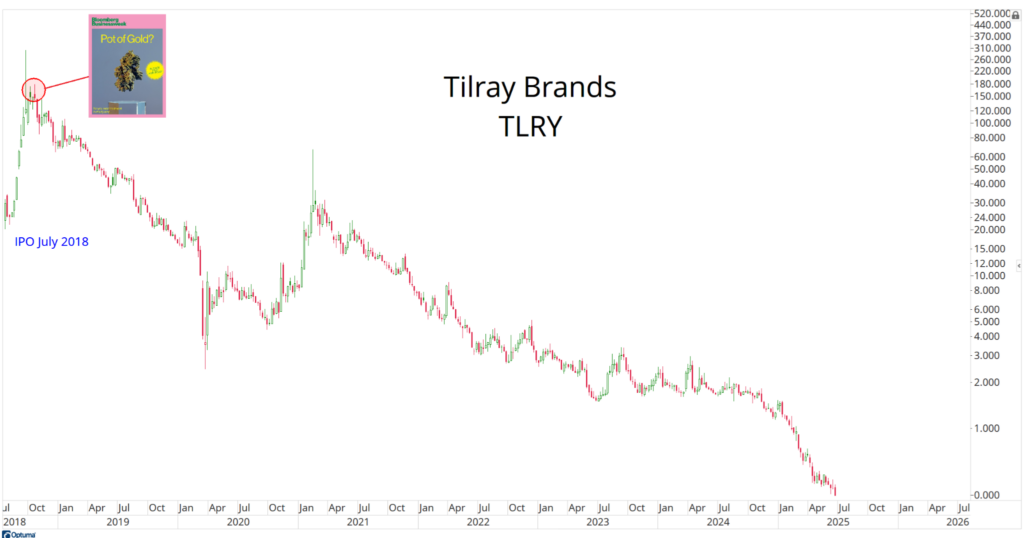
This was the “blue chip” of the space, down more than 95% since its IPO.
That’s not a drawdown. That’s a wipeout.
And it’s a great reminder that when magazines start trying to “help” you invest in something, you should at least pause and ask why now.
We pay very close attention to these covers. Not because they’re right, but because of when they tend to show up. They usually mark moments when everyone is already on the same side of the boat.
The more clever the cover, the more I pay attention.
We saw it earlier this year with crude oil. We’ve seen it over and over again across cycles.
This one was no different.
But the bigger lesson here isn’t just about magazine covers. It’s about how powerful a good story can be.
I had college buddies texting me asking which pot stocks to buy. Everybody “knew” this was going to be huge. It felt obvious.
And that’s usually when it’s the most dangerous.
Because while everyone was focused on the opportunity, price was already rolling over.
And today you can walk around New York City and smell the demand everywhere.
But the market already told us years ago there was never going to be demand for the stocks.
That’s the part most people missed.
And it sets up the real punchline here.
Then Came the ETFs
If picking individual stocks felt too risky, don’t worry, Wall Street had a solution for you.
You could just buy the whole thing.
Diversified exposure. Own the theme. Put it away and let the “inevitable” growth of the industry do the work.
That was the pitch.
Here’s how those ETFs worked out:
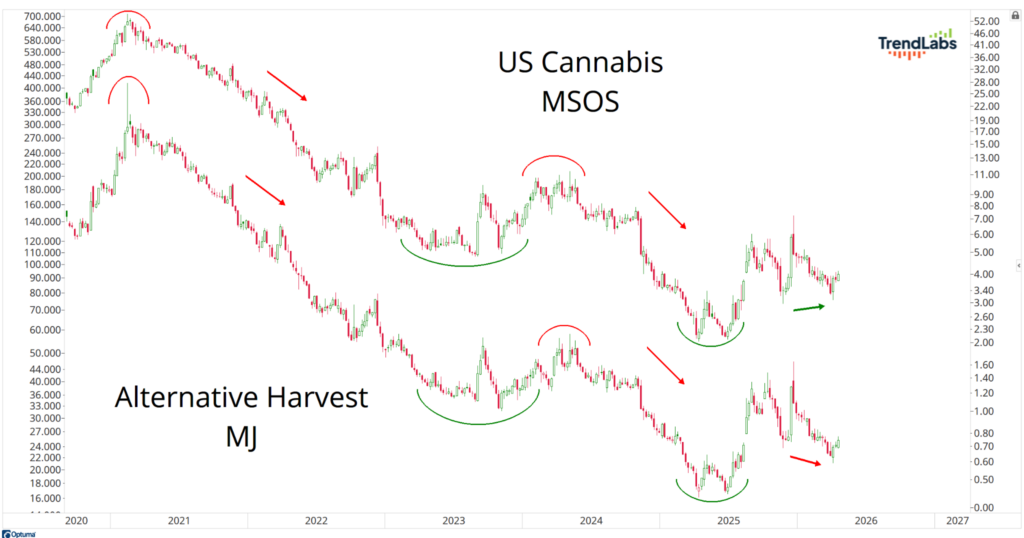
Charts that move from the upper left to the lower right are what we call “downtrends.”
We don’t buy those.
These peaked in early 2021, right alongside Chinese Internet stocks, Biotech, and all the high growth favorites tied to the ARKK crowd.
The difference is that most of those groups eventually repaired themselves. Biotech, for example, has been a huge winner for us more recently.
There’s a time and a place for everything.
But not everything deserves a second act.
Some stories sound great. They just never translate into sustained demand for the stocks.
Meanwhile, demand for the actual product is impossible to miss. You smell it everywhere, not just downtown or in the old spots. Midtown, side streets, right out in the open. Dispensaries on every block.
The demand is real.
Just not in the stocks.
And that’s the part people struggle with.
They think strong demand for a product has to mean strong demand for the equities tied to it.
It doesn’t. It never did here.
They tell you smoking pot is bad for you. Maybe.
But owning pot stocks? That’s been way more dangerous.
And the irony is perfect.
The one thing that was supposed to get high for investors…
Never got off the ground.
Stay sharp,
JC Parets, CMT
Founder, TrendLabs