
People are angry. That’s good.
Because if you’re actually paying attention, this is exactly what you want to see.
Everyone keeps trying to compare this environment to 1999. I get it. It’s an easy reference point. Huge companies, brand new technology, stocks at all-time highs. Sounds familiar.
But that’s where the similarities end.
Back in March of 2000, right at the peak of the dot-com bubble, consumer sentiment was at the highest level ever recorded. People felt great. They were confident. Optimistic. Fully bought in.
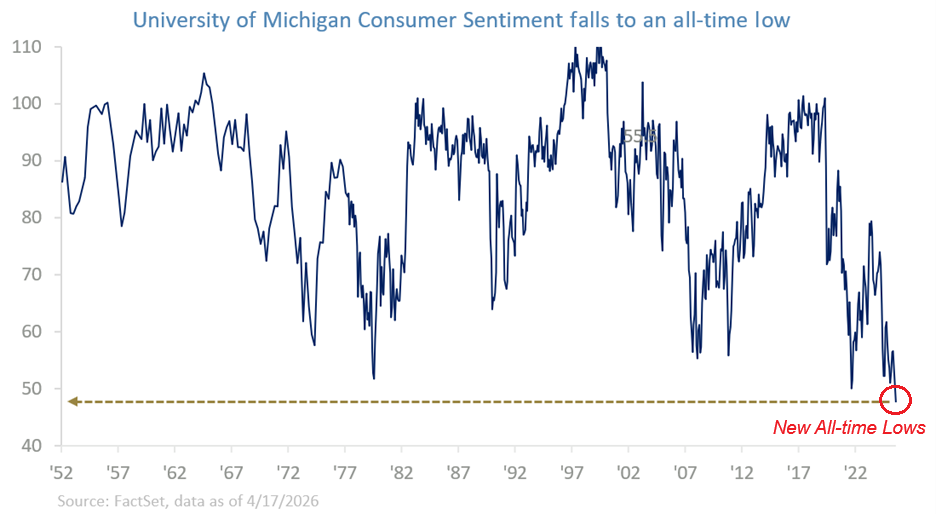
Today, it’s the complete opposite. Sentiment just hit the lowest level in history.
So while the headlines try to recycle the same old comparison, both the price behavior and the human behavior underneath it are telling a different story.
This isn’t 1999. It’s the mirror image.
And when you start to quantify just how pessimistic people really are, it becomes a lot easier to understand why this market keeps going higher.
The Pessimism Quantified
There isn’t one perfect way to measure sentiment.
Anyone who tells you there is, is lying to you.
What we can do, and what we do at TrendLabs every day, is stack the evidence. Different data sets with different angles. Same questions.
What are people saying? What are investors actually doing? And how are they positioned?
When you line it all up, the message is pretty consistent.
The American Association of Individual Investors has now logged nine straight weeks with more bears than bulls.
Median short interest across Russell 3000 stocks is sitting at the highest level in 15 years.
Investors are coming off some of their most bearish positioning in years.
And then you have the magazine covers. The Economist, Newsweek, and Barron’s are all leaning in the same direction.
Fear sells, and right now it’s everywhere.
But even with all of that, nothing comes close to this.
The University of Michigan Consumer Sentiment Index just broke down to new all-time lows:
Let that sink in.
This survey goes back 75 years. And as Raymond James Financial is showing in this chart, today represents the most pessimistic reading ever recorded.
At the exact same time that stocks are ripping to new highs.
The S&P 500. Nasdaq 100. Russell 2000 small caps. The NYSE Advance-Decline Line. All confirming strength with new all-time highs of their own.
This is not a narrow rally being dragged higher by a handful of mega caps. This is broad participation, both domestically and globally, with the All Country World Index ex-U.S. also at new all-time highs.
So prices are going up. And sentiment is collapsing.
If you’re an investor looking to own stocks, that’s not a problem.
That’s the setup.
Because the real risk isn’t when people are angry and underexposed. The risk is when they’re all in, feeling great, and convinced it only goes up (like in 1999).
That’s not today.
Today is the opposite.
And that’s where the opportunity comes from.
“It’s Just a Stupid Sentiment Survey”
I know. I’ve been hearing it for years. “It’s only a few hundred people, JC.”
“It’s just Michigan, it doesn’t represent anything.” “These magazine covers don’t matter.”
I get it. I’ve heard every version of the argument.
And yet, here we are. These same indicators, time after time, continue to point us in the right direction.
Not because any one of them is perfect. None of them are.
But because together, they tell a story.
And right now, the story is clear.
Prices are going higher.
Sentiment is going lower.
That’s the whole game.
It’s not about blindly buying stocks because people are miserable. Although it certainly doesn’t hurt.
It’s about recognizing when positioning and reality are out of sync.
That’s what creates opportunity.
That’s what this entire process is built on.
There’s a reason this letter is called Everybody’s Wrong.
After a few decades of doing this, you realize that there’s always a major disconnect somewhere. There’s always a place where the crowd is leaning too far in one direction.
Today, that direction is pessimism.
Back in 1999, people felt incredible while stocks were making new highs. Take a look at the chart above.
Today, people feel terrible while stocks are making new all-time highs.
Those are not the same environments. They lead to very different outcomes.
Now, is this great for people who don’t own stocks? For people betting against them? For people waiting for a better entry that never comes?
Of course not. But that’s not your problem.
Your job is not to make everyone else comfortable. Your job as an investor is only to make money.
Can you still have empathy for them? Sure. You should. But empathy doesn’t belong in your portfolio construction.
This is a results business.
And when I see stocks around the world breaking out to new highs while sentiment collapses to new lows, I see a market that is climbing the proverbial “Wall of Worry.”
That’s where the best trends live.
The move already started.
And if this is how people feel now, imagine how much higher prices have to go before they finally come around.
Not when it’s uncomfortable. Not when it’s early.
When it’s obvious. That’s when they show up.
And that’s when we’ll be selling them all our shares.
This Week in Everybody’s Wrong
On Monday, we broke down the biggest story so far in 2026 for the stock market.
It’s not about what’s happening at the index level.
The real story is what’s happening down below.
The narrative around technology is falling apart.
On Tuesday, we talked about what that means for the market.
Here’s what happens when the anchor stops dragging.
On Wednesday, we looked at the current landscape through the eyes of a child.
One of my twin three-year-old boys thinks he’s the Incredible Hulk.
And that’s actually a great way to describe what we’re seeing out there.
On Thursday, we explained how volatility works.
From higher volatility comes lower volatility, and from volatility compression comes volatility expansion.
The thing is, that’s been happening a lot faster lately.
On Friday, we went deep on “nature,” “nurture,” and the process of you being you.
The fact is, what works for me might not work for you.
And the best way to invest is to be who you are.
On Saturday, Grant Hawkridge explored one of the main tendencies that keeps us from being our best.
Understanding how “confirmation bias” can blind you is one thing.
Seeing it play out in real time is something else entirely.
Have a great Sunday.
We’ll see you Monday morning…
Stay sharp,
JC Parets, CMT
Founder, TrendLabs