
Warren Buffett once shared a line from his longtime partner Charlie Munger that I think about a lot.
“There are only three ways a smart person can go broke: liquor, ladies, and leverage.”
Buffett explained that Munger only included the first two because they started with the letter L.
The real problem was leverage.
Borrowed money lets you make a bigger bet. When you’re right, that’s fun.
When you’re wrong, you find out why Munger wasn’t worried about the liquor.
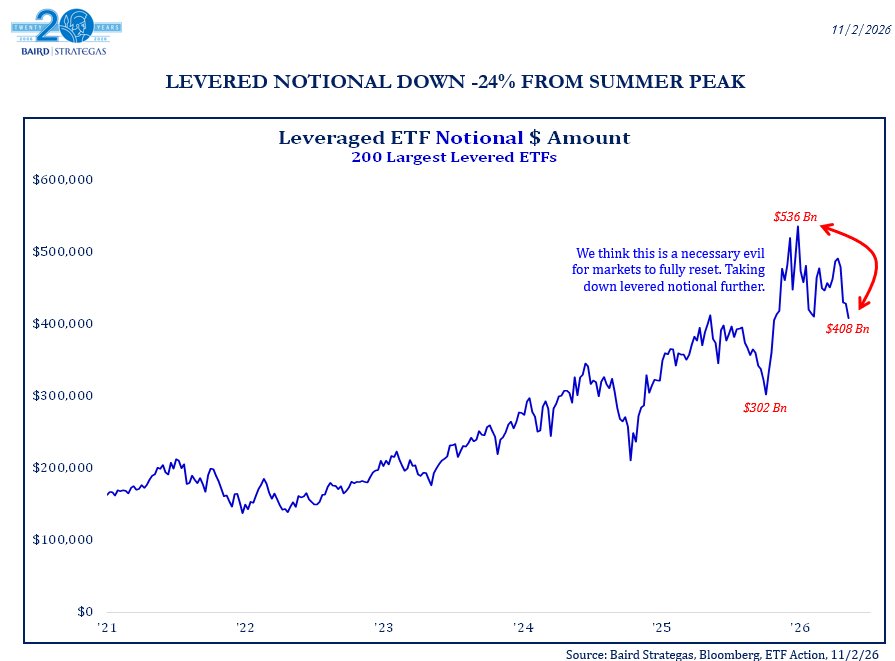
My friend Todd Sohn at Strategas has been tracking the explosion in funds that double and triple the daily moves of popular stocks.
A huge amount of that action has been in technology and artificial intelligence:
Think Nvidia (NVDA), Micron Technology (MU), and the companies making the chips powering AI.
Apparently, owning those stocks wasn’t exciting enough. People needed to double and triple the action.
Goldman Sachs (GS) counted about $200 billion in these leveraged and inverse funds, representing closer to $400 billion in market exposure.
Roughly $45 billion changes hands every day. During one week in October, investors poured a record $9.5 billion into leveraged stock funds.
About $7 billion went into the Direxion Daily Semiconductor Bull 3X Shares (SOXL), which aims to triple the daily moves of semiconductor stocks.
Meanwhile, professional trading firms were selling technology stocks at their fastest pace relative to their holdings since 2016.
What could possibly go wrong?
SOXL lost almost half its value in October. The fund doubling Micron’s daily moves fell about 35%, while Micron itself only dropped about 17%.
The double-Nvidia fund lost about 21%, compared with roughly just 10% for Nvidia.
Monday brought another 11.5% decline in SOXL and an 11.6% loss in the double-Micron fund.
This is the leverage coming back to reality. And it had to.
Somebody Forgot To Tell the Rest of the Market
While everybody was watching AI stocks get crushed, a whole bunch of other stocks were going up.
The S&P 500 slipped about 1% in October. But give every company an equal weight, instead of letting the biggest names dominate, and the index gained about 5%.
The average stock was doing better than the famous index.
Energy jumped about 14%. Consumer staples gained roughly 11%, health care and utilities about 10%, and materials about 8%. Financials and consumer discretionary each gained about 6%.
Technology fell about 8%.
That’s a lot of green for a stock market supposedly falling apart.
Health care, materials, energy, utilities, and consumer staples even finished October at their highest levels of the month.
We’re seeing it in our own work too. Our broader consumer index has been making new all-time highs.
Money is moving. Yesterday’s favorite stocks are getting sold while buyers show up somewhere else.
If all you watch is AI, you’re missing most of the story.
And people are getting nervous anyway.
Goldman reported roughly five short sales for every purchase of stocks its hedge fund clients expected to rise. Bets against stocks were near their highest level in five years.
Meanwhile, the demand for puts, contracts used to protect against declines or bet on them, jumped back up toward March levels.
Back then, the S&P 500 had fallen quite a bit. This time it’s only about 3% below its record closing high.
More fear, more stocks going up: That’s worth paying attention to.
Is This the Reset the Bull Market Needed?
The people tripling their semiconductor bets just lost almost half their money in a month.
Meanwhile, the average stock went up, several sectors finished October at their monthly highs, and our consumer index hit a new record.
Do we need the entire stock market to get crushed? Or is blowing up some of its most crowded, leveraged bets enough?
That’s the question I’m asking.
Because right now, the people taking the biggest risks are getting punished while plenty of other stocks keep going higher.