
The market just wrapped up April with the S&P 500 at fresh all-time highs. Same thing for the Nasdaq 100, the Dow, mid caps, small caps, even the tiny little micro-caps nobody pays attention to.
That’s not what a weak market looks like.
The trend in U.S. stocks is up, and not just in the handful of names people on TV scream about all day. We’re talking about broad participation across sectors, across market caps, and, increasingly, the entire world.
Because here’s the part most people miss: This isn’t just an American stock market anymore. It’s the stock market.
The biggest companies in the world trade right here on American exchanges. You probably own stocks right now you think are “American” that are actually based in Europe, Latin America, or Asia.
Doesn’t matter. They trade on the New York Stock Exchange and the Nasdaq every day with plenty of liquidity, right alongside McDonald’s (MCD) and Home Depot (HD).
And while everybody is busy arguing about seven tech stocks in the U.S., one of the most important stock markets in the world just quietly broke out to new four-year highs.
China.
Not a Chinese stock. The whole market.
China Isn’t Dead. It Just Went Quiet.
The CSI 300, which is basically the Mainland China version of the S&P 500, just closed at new four-year highs.
Nobody on CNBC seems too interested, and the newspapers barely mention it. Which honestly makes me like it even more.
These are the biggest and most liquid companies trading in Shanghai and Shenzhen. This is China’s blue-chip index. While investors everywhere chased the same crowded U.S. growth trade over the past few years, China got left for dead.
In fact, you could make the case this is the most hated major stock market in the world right now:
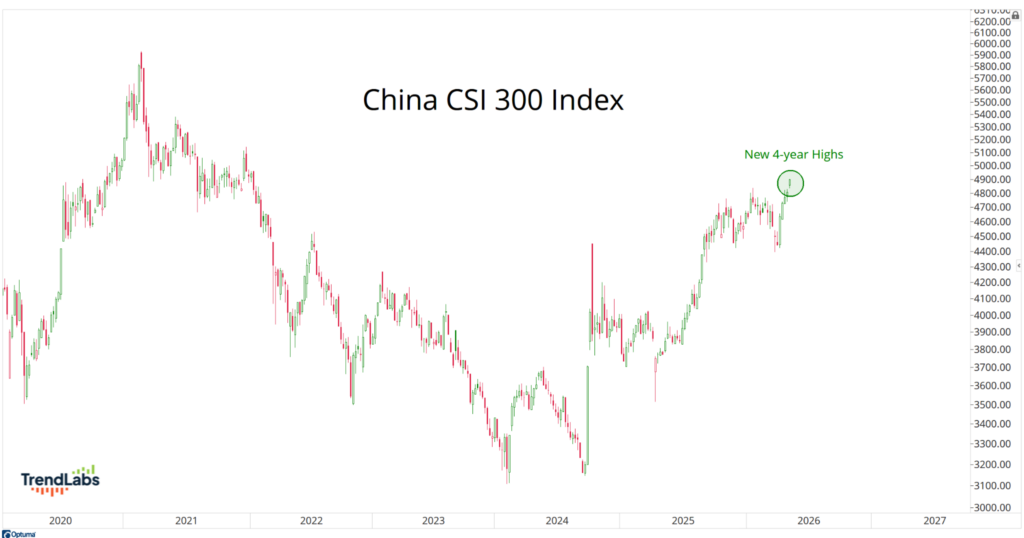
Nobody owns Chinese stocks. Not Americans, not institutions. Hell, not even the Chinese seem to want them anymore.
That’s usually where the opportunity starts.
Remember, you don’t need some special account in Hong Kong to participate. More than 200 Chinese companies trade right here on U.S. exchanges. Dozens of them are billion-dollar companies. Some are worth well over $100 billion.
That’s real money, real businesses, and real trends.
And the market is starting to notice.
It’s Just Math
Some people will tell you this entire bull market is being held up by a few mega-cap stocks.
That sounds great on television. The problem is the data says otherwise.
We count this stuff ourselves.
More stocks are participating, more sectors are breaking out, and more countries are joining the move.
That’s what healthy bull markets look like. Participation expands.
When bull markets start broadening out globally, it becomes a lot bigger than just chasing the same five U.S. stocks everybody already owns.
I think when this cycle is over, a lot of investors are going to realize they spent years avoiding an entire market because of scary headlines and bad sentiment while the stocks themselves were quietly improving underneath the surface.
That’s how major trends get missed in real time.
At the end of the day, we’re not here to argue about politics or debate China on the internet. We’re here to make money in stocks.
Right now, the weight of the evidence suggests there’s a lot more strength there than most investors realize.
If you want to see exactly which Chinese stocks we’re buying, you can follow along in The Divergence and The Primary Trend model portfolios in real time.
I prefer it that way.
Stay sharp,
JC Parets, CMT
Founder, TrendLabs