
I keep hearing about the “K-shaped economy.”
The idea is that America is splitting into two groups.
People at the top are doing well because they own stocks, houses and businesses that have gone up in value.
People at the bottom are having a harder time keeping up with higher prices.
Draw those two groups on a piece of paper and one line goes up while the other goes down. It looks like the letter K.
I understand the point. And I want to be careful here because I’m not trying to make light of anyone having a difficult time.
If your rent went up 30%, your groceries are more expensive, and you’re struggling to buy your first house, having some guy with a stock market blog tell you the economy is fine probably isn’t very helpful.
That’s not what I’m trying to do.
I’m looking at this through the eyes of an investor.
I want to know whether this “K-shaped economy” is actually something new that should change the way we think about markets, or whether we’ve simply given a new name to something that’s been happening in America for a long time.
The more I look at it, the more I think it’s the latter.
America has been producing winners and losers at the same time for almost 250 years.
The Industrial Revolution created enormous fortunes while putting other people out of work.
The 1920s were fantastic for Wall Street, while American farmers were having a miserable decade.
Globalization made many products cheaper for consumers while entire manufacturing towns lost jobs.
Then the internet came along and created some of the biggest fortunes in human history, at the same time destroying businesses that had been around for generations.
None of those periods were good for everyone. But that didn’t mean America wasn’t growing.
That distinction matters.
An economy is constantly changing. Money moves. Technology changes. Some jobs disappear and new ones take their place. Some companies figure it out, others don’t.
We talked about a similar idea a couple of weeks ago with inflation.
There is no one inflation rate that every American experiences the same way.
A homeowner with a 3% mortgage and a portfolio full of stocks is living in a very different economy from a renter trying to buy their first house.
The averages can hide completely different realities underneath.
That’s not some new flaw that suddenly appeared after COVID-19. It’s been a feature of the American economy since long before any of us were here.
And when I look at the recent data, the K-shaped story gets even more interesting.
What If the K Is Actually Getting Smaller?
If the argument is that lower-income Americans are falling further and further behind, we should be able to see it in the numbers.
But look at this.
Bank of America divides its customers into three groups based on household income: a bottom third, a middle third, and a top third.
In June, after-tax wages for the lower-income group were growing 4.1% from a year earlier. The middle-income group was growing 3.4%.
In other words, the people we’re being told are falling further behind were recently getting larger percentage raises than the people in the middle:
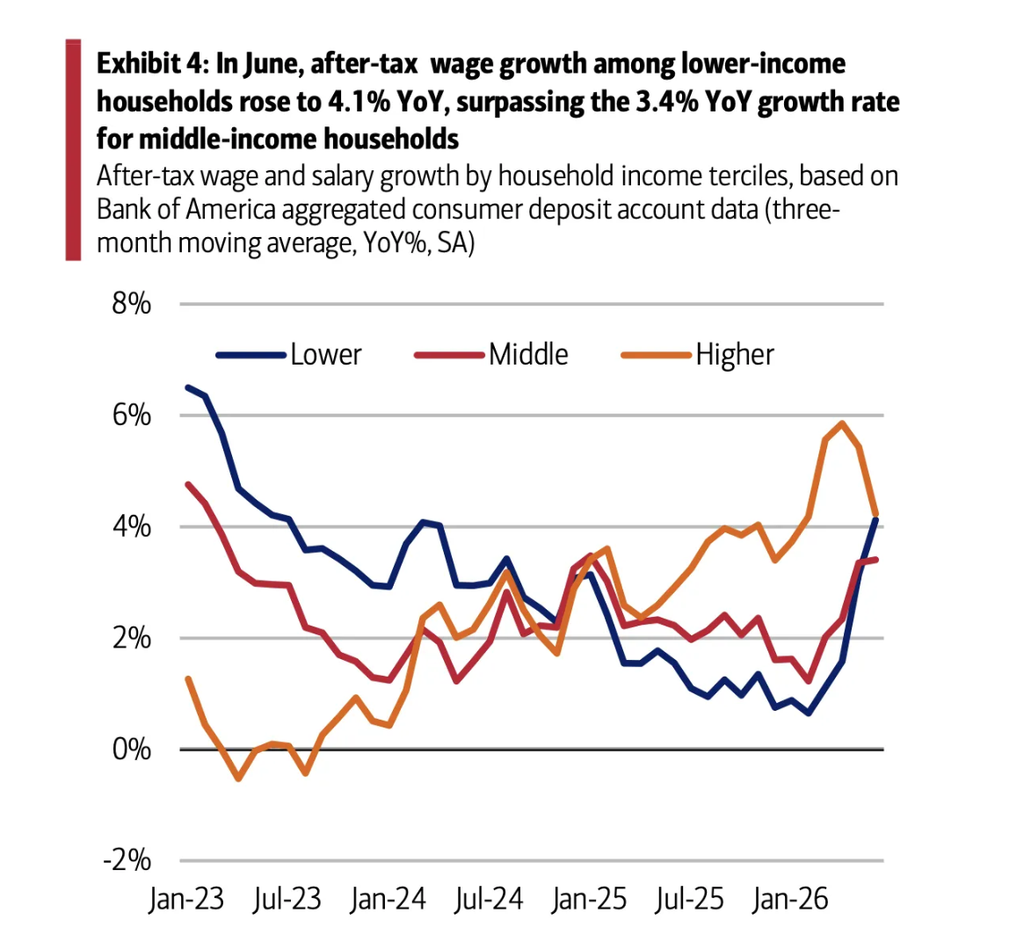
Look at that blue line on the far right. That’s lower-income households. This isn’t just a one-month curiosity, either.
Coming out of the pandemic, lower-wage workers experienced some of the strongest wage growth in the country.
Federal Reserve research has found that the gains were large enough to reverse a meaningful portion of the wage inequality that had built up over previous decades.
That’s pretty important if we’re going to have a conversation about the K getting wider.
It doesn’t mean the bottom third suddenly became rich.
A 5% raise for someone earning $40,000 obviously isn’t the same number of dollars as a 5% raise for someone earning $400,000.
And none of this means everyone is doing great.
Housing affordability can be a real problem. Inflation can hurt. Wealth in America remains very unevenly distributed.
But again, I’m trying to figure out what’s new here.
Rich people owning more assets than poor people isn’t new. Homeowners benefiting when home prices rise isn’t new.
People who own stocks getting richer during a bull market isn’t new.
That’s been happening for a long time.
What would be new and concerning is if lower-income Americans were consistently falling further behind on every important measure.
That’s just not what the data are showing. In some cases, we’re seeing the opposite.
So maybe instead of thinking about America as two lines permanently moving away from each other, it makes more sense to think about a gigantic economy where different groups are constantly doing better and worse at different times.
Sometimes the gap expands. Sometimes it shrinks.
The important part for us is figuring out whether any of it changes the trend.
What Does Any of This Have To Do With Stocks?
This is where I come back to the market.
I’m an investor. I’m not trying to grade America on fairness.
I’m trying to understand whether something happening in the economy should change the way we invest our money.
And from that perspective, I don’t see the “K-shaped economy” as some kind of new warning sign.
There have been struggling consumers during plenty of bull markets. There have been layoffs while stocks were making new highs.
Some industries have been dying while completely different industries were creating fortunes.
That’s what happens in an economy with hundreds of millions of people and millions of businesses.
They aren’t all going to be doing the same thing at the same time.
Think about the internet in the 1990s. It was terrible news if you owned a business that the internet was about to destroy. Your experience of the economy might have been awful.
But imagine looking at those struggling businesses and concluding that the internet itself must therefore be bad for the economy or bad for stocks.
You would have missed one of the biggest economic transformations in history.
That’s the danger for investors today.
If we go looking for evidence that somebody somewhere is struggling, we’re always going to find it. That’s true today, and it was true 50 years ago.
The existence of losers doesn’t mean there aren’t winners.
And the existence of inequality doesn’t tell us whether the S&P 500 is going up or down.
That’s why I think investors should spend less time worrying about what letter somebody thinks the economy looks like and more time watching the trends that actually affect our portfolios.
Is the market going up? Are more stocks participating? Are important sectors making new highs? Is credit behaving well?
Are the companies we own making us money?
Those questions are much more useful to me than whether economists have come up with a new letter to describe something America has been dealing with for centuries.
I don’t dismiss the K-shaped economy because I don’t care about people who are struggling.
I dismiss its usefulness as an investment signal because I don’t see much evidence that it’s new.
America has always been messy. Some people are doing great while others aren’t. Industries rise and fall. Fortunes are created and lost.
That’s not a bug. It’s part of the system.
And somehow, through all that messiness, the American economy has continued to grow and the stock market has continued to create enormous amounts of wealth over time.
So I’ll keep watching the evidence that matters to me as an investor.
If the trend changes, we’ll change with it.
Until then, it’s very clear that I don’t need another letter of the alphabet to tell me what to do with my portfolio.
Stay sharp,
JC Parets, CMT
Founder, TrendLabs