Most people who own stocks don’t spend much time thinking about the bond market.
I don’t blame them.
Bonds are boring. Stocks are fun, right?
Nobody’s bragging at a cocktail party about the incredible move they caught in high-yield credit spreads.
But if you own stocks, there are a few things happening in the bond market that you should absolutely be paying attention to.
And this is one of them.
It’s called a “credit spread.”
If that sounds complicated, it isn’t.
Imagine two people ask to borrow $100 from you.
The first is the U.S. government. Whatever you think about politicians, the government has historically been considered one of the safest borrowers in the world.
The second is a company with a bunch of debt and a questionable financial situation.
Who are you going to charge more interest?
Obviously, the risky company.
That extra interest investors demand for taking the additional risk is basically what we’re talking about when we talk about credit spreads.
It turns out that watching what happens to that difference can tell us a lot about what investors are doing with their money.
More importantly, it can help us decide what we should be doing with our money.
When Investors Get Nervous
During healthy markets, investors are willing to take risks.
They’re buying stocks. They’re buying lower-quality bonds. They’re looking for opportunities to make money instead of places to hide it.
Because investors aren’t particularly worried about these companies failing, they don’t demand nearly as much extra interest to lend them money.
So the difference between what safe U.S. Treasury bonds pay and what riskier high-yield bonds pay gets smaller.
We call that “tightening credit spreads.”
But when investors start getting scared, the exact opposite happens.
Suddenly, nobody wants to lend money to the sketchier companies unless they’re getting paid a whole lot more to do it.
That difference starts getting bigger.
We call that “widening credit spreads.”
And when credit spreads start widening aggressively, I pay attention. That’s the bond market telling us something’s wrong.
We saw it during the Great Financial Crisis. We saw it during COVID-19. We see it whenever stress starts building beneath the surface of markets.
This is why I care about bonds even though I’m primarily investing in stocks.
The bond market is another gigantic group of investors voting with real money. Why wouldn’t we listen to what they’re telling us?
Right now, they’re not scared. Credit spreads are making new lows:
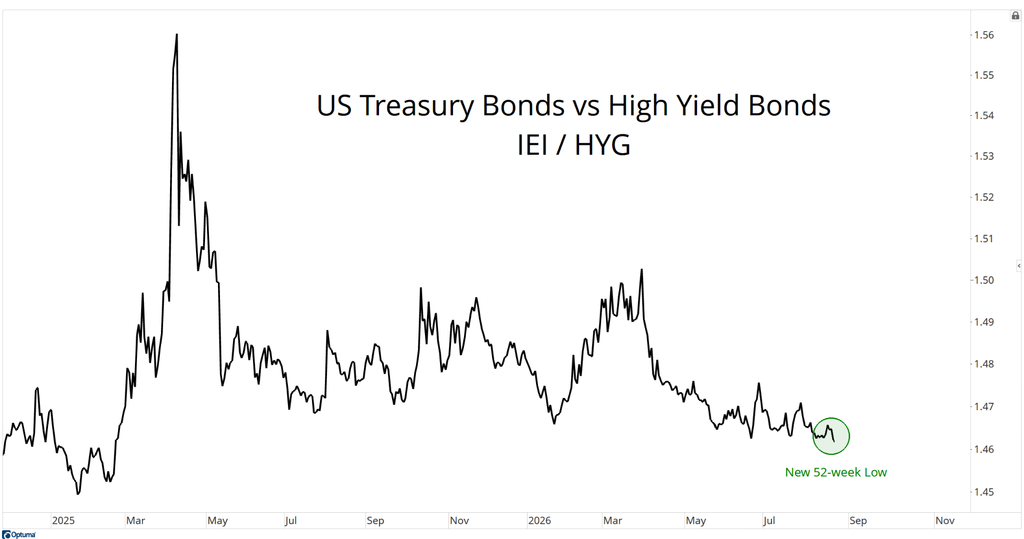
One simple way I track this is by comparing U.S. Treasury bonds with high-yield bonds. That’s the black line on today’s chart.
When that line is rising, investors are moving toward safety and credit conditions are getting worse.
When it’s falling, investors are embracing risk and credit conditions are improving.
Right now, it’s falling to new 52-week lows.
That’s not what financial stress looks like.
Forget What They’re Saying. Watch What They’re Doing.
There’s another piece of this that makes today’s chart even more interesting.
The blue line is the U.S. Dollar Index (DXY):
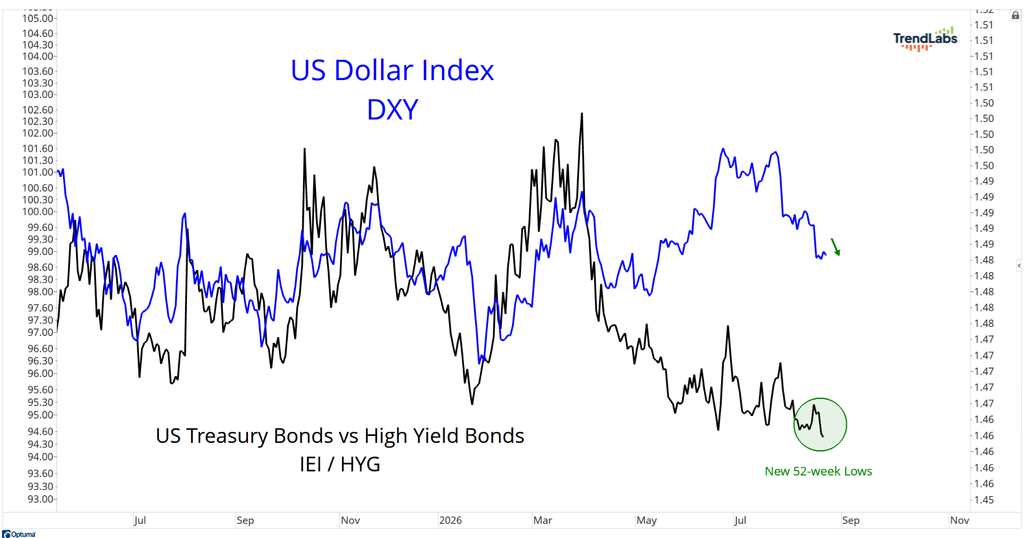
The dollar has historically acted as a safe haven during periods of market stress. When investors get scared, money tends to move toward the dollar.
When investors are feeling good and taking more risk, there isn’t as much demand for that safety.
So a strong dollar and widening credit spreads can be a dangerous combination.
A weaker dollar and tightening credit spreads?
That’s much more consistent with a healthy environment for stocks.
Recently, these two lines disagreed.
Credit spreads kept tightening while the dollar was strengthening.
So who was right?
Was the bond market too optimistic? Were credit spreads eventually going to reverse higher as stocks came under pressure?
Or were stocks and credit right, with the dollar eventually rolling over?
The dollar is rolling over while credit spreads are making new lows.
That’s exactly what stock market bulls want to see.
And this is a perfect example of what we call “intermarket analysis.”
We’re not staring at the S&P 500 all day trying to guess what happens next. We’re looking around.
What’s happening in bonds? What’s happening in currencies?
Where are investors looking for safety? Where are they taking risks?
All of these enormous markets are connected. And sometimes they can tell us things about stocks that we can’t see by looking at stocks alone.
This is also why I don’t need to make investing more complicated than it needs to be.
If you’re wondering what would make me much more defensive about stocks, I would start right here.
Show me credit spreads widening.
Show me investors dumping risky bonds for safer Treasury bonds.
Show me the dollar ripping higher as investors scramble for safety.
If those things start happening together, I’ll be paying close attention.
But that’s not what’s happening today.
Today, the bond market is telling us investors are still willing to take risks. The stock market is telling us the same thing.
The dollar appears to be joining them.
You can turn on the television and listen to someone explain what the Federal Reserve might do.
You can read what the Treasury secretary said. You can spend all day arguing about the economy.
Or you can watch where investors are actually putting their money.
I’ll take the last one.
Every time.
Stay sharp,
JC Parets, CMT
Founder, TrendLabs