
There are a lot of powerful investors in the world.
Warren Buffett has hundreds of billions of dollars at Berkshire Hathaway (BRK.B). BlackRock (BLK) manages trillions. Sovereign wealth funds can move entire markets.
As investors, we’re generally interested in what these people and institutions are doing with their money.
Not because they’re always right, but because when people with enormous amounts of capital start putting money behind a theme, I want to know about it.
I’ve been doing this for almost 25 years, and I’m not sure I’ve ever seen anything quite like what we’re watching right now.
I call it White House Capital.
President Trump’s latest financial disclosure showed more than 1,000 securities transactions during June.
The transactions totaled somewhere between $78 million and $263 million because government disclosures report transaction sizes in ranges.
Among the biggest purchases were at least $1 million each of Visa (V) and Mastercard (MA).
Trump’s accounts bought more than $1 million worth of Visa in June. Now V is breaking out to the highest levels in its history:
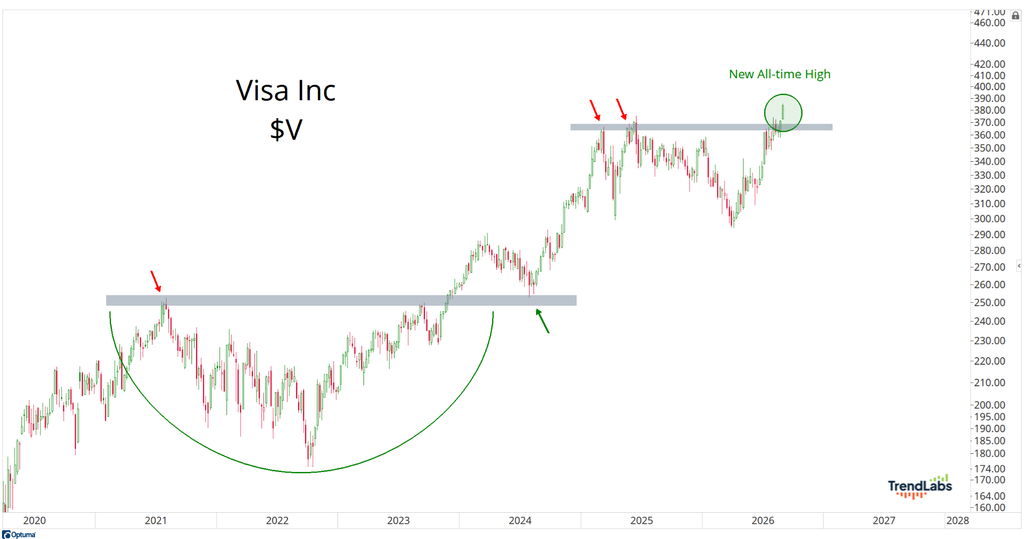
Mastercard, which his accounts also bought for more than $1 million, is right near record highs, too.
Think about what these businesses represent.
Every time somebody buys groceries, books a hotel, orders something online or pays for dinner with a card, Visa and Mastercard are sitting in the middle of the transaction.
So when those stocks are making new highs while millions of dollars from these accounts are flowing into them, I’m paying attention.
But White House Capital is becoming much bigger than a few stock purchases.
The Crypto Bros Went to the White House
Last week, the White House basically threw a party for the crypto industry.
Brian Armstrong from Coinbase (COIN) was there. Brad Garlinghouse from Ripple was there, Vlad Tenev from Robinhood (HOOD), too.
So were the Winklevoss twins from Gemini (GEMI), Arjun Sethi from Kraken, Sergey Nazarov from Chainlink (LINK), Chris Dixon from Andreessen Horowitz, Mike Belshe from BitGo (BTGO), Peter Smith from Blockchain.com, and Alana Palmedo from Paradigm.
And it wasn’t just the crypto bros. Adena Friedman, the CEO of Nasdaq (NDAQ), was there, as was Jeffrey Sprecher, the CEO of Intercontinental Exchange (ICE), which owns the New York Stock Exchange.
The heads of the Securities and Exchange Commission (SEC) and the Commodity Futures Trading Commission (CFTC) were also involved.
And sitting in the middle of all of them was the President of the United States (POTUS).
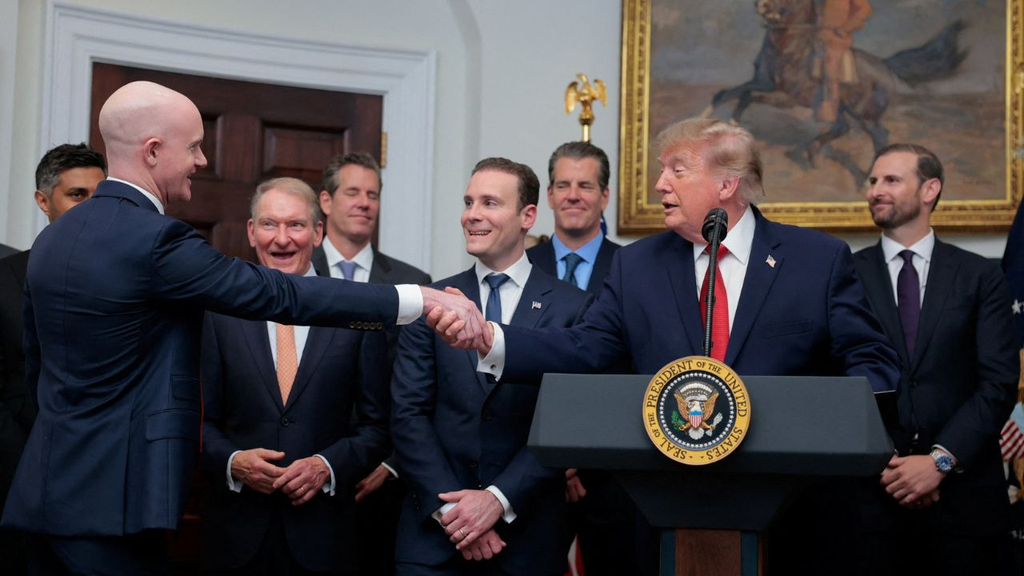
Think about how crazy this would have sounded a few years ago. Crypto spent most of its existence fighting Washington D.C.
Regulators were suing crypto companies, exchanges were battling the government, and plenty of politicians wanted nothing to do with the industry.
Now some of the most important people in crypto and traditional finance are sitting inside the White House discussing the future of digital assets with the POTUS.
Trump used the meeting to push Congress for a version of the CLARITY Act, which is designed to establish clearer rules for digital assets.
Meanwhile, regulators are working through how tokenized securities, crypto exchanges, and other digital assets should operate in the U.S.
That’s a totally different environment from the one this industry was operating in just a few years ago.
As investors, I think we’d be foolish not to recognize that change.
Don’t Fight the Money
This is really the entire idea behind White House Capital.
We’ve always kept an eye on what the most powerful people and institutions in the world are doing with their money.
If Warren Buffett makes a giant investment, we look. If a sovereign wealth fund starts pouring billions into an industry, we look.
If private equity firms suddenly start buying everything in a particular sector, we want to understand why.
That’s just investing.
What’s different today is that I’m not sure we’ve ever seen a group with this much power investing so actively and so publicly while simultaneously having this much influence over the rules governing those same industries.
That’s why I’m paying such close attention.
Look at crypto.
The administration is publicly pushing for clearer crypto regulations while the President is hosting the CEOs and founders of Coinbase, Ripple, Robinhood, Kraken, Gemini, Chainlink, and other major financial companies at the White House.
Meanwhile, Bitcoin and the broader crypto market have added hundreds of billions of dollars in value.
Look at the consumer.
Trump’s investment accounts bought more than $1 million each of Visa and Mastercard, and now both stocks are trading around record highs.
These are trends.
That doesn’t mean we automatically buy everything the White House likes. It doesn’t mean every investment associated with these people is going higher.
And it certainly doesn’t mean we abandon the process that’s worked for us all these years.
Price still comes first.
But when price, money, policy, and some of the most powerful people in the world are all moving in the same direction, I’m going to pay attention.
I’m particularly interested in not fighting these trends.
If the most powerful government in the world is making it easier for capital to flow into an industry, I want to know which companies benefit.
If billions of dollars are moving toward a new technology, I want to know where they’re going.
And if those trends are confirmed by stocks and assets making new highs, that’s even better.
We don’t need to predict what Washington D.C. does next. We don’t need to argue about whether these policies are good or bad.
And we definitely don’t need to make this political.
We just need to follow the money.
White House Capital is telling us where it’s going.
I want to participate.
Stay sharp,
JC Parets, CMT
Founder, TrendLabs