
Founder’s Note: Sam Gatlin hasn’t been on the planet long, but he’s developing rich experience, and he’s perceptive.
He shared a little about the energy story driving growth in his broader neighborhood, and he’s getting even closer to home today for some insight on a key American industry.
Here’s Sam with a note on what’s happening on our farms… – JC
By Sam Gatlin
If you grow up around farmers, you learn pretty quickly that markets can make significant real-life impacts.
Out here in Kansas, that means wheat, cattle, fuel, fertilizer, interest rates, and more.
Lately, one of the things I keep hearing about is fertilizer. Farmers have been complaining about it, for good reason.
Fertilizer is expensive, fuel is expensive, equipment is expensive, and money is expensive.
And when input costs keep rising, it becomes much harder to make the math work.
That’s the pain point.
But here’s the good news: markets give us a way to do something about it.
If higher fertilizer costs are going to hurt farmers, raise food prices, and squeeze consumers at the grocery store, then we should at least look for ways to profit from the same forces that are creating that pain.
We don’t get to choose the macro environment, but we do get to choose how we respond.
Europe’s Gas Problem Is Back
The first place to look is European natural gas, not the natural gas we produce here in the United States.
That distinction matters because America has spent years drilling, fracking, and producing a massive amount of cheap natural gas.
That has been a huge advantage for American consumers, American industry, and anyone who enjoys blasting the air conditioner in August without taking out a second mortgage.
Europe doesn’t have that same luxury…
That’s why European gas prices went completely insane during the Russia-Ukraine energy shock, trading north of $300 before collapsing all the way back into the low double-digits.
Since then, prices have spent years repairing the damage, carving out a massive bearish-to-bullish reversal pattern, which is now in the early stages of resolving higher:
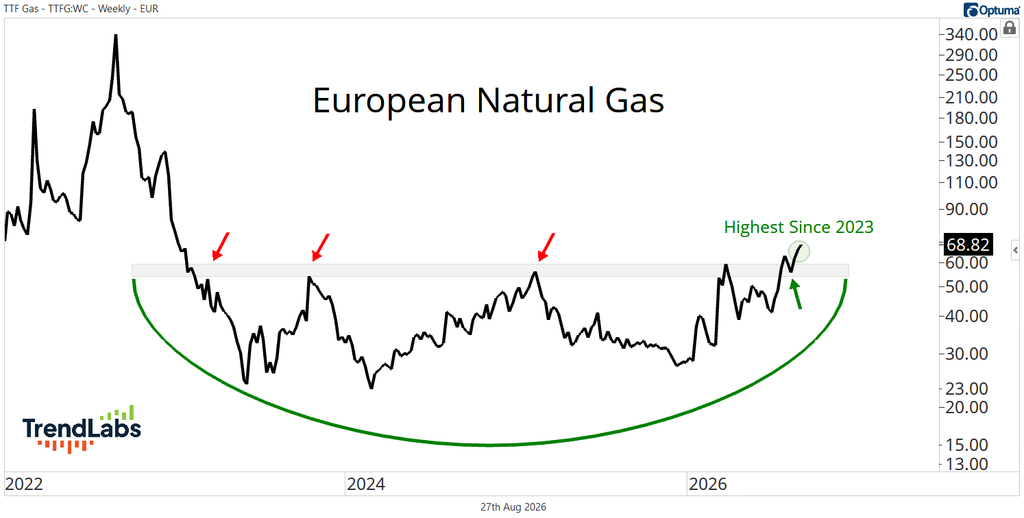
European natural gas is trading at its highest level since 2023, and this appears to be the beginning of a new primary uptrend.
That matters to normal people because natural gas is directly tied to electricity, heating, industrial production, and fertilizer.
When European gas prices rise, factories, farmers, and consumers feel it.
Eventually, grocery stores feel it as well.
Follow the Fertilizer
This is where Nutrien (NTR) comes in.
Nutrien is the world’s largest potash producer and one of the most important fertilizer companies on the planet.
It’s not a perfect one-for-one natural gas trade, but as a major crop-nutrient bellwether, it tends to respond when the global fertilizer cycle heats up.
Historically, Nutrien has tracked European natural gas surprisingly well:
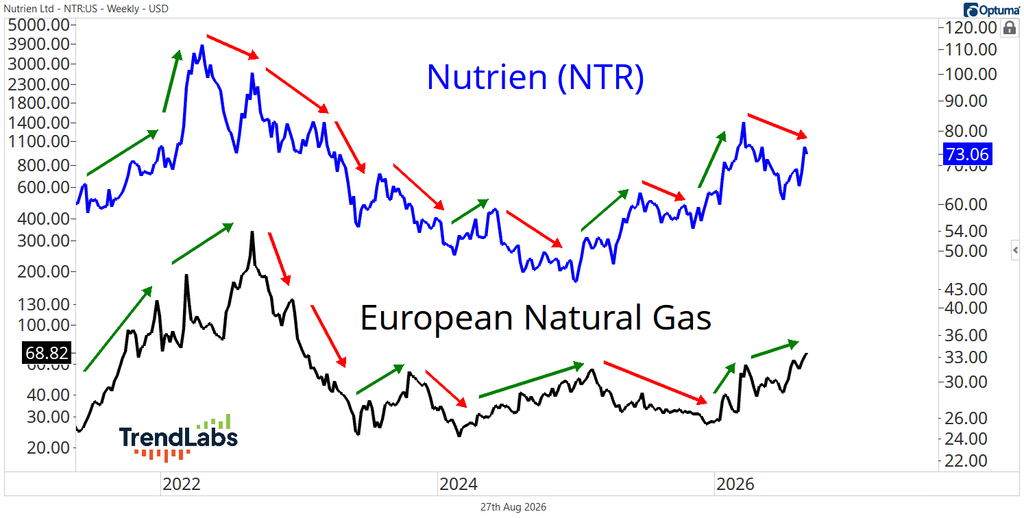
You can see the relationship clearly on the chart.
When European natural gas trends higher, Nutrien usually follows.
And when gas rolls over, Nutrien tends to struggle.
Right now, European natural gas is already breaking out to the highest level since 2023, while Nutrien hasn’t fully caught up yet.
That’s the opportunity.
If the old relationship reasserts itself, fertilizer stocks should continue catching a bid.
And if fertilizer prices keep rising, that becomes another tailwind for the broader agriculture trade.
This is how macro works in the real world.
One chart starts moving, another chart catches up, and then the pain shows up in the economy after the market already gave you the signal.
Kansas City Wheat Is Listening
Here in Kansas, we just finished harvesting wheat in July.
On our family farm, we’ve taken some profits, but we’re still holding some of the crop because Kansas City wheat is acting too well to ignore.
This is the first chart I check when I wake up in the morning.
It’s home to me…
It’s combines rolling through fields in July, grain trucks on county roads, and family members calling to ask whether they should sell more wheat or wait for higher prices.
Right now, the chart says waiting still makes sense:
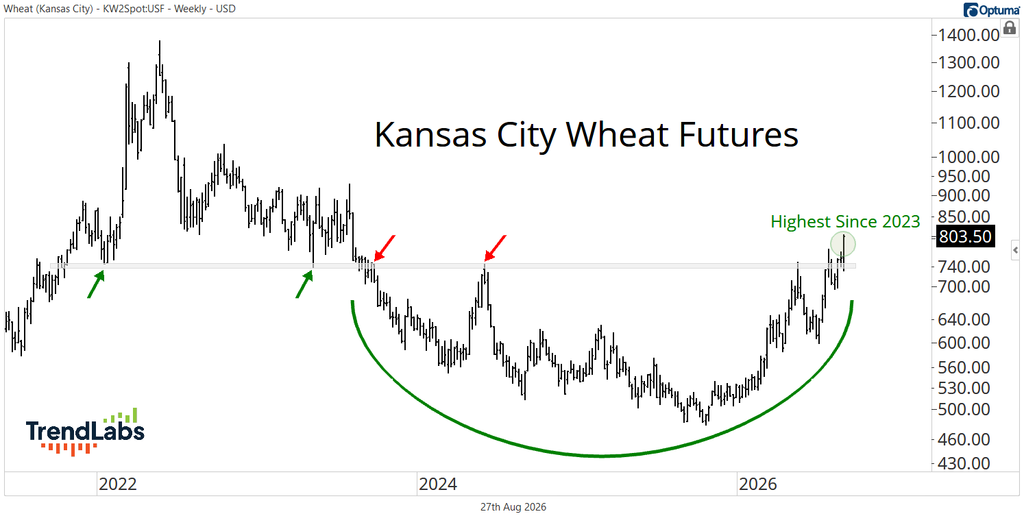
Kansas City wheat futures are breaking out to the highest level since 2023, and they’re doing it as fertilizer, energy, and other input costs are pushing higher again.
And if wheat is waking up, the entire agriculture complex deserves more attention.
The Cowboy Math
This is the part most people miss.
Higher fertilizer, grocery bills, and natural gas prices suck.
Nobody is cheering for a more expensive world, and I certainly understand why farmers are frustrated when fertilizer keeps eating into the bottom line.
But sitting around complaining about it doesn’t make anyone richer.
At TrendLabs, our job is to identify the environment we’re in, then let our systems do the heavy lifting.
We’ve built repeatable strategies that can adapt as leadership changes.
Sometimes that means buying technology.
Other times it means buying healthcare.
And sometimes, as unsexy as it may sound, it means fertilizer, wheat, and agribusiness.
That may not be as exciting as chasing some speculative growth stock with a name nobody can pronounce.
But if the chart is breaking out, I’m interested.
As an investor, I only care about where money is flowing, and right now money is starting to move into some very old-school areas of the market.
And if we can profit from it while everyone else is complaining about it, that sounds like a pretty good trade to me.
Stay safe out there,
Sam Gatlin
Analyst, TrendLabs