There’s a song from the 1980s called “She Blinded Me With Science.”
I’m starting to think we need an updated version.
Because while everybody’s been arguing about artificial intelligence, data centers, semiconductors, and which technology company is going to be worth $10 trillion first, something else has been happening right in front of us.
Science is having a moment.
We’ve been talking about healthcare for months. We’ve been watching money rotate into the sector, just like it’s rotated into other former laggards such as energy and materials.
And now the charts are confirming it.
Here’s the Healthcare Index (XLV) relative to the S&P 500:
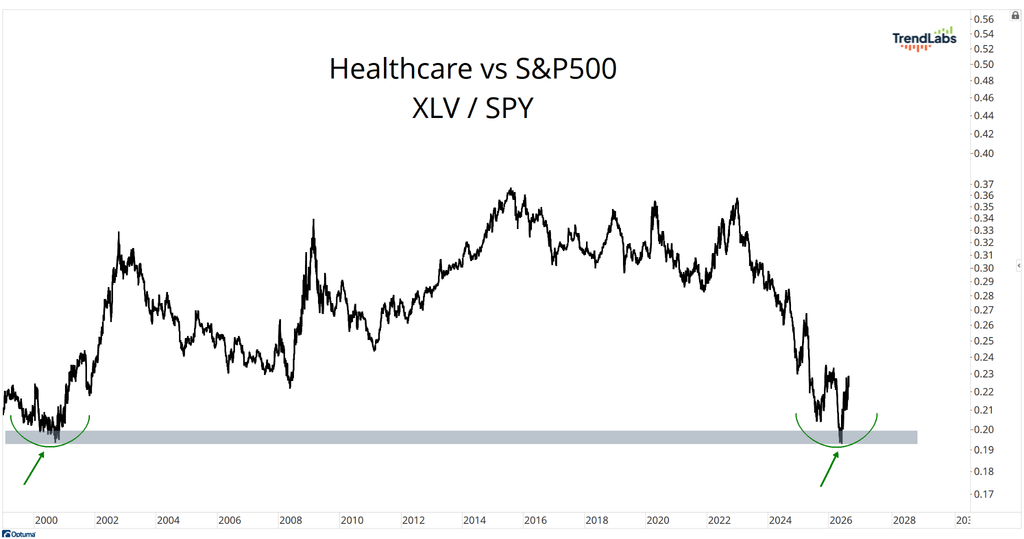
Let’s review what this chart means.
When the line is going up, healthcare is outperforming the rest of the market. When it’s going down, healthcare is underperforming.
And boy, has healthcare underperformed.
Earlier this year, healthcare vs the S&P 500 fell to levels we hadn’t seen in roughly 25 years.
You have to go all the way back to around the turn of the century to find healthcare this beaten up compared with everybody else.
Then something interesting happened: It stopped going down.
Not just anywhere, either. Healthcare stopped falling relative to the market right around the same area where it stopped falling 25 years ago.
You’re welcome to call that a coincidence.
I call it “supply and demand.”
Either way, after one of the longest periods of relative underperformance we’ve seen from this sector, buyers are showing up again.
And I think that matters.
The Average Healthcare Stock Is at an All-Time High
Relative strength is information. But we don’t pay our bills in relative returns.
Eventually, prices actually need to go up.
So let’s forget about XLV vs the S&P 500 for a minute and just look at healthcare.
There are two really useful ways to do this.
The traditional S&P 500 Healthcare Index is weighted by market capitalization.
That means the biggest companies get the biggest votes. Giants like Johnson & Johnson (JNJ) and UnitedHealth (UNH) have a much greater impact on the index than the smaller companies.
Then we can look at healthcare on an equally weighted basis.
Think of it like an election, where every stock gets exactly one vote. The biggest company doesn’t get any more voting power than the smallest company.
I like looking at both because together they tell us whether this is just a few giant stocks carrying the sector or whether the strength is spreading underneath the surface.
Right now, the answer is pretty clear.
Market-cap weighted XLV is at all-time highs:
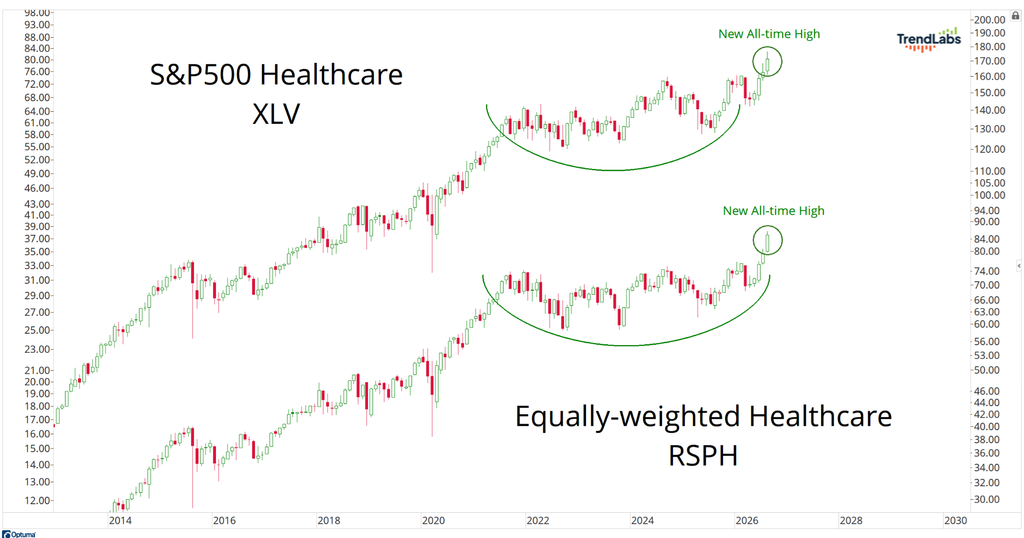
And look at the equally weighted version, RSPH. That’s at all-time highs, too.
This isn’t just one or two giant pharmaceutical companies dragging healthcare higher.
The average healthcare stock has never been higher.
And here’s the part I find especially interesting: Investors still don’t seem to believe it.
Short interest remains enormous across different parts of the sector. Biotechnology has plenty of it. So do equipment, services, and pharmaceuticals.
In other words, while prices are breaking out, there are still a whole lot of investors betting that these stocks are going down.
That’s quite a combination.
New highs in price, a sector emerging from 25-year relative lows, and plenty of people still betting against it.
I’m interested.
AI Is Coming for Biology
This is where the story gets much bigger than a healthcare chart.
For the past few years, the AI boom has mostly been about building the computers.
We needed chips, data centers, electricity and a whole lot of money to make all of this possible.
That’s already created some of the biggest companies and biggest stock-market winners in the world.
But now comes the interesting part. What are we going to do with all that computing power?
Science looks like a pretty good answer.
Just this month, Moderna (MRNA) and Merck (MRK) announced successful results from a major trial of a new melanoma treatment.
Instead of creating the same treatment for everyone, they study the mutations inside a patient’s tumor and create a treatment specifically for that person.
Think about that. We’re not just learning how to treat melanoma. We’re learning how to treat your melanoma.
And we’re seeing progress elsewhere too. A new treatment from Revolution Medicines (RVMD) was just approved for pancreatic cancer, one of the deadliest cancers in the world.
In its clinical trial, patients taking the drug lived about twice as long as those receiving standard chemotherapy.
We’re also getting new ways to detect Alzheimer’s with a simple blood test and new technologies designed to attack cancer cells in completely different ways.
This is where AI comes in.
Nvidia (NVDA) and Eli Lilly (LLY) are investing up to $1 billion in an AI lab focused on discovering new medicines. The idea is to use these incredibly powerful computers to help scientists find better drugs and find them faster.
We spent the first chapter of the AI boom building the computers.
The next chapter may be using them to solve some of the hardest problems in biology.
AI is helping scientists find better cancer treatments, discover new medicines and figure out which treatment works best for each patient. Plenty of experiments will fail along the way.
That’s how science works.
But as investors, we don’t need to know which disease gets cured next.
We need to pay attention to where the money is going and what the market is telling us.
Healthcare spent years falling behind the rest of the stock market. Now that trend is changing.
Healthcare stocks are making new all-time highs, biotechnology stocks are working again, and investors are pouring money into new medical technology.
At the same time, some of the most powerful computers ever built are being pointed at some of the hardest problems we’ve ever tried to solve.
Maybe we’ve been thinking about the AI boom all wrong.
We spent years investing in the machines.
Now we get to invest in what those machines can do.
I’m bullish on science.
This Week in Everybody’s Wrong
On Monday, we took time to recognize what’s happening beneath the surface of this bull market.
It’s a big group with a lot going on: chemicals, fertilizer, mining, and metals.
And the average materials stock has never been stronger.
On Tuesday, we looked at what appears to be the beginning of a big move for Bitcoin.
History can tell us where the world’s first cryptocurrency might be going from here.
And our roadmap is already working.
On Wednesday, we talked about the K-shaped economy.
Through a lot of messiness, America keeps growing, and the stock market keeps creating enormous wealth.
The existence of winners and losers is part of the process.
On Thursday, we told you the bond market is trying to tell you something.
To review, widening credit spreads tell you something’s wrong, and tightening credit spreads tell you everything’s fine.
In short, bond market investors aren’t scared.
On Friday, we reviewed a basic but controversial issue for markets and the public.
If the White House is causing billions of dollars to flow into new technologies and supporting industries, we want to know about it.
If those trends are confirmed by stocks and assets making new highs, that’s even better.
On Saturday, Sam Gatlin brought it all back home.
Sam’s from Kansas, and he has a great feel for the lay of the land for American farmers right now.
He also has a constructive view of an opportunity for investors and traders.
Have a great Sunday.
We’ll see you Monday morning…
Stay sharp,
JC Parets, CMT
Founder, TrendLabs