
I was at a birthday party last week when someone confidently explained to me that only “a handful of AI stocks” are responsible for this entire market going up.
And without those stocks, apparently we’d already be in a recession.
You hear this kind of stuff everywhere now.
So I started thinking about it on the drive home.
Would we actually be in a bear market right now if it weren’t for these so-called AI stocks?
And before we even answer that, what exactly is an “AI stock”?
Every company I talk to is using AI now. I use it every day. You probably do, too.
So where’s the line?
If a company uses AI, benefits from AI, talks about AI on earnings calls, or sells products to companies using AI… does that make it an AI stock?
I honestly don’t know anymore.
What I do know is that we have actual data. Thousands of stocks worth of data.
And when I look underneath the surface of this market, I’m not seeing a tiny group of stocks dragging everything higher while the rest of the market falls apart.
I’m seeing the opposite.
I’m seeing more stocks participating in this advance than at almost any point during this cycle.
Small-cap stocks are breaking out. Mid caps are making new highs. Equal-weight indexes are confirming. Breadth is expanding.
That’s usually not what bear markets look like.
So let’s look at the evidence together and see if this “only AI stocks are working” narrative actually holds up.
This Doesn’t Look Like a Narrow Market
The Russell 3000 Index represents roughly 98% of the entire investable U.S. stock market.
Inside that index are about 3,000 publicly traded companies. Everything from the mega-cap household names everybody talks about, all the way down to the smaller companies most investors have never heard of.
And two-thirds of that index is made up of small caps. That’s the Russell 2000.
These are the smaller businesses. Regional banks. Industrial companies. Retailers. Energy names. Healthcare companies. Local businesses most people don’t associate with “AI” at all.
And last week, that index closed at its highest levels in history:
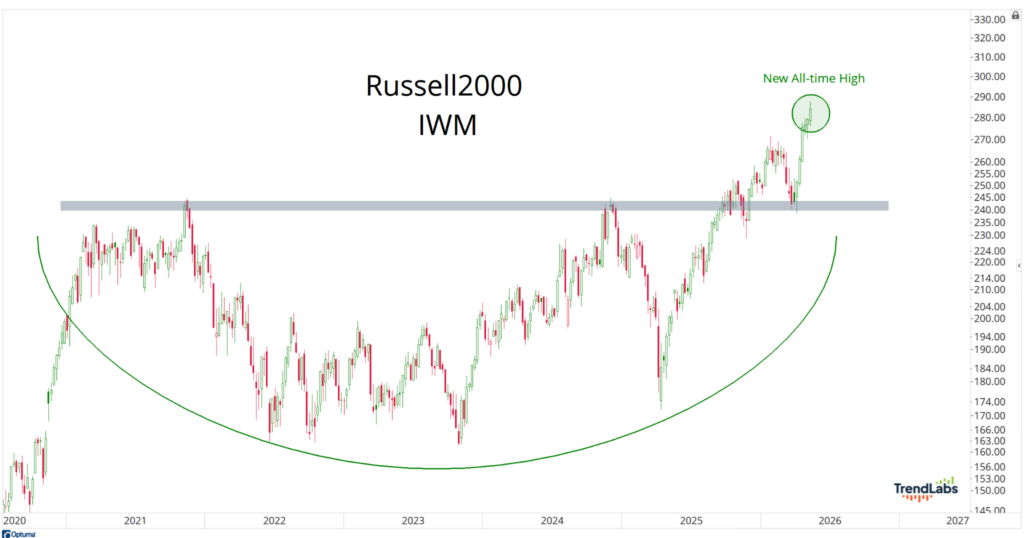
That’s a pretty big detail if we’re trying to argue only a few stocks are carrying this market.
Because the way I learned it, when an index representing two-thirds of the stock market is making fresh all-time highs, we probably don’t have a participation problem.
We have participation everywhere. This is what technicians call “market breadth.”
It’s just a fancy way of asking a simple question: How many stocks are actually going up?
Right now, by my count, the answer is: a lot of them.
Not just the stocks getting talked about on podcasts. Not just the companies spending billions on chips. Not just the handful of names people blame for every new high in the S&P 500.
A broad list of stocks across sectors, industries, and market caps are participating in this move.
Historically, that’s the kind of environment that tends to happen during bull markets. Not recessions. Not bear markets.
More Stocks Keep Joining the Party
What’s funny about this whole “only AI stocks are working” narrative is that the evidence keeps pointing in the exact opposite direction.
Take mid caps for example. Nobody talks about mid caps. They’re the middle child of the market.
Not the giant trillion-dollar companies dominating headlines, and not the tiny speculative stocks either. Just a massive group of companies quietly doing their thing while everybody argues about Nvidia (NVDA).
Last week, mid caps also closed at new all-time highs:
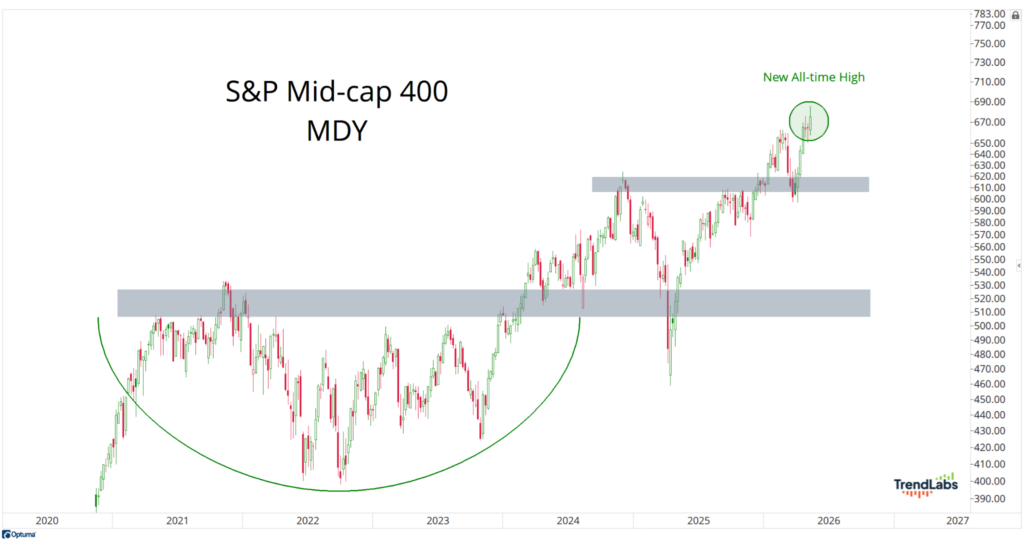
So let’s review what we’ve got here:
- the S&P 500 is at new highs;
- the Nasdaq 100 is at new highs;
- small caps are at new highs; and
- mid-caps are at new highs.
That doesn’t sound like a market hanging on by a thread. It sounds like more stocks are joining the party.
Because if this were really just a few AI names dragging the indexes around, you probably wouldn’t see strength expanding into smaller and more economically sensitive groups of stocks.
You definitely wouldn’t expect indexes representing thousands of companies to be breaking out at the same time.
That’s broad participation. That’s expanding breadth.
And historically, those are characteristics of healthy bull markets, not recessions.
So no, I don’t think we’d be in a bear market without “AI stocks.”
I think people are looking at the loudest stocks and missing what’s happening underneath the surface.
The rally is actually broadening out.
The strength isn’t isolated to one area. It’s spreading across sectors, market caps, and industries.
Until that changes, we’re going to keep doing what has historically made the most money during bull markets:
We’re going to continue owning stocks.
Not because some guy at a birthday party told us to.
Because the weight of the evidence says we should.
Stay sharp,
JC Parets, CMT
Founder, TrendLabs