
There’s an old saying on Wall Street that you should “sell in May and go away.”
The idea is pretty simple.
Stocks have historically performed much better during certain months of the year than others.
And the best six-month stretch has traditionally been November through April.
In fact, the best three-month period of the year has historically been November through January.
So if you know that stocks tend to do their best work starting in November, wouldn’t it make sense to start looking for opportunities in October?
My friend Jeff Hirsch, editor of the Stock Trader’s Almanac, has a saying I love: “Buy in October and get your portfolio sober.”
I was just with Jeff a couple of weeks ago. He’s a longtime friend, someone I’ve learned a tremendous amount from over the years.
His research into how stocks behave at different times of the year has made this book a staple on the desks of serious traders all across Wall Street.
Of all the seasonal patterns I’ve studied over the years, this one might be my favorite.
Because we’re not just entering the best six months of the year.
We’re also entering what has historically been the strongest stretch of the entire four-year presidential election cycle.
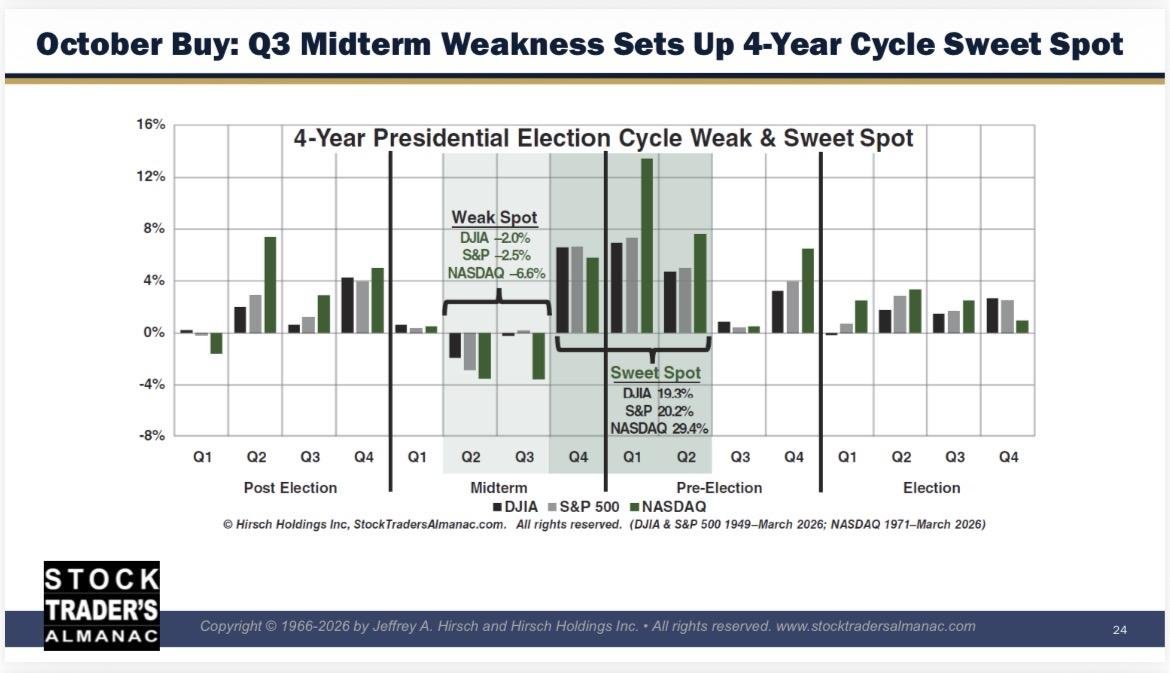
That’s right. The few quarters have historically been the sweet spot for stocks.
And it starts right now.
The Sweet Spot
Every four years, Americans elect a president.
Two years later, we have the midterm elections, when voters decide who represents them in Congress.
For whatever reason, stocks have developed a pretty interesting pattern around this four-year calendar.
The middle of the president’s term has historically been the weakest period for stocks.
In particular, the second and third quarters of the midterm year have been especially difficult.
That’s April through September of the second year.
But then something interesting happens. Starting in October of the midterm year, stocks have historically taken off.
And that strength tends to continue through the first half of the following year.
Look at the numbers from Jeff Hirsch and the “Stock Trader’s Almanac.”
During this three-quarter sweet spot, the Dow Jones Industrial Average has historically gained an average of 19.3%.
The S&P 500 has gained 20.2%. And the Nasdaq has climbed an average of 29.4%.
Those are some pretty remarkable numbers for just seven months.
Remember, those are historical averages, not predictions for what happens next.
Now, here’s what makes the current setup even more interesting.
Stocks were supposed to struggle during the second and third quarters of this year. That’s what the historical pattern suggested, anyway.
But they didn’t. In fact, stocks held up pretty well.
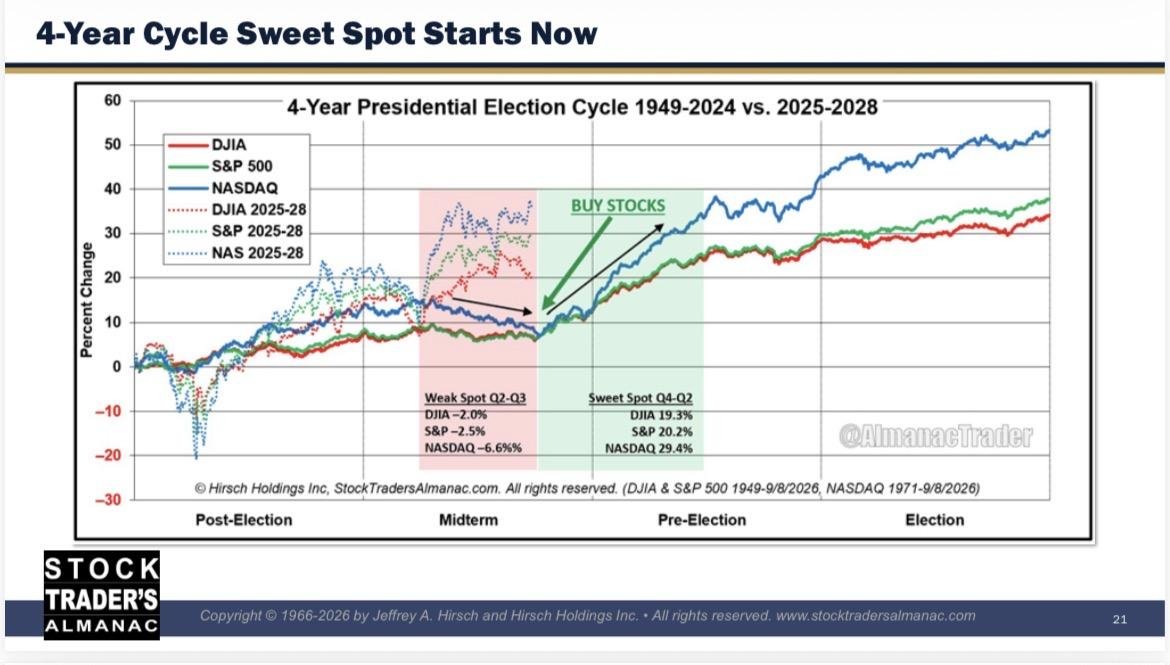
The period that was supposed to be the weakest stretch of the entire four-year cycle wasn’t particularly weak at all.
Think about that for a second.
If stocks couldn’t go down when they were supposed to, what’s going to happen when we enter the part of the calendar when they’re supposed to go up?
I don’t know the answer to that question.
But I sure as hell want to find out.
What Are We Buying?
So, what does all of this mean for investors?
Well, for starters, I think we should be looking for opportunities to buy stocks.
Not because some calendar says we have to. And certainly not because the market owes us anything.
But because we’re entering a period that has historically provided one of the strongest tailwinds investors can ask for.
And when the wind is at your back, I’d rather be looking for opportunities to take advantage of it than spending all my time worrying about what might go wrong.
There are a couple of ways I’m approaching this.
First, I’m looking at stocks we’ve wanted to own that have recently pulled back in price.
Maybe they were getting a little expensive. Maybe they needed to cool off after a big rally. Or maybe investors simply decided to take some profits.
Whatever the reason, if a stock we like comes back down to an area where buyers have stepped in before, that can give us an opportunity to buy it at a much better price.
The idea is to find situations where we have a lot more to potentially make than we have to lose if we’re wrong.
That’s a pretty good way to approach investing regardless of what month it is.
The other thing I’m looking for is relative strength.
These are the stocks that are already holding up better than the rest of the market. While other stocks are falling or going nowhere, these are the ones refusing to go down.
I love that.
Because some of the best market leaders begin separating themselves from the pack during corrections and periods when money is moving from one group of stocks to another.
You don’t always have to wait for the entire market to start rallying to figure out which stocks investors want to own.
A lot of times, they’re already telling you.
And if we’re about to enter a period when stocks historically do very well, I want to know which ones are already leading before that tailwind really gets going.
But there’s another side to this that I think is just as important.
What Happens If Stocks Don’t Go Up?
Seriously.
What if we enter what has historically been the strongest period of the entire presidential cycle, and stocks struggle?
That would get my attention.
When the market is supposed to go down and doesn’t, that’s information. And when the market is supposed to go up and doesn’t, that’s information too.
The market doesn’t care about our calendars. It doesn’t care what happened in 1954 or 1986 or 2010.
It certainly doesn’t care what we think should happen next.
That’s why we study these patterns in the first place.
It’s not because they’re guaranteed to repeat, but because they give us something to measure the market against.
So, from an execution standpoint, I’m looking for opportunities to put money to work.
I want to buy strong stocks, take advantage of volatility, and find situations where the potential reward is much greater than the risk.
From a bigger-picture analysis standpoint, I’ll be watching how stocks behave during a period when history suggests they should be doing very well.
If they respond the way they historically have, great. We want to participate.
If they don’t, that’s something we need to pay attention to.
Either way, we’re going to learn something.
And I can’t think of a better time to give another shout-out to my friend Jeff and the “Stock Trader’s Almanac.”
There are plenty of seasonal tendencies worth studying.
But this particular stretch of the presidential cycle is one of the most powerful I’ve ever come across.
Stocks just made it through what was supposed to be the difficult part of the calendar without much difficulty.
Now we’re entering the easy part.
Let’s see what they’ve got.
This Week in Everybody’s Wrong
On Monday, we reminded you that sometimes you don’t need a weatherman to know which way the wind’s blowing.
Indeed, markets aren’t interested in waiting around for old guys to figure things out.
In fact, SpaceX is coming for your phone.
On Tuesday, we took a reality check and talked about something pretty simple.
If you own more of what’s going up, your portfolio will usually do better than a portfolio that owns a lot less of it.
Bottom line, make sure you’re not being asked to celebrate losing less.
On Wednesday, we showed you three charts that better not break.
Different parts of the economy are all testing important levels at the same time.
These are logical places for buyers to step in, so let’s see if they show up.
On Thursday, we explained how investors have decided they don’t need things like crude oil, natural gas, and copper.
Someday, everybody’s going to wish they’d paid more attention to this commodity supercycle.
Do you really want to bet that energy is going to become even less important from here?
On Friday, we told you our job isn’t to come up with creative explanations for every market move.
We’re here to take advantage of the opportunities in front of us.
And something’s happening with Warren Buffett’s old outfit.
On Saturday, Sam Gatlin returned for a check-up with one of the world’s most important industrial metals.
As Sam’s Rare Earth Index shows, those stocks have collapsed to new 52-week lows.
So what’s next for Dr. Copper?
Have a great Sunday.
We’ll see you Monday morning…